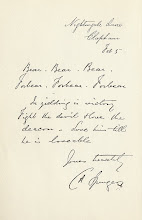
A letter from C. H. Spurgeon to his wife, Suzanna. She was very dear to him. His letters to her are full of great affection and spiritual joy. The date of this letter is not known.
Sweet One,
How I love you! I long to see you; and yet it is but half-an-hour since I left you. Comfort yourself in my absence by the thought that my heart is with you. My own gracious God bless you in all things,—in heart, in feeling, in life, in death, in Heaven! May your virtues be perfected, your prospects realized, your zeal continued, your love to Him increased, and your knowledge of Him rendered deeper, higher, broader—in fact, may more than even my heart can wish, or my hope anticipate, be yours for ever! May we be mutual blessings;—wherein I shall err, you will pardon; and wherein you may mistake, I will more than overlook.
Yours till Heaven, and then,
C. H. S.
The Letters of Charles Haddon Spurgeon, first published in 1923, published in electronic format by Logos Research Systems, Inc., 2009, p. 74.