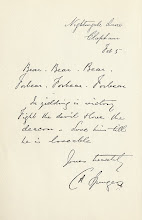
A portion of a letter by John Calvin to his fellow reformer, Melanchthon. He referred to him as "most distinguished sir," and spoke of him as a man "whom I venerate from the heart." The letter is a response to Melanchthon's comment about antagonists who were teaching false doctrine and causing trouble in the churches. He said that they "have no other object in view than to show themselves off on a public stage." Calvin responds with an exhortation to be careful themselves for they too are being observed. The letter was written from Geneva, August 23, 1555.
But though their [the antagonists] expectations, as I trust and as is probable, will be frustrated, nevertheless, even if they should gain the plaudits of the whole world, it becomes us to direct all our attention with so much the more zeal to that heavenly prize-giver under whose eyes we combat.
What! Shall the sacred assembly of the angels, who animate us by their favour, and strenuously point out to us by their example the manner of acting, permit us to grow sluggish or advance with hesitating steps? And the whole band of the holy fathers! Do they not also stimulate us to exertion? In fine, the church of God which is present to our view in the world! When we know that its prayers combat on our side, and that it is animated by our example, shall its suffrages in our favour be lost upon us?
No, let this be my theatre, and satisfied with its approbation, though the whole world should hiss me, I shall never want courage. I am very far from envying these silly and noisy players. Let them enjoy for a brief space and in an obscure corner their barren little sprig of triumph. What the world deems worthy of its applause or hatred does not escape me. But far more important I hold it to follow the rule prescribed by our Master. Nor have I any doubt that this ingenuousness will in the end prove more agreeable to all pious and rational minds, than a complaisant and wavering manner of teaching, which is always swayed by some empty terror.
John Calvin: Tracts and Letters, edited by Jules Bonnet and translated by David Constable, first published by the Presbyterian Board of Publication, 1858, republished by The Banner of Truth Trust, 2009, vol. 6, p. 219.