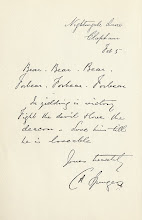
A selection from a letter by the Welsh Protestant preacher, Christopher Love, to his wife, on the day before his execution by the English government. He was found guilty of treason because he was of Presbyterian persuasion. Other Puritans would be ejected from the Church of England but Love was tried and put to death. He left four children behind with another soon to be born. In writing he revealed great love and care for his wife and demonstrated confidence and faith in Christ. The letter was written from the Tower of London, August 22, 1651.
I am now going from a prison to a palace. I have finished my work, I am now to receive my wages. I am now going to heaven where are two of my children, and leaving thee on the earth where are three of my babes. Those two above need not my care, but the three below need thine. It comforts me to think two of my children are in the bosom of Abraham and three of them will be in the arms and care of so tender a godly mother.
I know thou art a woman of a sorrowful spirit, yet be comforted; though thy sorrow be great for thy husband's going out of the world, yet the pains shall be the less in bringing thy child into the world. Thou shalt be a joyful mother, though thou beest a sad widow. God hath many mercies in store for thee; the prayers of a dying husband for thee will not be lost. To my shame I speak it: I never prayed so much for thee at liberty as I have done in prison…
Dear wife, farewell. I will call thee wife no more. I shall see thy face no more, yet I am not much troubled for now I am going to meet the Bridegroom, the Lord Jesus Christ, to whom I shall be eternally married.
A Spectacle Unto God: The life and death of Christopher Love, by Don Kistler, Soli Deo Gloria Publications, 1994.
Showing posts with label wife. Show all posts
Tuesday, December 28, 2010
From a Prison to a Palace
Labels:
children,
Christ,
Christopher Love,
death,
heaven,
martyr,
persecution,
prison,
wife
Monday, April 12, 2010
May Your Child Be His Child
A selection from a letter by John Newton to John Ryland, Jr. Ryland's wife, Elizabeth, had just given birth to their first and only child. Mrs. Ryland died a few weeks after giving birth. Newton wrote a letter of sympathy then but this letter was full of rejoicing for the little boy that graced their home. The letter was written December 16, 1786. Having a granddaughter born this past week, Nasia Marie Hewlett (pictured here), reminded me of Mr. Newton's prayer for the Rylands.
I will join you in praising the Lord for his goodness. May he crown the mercy by raising up Mrs. Ryland to praise him in his house. And may your child be his. You have now another comfort, another care, and what, if grace prevent not, might be another snare; but to those who feel their own weakness, grace is all-sufficient. My best wishes await you both.
Wise Counsel: John Newton’s Letter to John Ryland, Jr., edited by Grant Gordon, The Banner of Truth Trust, 2009, letter #36, p. 181.
I will join you in praising the Lord for his goodness. May he crown the mercy by raising up Mrs. Ryland to praise him in his house. And may your child be his. You have now another comfort, another care, and what, if grace prevent not, might be another snare; but to those who feel their own weakness, grace is all-sufficient. My best wishes await you both.
Wise Counsel: John Newton’s Letter to John Ryland, Jr., edited by Grant Gordon, The Banner of Truth Trust, 2009, letter #36, p. 181.
Labels:
advantages of prayer,
birthday,
John Newton,
John Ryland,
praise,
son,
wife
Monday, October 12, 2009
A Very Sweet View of Affliction

A selection from a letter by Rev. Thomas Boston, to his friend James Hog. Boston’s wife suffered from depression. She had gotten better but then turned worse again. The letter is full of faith and trust in the Lord even in the midst of afflictions. It was written August 8, 1724.
There is no appearance of the dissolution of the cloud that for several years now has been over my wife. We have made a new essay this season in the use of means for her help; but all hitherto serves for nothing, but to discover that vain is the help of man in the case.
She has not wanted seasonable supports from a higher hand; and when several coals were by wise and holy Providence cast in together into our furnace, she who behooved to be waited on and served before, was even helped to wait on, and be very helpful to others in distress; and then the clouds returned after the rain, and now she comes little out of the bed at all.
But all is necessary, and He is infinitely wise who has the managing of all in His hand. It is a very sweet view of affliction, to view it as the discipline of the covenant; and so it is indeed; and nothing else to the children of our Father’s family. In that respect it is medicinal; it shines with many gracious purposes about it; and, end as it will, one may have the confidence of faith, that it shall end well. And O how happy would we be if we could always maintain the confidence of faith! The soul in that case would be like that babe in the shipwrecked woman’s arms on the plank, smiling amidst the waves, unconcerned with the hazard.
Memoirs of Thomas Boston, first published in 1899, reprinted by the Banner of Truth, 1988, p. 499.
There is no appearance of the dissolution of the cloud that for several years now has been over my wife. We have made a new essay this season in the use of means for her help; but all hitherto serves for nothing, but to discover that vain is the help of man in the case.
She has not wanted seasonable supports from a higher hand; and when several coals were by wise and holy Providence cast in together into our furnace, she who behooved to be waited on and served before, was even helped to wait on, and be very helpful to others in distress; and then the clouds returned after the rain, and now she comes little out of the bed at all.
But all is necessary, and He is infinitely wise who has the managing of all in His hand. It is a very sweet view of affliction, to view it as the discipline of the covenant; and so it is indeed; and nothing else to the children of our Father’s family. In that respect it is medicinal; it shines with many gracious purposes about it; and, end as it will, one may have the confidence of faith, that it shall end well. And O how happy would we be if we could always maintain the confidence of faith! The soul in that case would be like that babe in the shipwrecked woman’s arms on the plank, smiling amidst the waves, unconcerned with the hazard.
Memoirs of Thomas Boston, first published in 1899, reprinted by the Banner of Truth, 1988, p. 499.
Labels:
affliction,
covenant,
depression,
James Hog,
Thomas Boston,
trust,
wife
Friday, August 14, 2009
Delight In Being Heirs Together of the Grace of Life

A selection from a letter by Rev. J. H. Thornwell to his wife, Nancy. In The Life and Letters of J. H. Thornwell by B. M. Palmer, six letters are printed which he wrote to his wife during a summer trip to Europe in 1841. He wrote her from England, Scotland and France. The letters reveal how close they were. He referred to her as “my dearest, most precious Nancy.” He said she was “ten thousand times dearer to me than all the world besides.” But in one letter, written from Glasgow, he shared how he hoped that they would have a better spiritual relationship together. The letter was written July 15.
It is with heartfelt pleasure that I sit down to hold communication with her whom my soul loves, in the only way which is now left me. I feel that, in your affections, I possess a prize of inestimable value; and I look forward, with interest and delight, to the renewed joys which we shall experience in the society of each other, when God shall bring us together again, after our long and painful separation.
I have thought much of the best methods of sanctifying our love, and of being fellow-helpers to each other in our heavenly pilgrimage. I feel a renewed obligation, from God’s great goodness to me since I left home, to devote myself wholly, unreservedly, to His service and glory. He has protected me from danger, and has, I trust, entirely restored my health. What can I render to Him but that life which He has preserved, that health which He has restored, and that strength which He has increased?
Let us both endeavour to be more holy, watchful and devoted; let us endeavour to build each other up in the most holy faith. I am afraid that, in past times, our intercourse has not been sufficiently of a religious character. We have both been a little shy in communicating our spiritual states, our joys or sorrows, our hopes and fears. If there has been an error of this sort, let us try to correct it hereafter, and delight more in being heirs together of the grace of life. It is my earnest prayer that God may give us grace to glorify His name in all things.
The Life and Letters of James Henley Thornwell, by B. H. Palmer, first published in 1875, republished by the Banner of Truth, 1974, p. 175.
It is with heartfelt pleasure that I sit down to hold communication with her whom my soul loves, in the only way which is now left me. I feel that, in your affections, I possess a prize of inestimable value; and I look forward, with interest and delight, to the renewed joys which we shall experience in the society of each other, when God shall bring us together again, after our long and painful separation.
I have thought much of the best methods of sanctifying our love, and of being fellow-helpers to each other in our heavenly pilgrimage. I feel a renewed obligation, from God’s great goodness to me since I left home, to devote myself wholly, unreservedly, to His service and glory. He has protected me from danger, and has, I trust, entirely restored my health. What can I render to Him but that life which He has preserved, that health which He has restored, and that strength which He has increased?
Let us both endeavour to be more holy, watchful and devoted; let us endeavour to build each other up in the most holy faith. I am afraid that, in past times, our intercourse has not been sufficiently of a religious character. We have both been a little shy in communicating our spiritual states, our joys or sorrows, our hopes and fears. If there has been an error of this sort, let us try to correct it hereafter, and delight more in being heirs together of the grace of life. It is my earnest prayer that God may give us grace to glorify His name in all things.
The Life and Letters of James Henley Thornwell, by B. H. Palmer, first published in 1875, republished by the Banner of Truth, 1974, p. 175.
Labels:
devotions,
heirs of life,
J. H. Thornwell,
love,
wife
Subscribe to:
Posts (Atom)