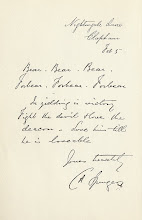
Extract from a letter by Andrew Fuller to Benjamin Francis, July 13, 1788, about a personal weakness in pastoral ministry:
I find a perpetual proneness to read and study rather as a minister than as a Christian; more to find out something to say to the people than to edify my own soul.
The Armies of the Lamb: The Spirituality of Andrew Fuller, edited and introduced by Michael A. G. Haykin, Joshua Press, p. 113.
Friday, December 14, 2007


Tuesday, December 11, 2007
Deep Enmity in my Heart
A portion of a letter from Joseph Alleine (1633-1668), to a dear friend, lamenting the lack of deep love in his heart for Christ:
Oh, the deep enmity that there is in my heart against Christ, notwithstanding all the personal excellencies that I know to be in him, and all the benefits I have received from him! He shed his heart's blood for me, and yet I do begrudge any service for him.
Life and Letters of Joseph Alleine, by Rev. Richard Baxter, Theodosia Alleine, and others, with a new introduction by Joel R. Beeke and Herb Samworth, Reformation Heritage Books, reprinted in 2003, p. 280.
Sunday, December 9, 2007
Doctrinal Sermons
From the pen of David Kinghorn to his son, Joseph Kinghorn, pastor of St. Mary’s Baptist Church, Norwich, England, who was preaching a series of sermons on doctrinal topics. The letter was written on July 25, 1795:
I quite approve of your plan of preaching a few doctrinal sermons, as it keeps up in the minds of the people a view of those truths on which Christianity is founded, in all its practical effects on the heart and life. For without the doctrinal part, religion sinks into dead formality, and without the practical part, it dashes on the rocks of speculation, and beats itself to pieces in idle disputation…
The Life and Works of Joseph Kinghorn, by Martin Hood Wilkin, reprinted by Particular Baptist Press, 1995, p. 254.
Friday, December 7, 2007
Agreement in Doctrine and Practice
A selection from a letter written by C. H. Spurgeon, July 20, 18??, to someone who had inquired about a church member who had been directed to find another church or face discipline because of his annihilationist views.
We, as a church at the Tabernacle, cultivate fellowship with all the churches of our Lord, although within our own membership, we have a basis of agreement in doctrine and practice, and where a member differs from it, it is his duty to remove to some other community where his views are held, or else he must expect us to withdraw from him.
Letters of Charles Haddon Spurgeon, Selected with Notes, by Iain H. Murray, Banner of Truth, 1992, p. 151.
Thursday, December 6, 2007
Letters Not Good for Debating
From a letter by Martin Luther to Philip Melanchthon, September 9, 1521, in discussing the problem of monastic vows:
It is not good to debate in a letter. While one writes quite verbosely about something the other person already knows only too well, one omits what the other person is most interested in…
Luther's Works, Letters I, Vol. 48, edited by J. J. Pelikan, H. C. Oswald and H. T. Lehmann, Fortress Press, letter # 95.
Wednesday, December 5, 2007
Our Strength and Our Comforts
A line from a letter by Benjamin Morgan Palmer to his daughter, Anna, January 4, 1869:
God, who makes our strength equal to our duty, makes also our comforts equal to our responsibilities.
The Life and Letters of Benjamin Morgan Palmer, by Thomas Cary Johnson, Banner of Truth, p. 383.
God, who makes our strength equal to our duty, makes also our comforts equal to our responsibilities.
The Life and Letters of Benjamin Morgan Palmer, by Thomas Cary Johnson, Banner of Truth, p. 383.
Monday, December 3, 2007
The Source of Afflictions
A selection from a letter by Thomas Charles, to Miss Wright (no date):
When [the Lord] afflicts, it is not willingly, that is, not from any injustice or cruelty in his nature; no, infinitely far from it. Afflictions proceed from his goodness; and they are ordered by perfect wisdom and the greatest tenderness.
Thomas Charles’ Spiritual Counsels: Selected from his Letters and Papers, by Edward Morgan, first published in 1836, reprinted by the Banner of Truth, 1993, p. 302.
Subscribe to:
Posts (Atom)