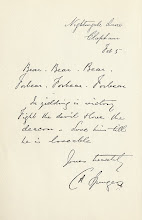
Showing posts with label Andrew Fuller. Show all posts

Wednesday, September 21, 2011

Good From Scripture for One's Own Soul

A portion of a letter from Andrew Fuller (1754-1815) to a young minister about preaching. Fuller wrote several letters to this person under the title, "Thoughts on Preaching." The emphasis in this paragraph is the need for searching the Scriptures for one's own benefit, not just to find sermons.

To understand the Scriptures in such a manner as profitably to expound them, it is necessary to be conversant with them in private; and to mix, not only faith, but the prayer of faith, with what we read. There is a great difference between reading the Scriptures as a student, in order to find something to say to the people, and reading them as a Christian, with a view to get good from them to one’s own soul. That which is gained in the latter of these ways is, beyond all comparison, of the greatest use, both to ourselves and others. That which we communicate will freeze upon our lips, unless we have first applied it to ourselves; or, to use the language of Scripture, "tasted, felt, and handled the word of life."

The Works of Andrew Fuller, "Thoughts on Preaching," volume 1, letter 1, p. 713.

Friday, July 1, 2011

The Summit of Ambition

A selection from a letter by Andrew Fuller, to Mr. and Mrs. James Chater and Mr. and Mrs. William Robinson, who were following in the train of William Carey, off to do mission work in India. Fuller exhorted each couple regarding their relations to the unconverted, as man and wife, and in regards to one another. He also challenged them to "be very conversant with your Bibles" and to "often think of the dying love of Christ." But above all, he entreated them to focus on Christ. The letter was written April 5, 1806.

My dear Brethren, know nothing but 'Jesus Christ and him crucified' [1 Cor. 2:2]. Be this the summit of your ambition. For you to live must be Christ [Phil. 1:21]. You may never be of that literary consequence which some are; but if you possess a savour of Christ, you will be blessings in your generation; and when you die, your names will be precious, not only in India and Britain, but in the sight of the Lord.

The Armies of the Lamb: The Spirituality of Andrew Fuller, edited and introduced by Michael A. G. Haykin, Joshua Press, p. 209.

Tuesday, February 15, 2011

I Much Wish to See this Mission Settle on a Permanent Foundation

A selection from a letter by missionary William Carey, to Andrew Fuller, one of the pastors who held the ropes in England while he mined for souls in India. Carey was concerned that the next generation of Christians in the home churches might not care for the work as Fuller and others had, and that the Mission would fail because of lack of funds. The matter-of-fact statements made by Carey are not reflective of weak faith but were meant to encourage Fuller and others to pass along to the next generation a love for the mission work in Serampore and all of India. The letter was written February 5, 1800.

I fear dear Bro. [Samuel] Pearce is dead [he died Oct. 10, 1799, but Carey did not yet know]. You, Bro. [John] Ryland [Jr.] and a few of the most active to provide funds for the Mission may soon die; and the work may fall through for want of active persons who will feel interested in it as you do.

The Publick mind may tire soon, especially if success is much longer delayed. In that case the Mission must be broken up for want of funds to support it and then all that is done will be lost…

I have written so much about our temporal concerns in all our Letters, because I fear some of them (may) miscarry and also because I much wish to see this Mission settle on a permanent foundation.

The Journal and Selected Letters of William Carey, collected and edited by Terry G. Carter, Smyth & Helwys, 2000, pp. 196-97.

Friday, November 19, 2010

I Cannot But Rejoice

A portion of a letter from missionary William Carey, to his pastor-friend in England, Andrew Fuller. Carey had received letters from Fuller and was thankful. He said, "Few things afford me more pleasure than your letters do." In his reply, Carey gave a report of baptisms for the year 1809. It took seven years before the mission work saw its first baptism but he was able this particular year to report that there had been many. The letter was written December, 1809.

I believe the number baptised within the last year, in all the Churches of Bengal, is sixty seven. Two or three of them have been excluded or suspended, but a greater number of those who had been formally excluded, have given satisfactory proof of repentance, and have been re-admitted to the Lord's table. All the churches are supplied with pastors and have the Word regularly dispensed among them, and some new stations have been attempted, and old ones strengthened. Upon the whole, I cannot but rejoice in what the Lord has done and is now doing among us.

The Journal and Selected Letters of William Carey, collected and edited by Terry G. Carter, Smyth & Helwys, 2000, pp. 202-03.

Tuesday, July 20, 2010

A Very Bright Constellation


A selection from a letter by Thomas Chalmers, Scottish Presbyterian preacher and professor, to J. E. Ryland of Northampton, England. Ryland's grandfather and father were luminaries in the Baptist constellation of great preachers in the later part of the 18th Century and the first part of the 19th Century. Dr. Chalmers shows his appreciation for the Baptist of that era. Ryland had written to Chalmers about the death of the well-known English essayist of Baptist persuasion, John Foster. Chalmer's letter was written from Edinburgh, November 17, 1842.

I ever had the greatest veneration both for him [John Foster] and Mr. [Robert] Hall, who along with Dr. [John] Ryland [Jr.], Andrew Fuller, Drs. [William] Carey, [Joshua] Marshman, and [William] Ward, made up altogether a very bright constellation, and which serves to signalize the Baptists of England more than any other denomination which I at present recollect.

Letters of Thomas Chalmers, edited by William Hanna, first published 1853, reprinted by The Banner of Truth, 2007, p. 322.

Thursday, December 31, 2009

Live Near to God


A selection from a letter by Andrew Fuller to a young man in prospect of his ordination to the gospel ministry. Fuller lamented the fact that he would not be able to attend the ordination but wrote some very valuable brotherly counsel to his young friend. The letter was written August 30, 1810.

If you would preserve spirituality, purity, peace, and good order in the church, you must live near to God yourself, and be diligent to feed the flock of God with evangelical truth. Without these nothing good will be done…

A young man, in your circumstances, will have an advantage in beginning a church on a small scale. It will be like cultivating a garden before you undertake a field. You may also form them in many respects to your own mind; but if your mind be not the mind of Christ, it will, after all, be of no use. Labour to form them after Christ’s mind, and you will find your own peace and happiness in it.

The Works of Andrew Fuller, edited by Andrew Gunton Fuller, first published in 1841, republished by The Banner of Truth Trust, 2007, p. 851.

Wednesday, October 7, 2009

A Little Girl Was Wrought Upon


A selection from a letter by Andrew Fuller to his friend in the ministry, John Ryland. Fuller wrote about the effects of a child’s death who had come to know the Lord. No date is given for the letter, but it was sometime in 1786.

Some time ago I spoke at a child’s grave, and addressed the children. It appears that a little girl was wrought upon, who is since dead. At that time her father and mother were very ignorant. She talked much to them before her death. I hope the Lord has lately wrought upon her mother. She seems very tender-hearted, and in real earnest after the salvation of her soul. Her husband has opposed her coming to meeting, but in vain. He beat her, but to no purpose. He then despaired, and began to think her right and himself wrong. ‘If it had not been of God,’ he said, ‘I had overcome it before now.’ The man invited me to visit his wife. I went, expecting him to dispute with me, as he had threatened to stop me in the street for that purpose; accordingly I gave him an opportunity; but, says the poor man, ‘I have done with that now, my chief concern is, What must I do to be saved?’ I cannot tell how it may issue as to him; he comes sometimes to meeting, and sometimes goes to hear Mr. Lydiat, at Warkton.

Last Tuesday I was visited by a lad, who has lately been observed to weep very much under the word. He appears to have every mark of true and deep contrition, and says a sermon I preached, two or three months ago, on sinners being under the curse of the Almighty, was first of use to him. The Lord carry on his work!

The Works of Andrew Fuller, edited by Andrew Gunton Fuller, first published in 1841, republished by The Banner of Truth Trust, 2007, p. li-lii.

Monday, June 29, 2009

Different Shades of Calvinism


A portion of a letter by Andrew Fuller to his wife. He was in the north of England, on his way to Scotland, speaking about and raising money for the mission work of William Carey in India. He wrote to her from York of a doctrinal conversation about Calvinism that he had with a Mr. Richardson and a Mr. Overton. The letter was written August 31, 1802.

R. There are different shades of Calvinism, I suppose, amongst you?

F. Yes; there are three by which we commonly describe; namely, the high, the moderate, and the strict Calvinists. The first are, if I may so speak, more Calvinistic than Calvin himself; in other words, bordering on Antinomianism.

R. Have you many of these?

F. Too many.

O. Do they not reckon you a legal preacher?

F. Yes; at this very time I am represented, throughout the religious circles of London, as an Arminian.

R. On what ground?

F. What I have written in a note in the Gospel its own Witness.

R. I remember that note. We all approve of it, and think it agrees with the doctrine held by our Church. But what do you call a moderate Calvinist?

F. One that is a half Arminian, or, as they are called with us, Baxterians.

R. And what [is] a strict Calvinist?

F. One that really holds the system of Calvin. I do not believe everything that Calvin taught, nor anything because he taught it; but I reckon strict Calvinism to be my own system.

The Works of Andrew Fuller, edited by Andrew Gunton Fuller, first published in 1841, republished by The Banner of Truth Trust, 2007, p. lxvii.

Wednesday, May 13, 2009

Fear We Are Forgotten


A selection from a letter by missionary William Carey to one of his dearest friends, Andrew Fuller, a supporting pastor in England. The mail was not always reliable and caused concerns whether his work had been forgotten. The letter was written January 21, 1802.

Our dear Brethren in England are not forgotten by us in our prayers, tho we have some reason to fear we are forgotten by them, it being now a year and a half, at least, since the date of the last letter we received.

The Journal and Selected Letters of William Carey, collected and edited by Terry G. Carter, Smyth & Helwys, 2000, p. 220.

Monday, May 11, 2009

Erroneous Views of the Gospel


A selection from a letter by Andrew Fuller to a friend, Charles Stuart, who had asked Mr. Fuller for a written account of his testimony. Fuller shared how hyper-Calvinism had shackled his mind and had prevented him from believing that he had a warrant to come to Christ. The letter was written in 1798.

I now found rest for my troubled soul; and I reckon that I should have found it sooner, if I had not entertained the notion of my having no warrant to come to Christ without some previous qualification. This notion was a bar that kept me back for a time; though, through divine drawings, I was enabled to overleap it. As near as I can remember, in the early part of these exercises when I subscribed to the justice of God in my condemnation, and thought of the Saviour of sinners, I had then relinquished every false confidence, believed my help to be only in him and approved of salvation by grace alone through his death. And if, at that time, I had known that any poor sinner might warrantably have trusted in him for salvation, I believe I should have done so and have found rest to my soul sooner than I did. I mention this because it may be the case with others, who may be kept in darkness and despondency by erroneous views of the gospel much longer than I was.

The Armies of the Lamb: The Spirituality of Andrew Fuller, edited and introduced by Michael A. G. Haykin, Joshua Press, p. 72.

Thursday, March 26, 2009

I Am Satisfied

An extract from a letter by Andrew Fuller to his dear friend in the ministry, John Ryland, Jr. Fuller was less than a month away from death. He wrote about his only basis of assurance and hope of heaven. The letter was written April 28, 1815.

I have very little hope of recovery; but I am satisfied to drink of the cup which my heavenly Father giveth me to drink. Without experience, no one can conceive of the depression of my spirits; yet I have no despondency. ‘I know whom I have believed, and that he is able to keep that which I have committed to him against that day.’ I am a poor guilty creature, but Christ is an almighty Saviour. I have preached and written much against the abuse of the doctrine of grace; but that doctrine is all my salvation and all my desire. I have no other hope than from salvation by mere sovereign, efficacious grace, through the atonement of my Lord and Saviour. With this hope, I can go into eternity with composure. Come Lord Jesus! Come when thou wilt! Here I am; let him do with me as seemeth him good!

The Armies of the Lamb: The Spirituality of Andrew Fuller, edited and introduced by Michael A. G. Haykin, Joshua Press, pp. 269, 271.

Wednesday, October 8, 2008

Habitual Rest in God

A selection from a letter by Andrew Fuller, to his friend John Ryland, expressing joy in the Lord even though he had undergone a heavy trial. The letter was written December 21, 1801.

I have lately had another heavy trial. Yet, under all, blessed be God, my heart is fixed, trusting in him. I have seldom enjoyed more habitual rest in God, than of late. O how sweet it is to have no will of my own, but that of God! I know I have an interest in your intercessions, and those of many other dear friends.

The Work of Faith, the Labor of Love and the Patience of Hope: Illustrated in the Life and Death of the Rev. Andrew Fuller, by John Ryland, published by Button & Sons, Paternoster Row, London, 1818, p. 238.

Wednesday, September 3, 2008

Edwards on Justification

An extract from a letter by Andrew Fuller to Timothy Dwight, grandson of Jonathan Edwards. The letter was written on June 1, 1805, commending the writings of Jonathan Edwards.

The writings of your grandfather, President Edwards, and of your uncle, the late Dr. Edwards [Jr.], have been food to me and many others. Our brethren Carey, Marshman, Ward, and Chamberlain, in the East Indies, all greatly approve of them. The President’s sermons on justification have afforded me more satisfaction on that important doctrine than any human performance which I have read.

The Armies of the Lamb: The Spirituality of Andrew Fuller, edited and introduced by Michael A. G. Haykin, Joshua Press, pp. 199-200.

Wednesday, July 30, 2008

We Must Give Account

A letter by Andrew Fuller, to his good friend, John Ryland, Jr., who was soon to move to Bristol to take up a teaching post at the Baptist College. The letter was written on December 3, 1793:

My Dear Brother,

I have no other occasion for writing, than to express my earnest desire, that your important removal may be for good. I am satisfied you are in the path of duty; on this consideration, I am willing to part with you. I loved Carey, but I loved the cause of Christ better; and on that account, I could not be sorry at his departure [to India]; though it was with a probability never to see him more.

Your views of divine truth, I consider as of great importance in the Christian ministry. Go then, my Brother, pour them into the minds of the rising generation of ministers. Perhaps, there could not have been a station in which you would have had so fair an opportunity of propagating gospel-truth. Let us do all we can in our different stations. Respectability of character and situation affords great opportunity of doing good. We have several of us, in different ways, hereby, fresh openings for usefulness. It is a trust, as well as other things, of which we must give account; and I hope our account will be with joy, and not with grief.

I have found, the more I do for Christ, the better it is with me. I never enjoyed so much of the pleasures of religion, as I have within the last two years, since we have engaged in the Mission business. Mr. Whitfield used to say, “The more a man does for God, the more he may.”

I should have been glad to have seen you at Kettering. As that cannot be, the Lord God of Israel prosper your way!

I am,
Very affectionately, yours,
Andrew Fuller

P.S. I will write as often as I find something interesting to write about, and opportunity admits. I hope you will do the same.

The Work of Faith, the Labor of Love and the Patience of Hope: Illustrated in the Life and Death of the Rev. Andrew Fuller, by John Ryland, published by Button & Sons, Paternoster Row, London, 1818, pp. 225-26.

Wednesday, July 9, 2008

Be Ashamed Yet Do Not Despair

A selection from a letter by Andrew Fuller, to his wayward son, Robert, whom he longed to see in Christ and living a godly life, written in December of 1808. Fuller’s son died three months later. In letters written to his father prior to his death, Fuller’s biographer, John Ryland, Jr., could say, “We hope, he was led to see the error of his way, and to make the Lord his refuge from the tempest and the storm.”

My dear son! I am now nearly fifty-five years old, and may soon expect to go the way of all the earth! But, before I die, let me teach you the good and the right way. “Hear the instructions of a father.” You have had a large portion of God’s preserving goodness; or you had, ere now, perished in your sins. Think of this, and give thanks to the Father of mercies, who has hitherto preserved you. Think, too, how you have requited him, and be ashamed for all that you have done. Nevertheless, do not despair! Far as you have gone, and low as you are sunk in sin, yet if, from hence, you return to God by Jesus Christ, you will find mercy. Jesus Christ came into the world to save sinners, even the chief of sinners. If you had been ever so sober and steady in your behaviour towards men, yet, without repentance towards God and faith in Christ, you could not have been saved; and, if you return to God by him, though your sins be great and aggravated, yet will you find mercy.

The Work of Faith, the Labor of Love and the Patience of Hope: Illustrated in the Life and Death of the Rev. Andrew Fuller, by John Ryland, published by Button & Sons, Paternoster Row, London, 1818, p. 303.

Sunday, May 4, 2008

Read Over Your Own Sermon

A selection from a letter by Andrew Fuller, to his friend John Ryland, consoling him in the loss of his wife, February 2, 1787:

I have often been in pain for you, since I saw you; but God is good, and will support you. I was thinking, whether it might not be of use to you, to read over the latter part of your own sermon, on God’s Experimental Probation of Intelligent Agents. God has long tried you, my Brother, by a series of trials; under which you have had one to feel with you, and for you. The Lord, it may be, has taken her away, that you may have a more direct recourse to him. It was much to me, when my child died, to think, ‘The Lord liveth, and blessed be my Rock!’ It is no small comfort, to think, you are not parted forever. Your dear departed might have adopted the words of her Lord, to you, ‘I shall see you again, and your heart shall rejoice, etc.’ O what a meeting shall we have at last!

The Work of Faith, the Labor of Love and the Patience of Hope: Illustrated in the Life and Death of the Rev. Andrew Fuller, by John Ryland, published by Button & Sons, Paternoster Row, London, 1818, pp. 224-25.

Monday, February 11, 2008

Do We Feel the Grace?

A selection from a circular letter to the churches of the Northamptonshire Baptist Association by Andrew Fuller, May, 1785:

We avow the doctrines of free, sovereign, and efficacious grace; but do we generally feel the grace therein discovered? If we did, how low should we live! How grateful should we be! We should seldom think of their sovereign and discriminating nature, without considering how justly God might have left us all to have had our own will, and followed our own ways; to have continued to increase our malady, and despise the only remedy! Did we properly enter into these subjects, we could not think of a great Saviour, and a great salvation, without loathing ourselves for being such great sinners; nor of what God had done for and given to us, without longing to give him our little all, and feeling an habitual desire to do something for him.

The Armies of the Lamb: The Spirituality of Andrew Fuller, edited and introduced by Michael A. G. Haykin, Joshua Press, p. 94-95.

Friday, December 14, 2007

A Preacher's Perpetual Proneness

Extract from a letter by Andrew Fuller to Benjamin Francis, July 13, 1788, about a personal weakness in pastoral ministry:

I find a perpetual proneness to read and study rather as a minister than as a Christian; more to find out something to say to the people than to edify my own soul.

The Armies of the Lamb: The Spirituality of Andrew Fuller, edited and introduced by Michael A. G. Haykin, Joshua Press, p. 113.

Wednesday, October 17, 2007

That None Be Left Behind

From a letter by Andrew Fuller to a relative, August, 1784:

My heart longs for you and the dear children. Give my love to them, and tell them to seek after the salvation of their souls; for they must soon die, as well as we. Let them not think that to be religious is to be melancholy; for surely to live in the fear of God is the happiest life in the world; and to die in his favour how desirable! May this be the case with us all. I long that none of the family may be left behind.

The Armies of the Lamb: The Spirituality of Andrew Fuller, edited and introduced by Michael A. G. Haykin, Joshua Press, p. 89.

Friday, September 7, 2007

Hold Christ

From a letter by Andrew Fuller to the Baptist Church in Kettering, September 22, 1782, who had called him to be their pastor:

Hold Christ and your religion with a close hand, but me and every other creature with a loose one! God can bless you without me, and blast you with me!

The Armies of the Lamb: The Spirituality of Andrew Fuller, edited and introduced by Michael A. G. Haykin, Joshua Press, p. 85.