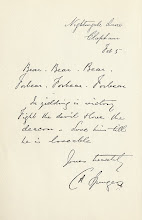
Extract from a letter by Augusta Toplady to a friend, March 6, 1767:
Every sigh, if directed to him [God], is a prayer; every tear shed for sin is a sort of oblation, acceptable to him in Christ, and shall be noted in his book. Yet not the sighs we breathe, nor the tears we pour, are our justifying merit; but the sigh, the tears, the obedience , the death, of his co-eternal Son; his are the propitiations, ours are the memorial, and the proof of the work of grace which his Spirit begins in the soul.
The Works of Augustus Toplady, Bookshelf Publications, reprint from the 1794 edition, p. 830.
Monday, March 3, 2008


Thursday, February 28, 2008
Preaching Christ
A selection from a letter by Robert Murray M’Cheyne to his friend, Rev. R. MacDonald, January 12, 1839, written after having been laid aside for awhile by illness:
It is a glorious thing to preach the unsearchable riches of Christ! We do not value it aright till we are deprived of it; and then Philip Henry’s saying is felt to be true – that he would beg all the week in order to be allowed to preach on the Sabbath day.
Robert Murray M’Cheyne: Memoir and Remains, Andrew A. Bonar, first published in 1884, reprinted by the Banner of Truth, 1966, p. 209.
It is a glorious thing to preach the unsearchable riches of Christ! We do not value it aright till we are deprived of it; and then Philip Henry’s saying is felt to be true – that he would beg all the week in order to be allowed to preach on the Sabbath day.
Robert Murray M’Cheyne: Memoir and Remains, Andrew A. Bonar, first published in 1884, reprinted by the Banner of Truth, 1966, p. 209.
Tuesday, February 26, 2008
Watch Over Yourself
From a letter by Jonathan Edwards to his 15 year old daughter, Mary, who was visiting family in New Hampshire, written July 26, 1749:
I hope you will maintain a strict and constant watch over yourself and against all temptations: that you don’t forget and forsake God; and particularly that you don’t grow slack in secret religion. Retire often from this vain world, and all its bubbles, empty shadows, and vain amusements, and converse with God alone; and seek that divine grace and comfort, the least drop of which is more worth than all the riches, gaiety, pleasures and entertainments of the whole world.
Posterity: Letters of Great Americans to Their Children, Dorie McCullough Lawson, Doubleday, 2004, pp. 132-33.
I hope you will maintain a strict and constant watch over yourself and against all temptations: that you don’t forget and forsake God; and particularly that you don’t grow slack in secret religion. Retire often from this vain world, and all its bubbles, empty shadows, and vain amusements, and converse with God alone; and seek that divine grace and comfort, the least drop of which is more worth than all the riches, gaiety, pleasures and entertainments of the whole world.
Posterity: Letters of Great Americans to Their Children, Dorie McCullough Lawson, Doubleday, 2004, pp. 132-33.
Monday, February 25, 2008
Our Religion
An extract from a letter by Rev. J. H. Thornwell, to a pastor, telling him of the profit he had received from Calvin’s commentary on Genesis, January 30, 1860.
I have just finished Calvin’s Commentary on Genesis, and cannot tell you how much spiritual refreshment and comfort I have derived from the light which his own experience and grace enabled him to throw upon the dealings of God with the ancient patriarchs. Every day enlarges my views, and deepens my convictions of the infinite riches of Divine wisdom and goodness. We serve no hard master. Our religion is no cold and lifeless homage to an unsympathizing superior. We have a Saviour that loves us, that enters into all our joys and sorrows, that permits us to converse familiarly with Him, and that shows, in the confidence of friendship, the secret of His covenant.
The Life and Letters of James Henley Thornwell, first published in 1875, republished by the Banner of Truth, 1974, p. 445.
I have just finished Calvin’s Commentary on Genesis, and cannot tell you how much spiritual refreshment and comfort I have derived from the light which his own experience and grace enabled him to throw upon the dealings of God with the ancient patriarchs. Every day enlarges my views, and deepens my convictions of the infinite riches of Divine wisdom and goodness. We serve no hard master. Our religion is no cold and lifeless homage to an unsympathizing superior. We have a Saviour that loves us, that enters into all our joys and sorrows, that permits us to converse familiarly with Him, and that shows, in the confidence of friendship, the secret of His covenant.
The Life and Letters of James Henley Thornwell, first published in 1875, republished by the Banner of Truth, 1974, p. 445.
Friday, February 22, 2008
Grief Moderated
A portion of a letter from the one-eyed Baptist preacher of Wales, Christmas Evans, to the poet, Robert ap Gwilym Ddu, who had recently lost his daughter in death.,written on November 5, 1834:
The religion of Jesus does not make us unfeeling Stoics in the face of losing our loved ones, but it moderates our grief with submission to the will of God.
Christmas Evans: The Life and Times of the One-Eyed Preacher of Wales, by Tim Shenton, Evangelical Press, 2001, p. 436.
The religion of Jesus does not make us unfeeling Stoics in the face of losing our loved ones, but it moderates our grief with submission to the will of God.
Christmas Evans: The Life and Times of the One-Eyed Preacher of Wales, by Tim Shenton, Evangelical Press, 2001, p. 436.
Tuesday, February 19, 2008
Oh, That Heavenly Loadstone!
An extract from a letter by John Newton to his Baptist friend, Rev. John Ryland, Jr., May 28, 1775:
In our turns we are all favoured with a glimpse of him [King Jesus], and have had cause to say, How great is his goodness! How great is his beauty! We have the advantage of the Queen of Sheba, a more glorious object to behold, and not so far to go for the sight of it. If a transient glance exceeds all that the world can afford for a long continuance, what must it be to dwell with him! If a day in his courts be better than a thousand, what will eternity be in his presence! I hope the more you see, the more you love; the more you drink, the more you thirst; the more you do for him, the more you are ashamed you can do so little; and that the nearer you approach to your journey’s end, the more your pace is quickened. Surely, the power of spiritual attraction should increase as the distance lessens. Oh, that heavenly loadstone! May it so draw us, that we may not creep, but run. In common traveling, the strongest become weary if the journey be very long; but in the spiritual journey, we are encouraged with a hope of going on from strength to strength…
Letters of John Newton: with Biographical Sketches and Notes, by Josiah Bull, reprinted by the Banner of Truth, p. 206-207.
In our turns we are all favoured with a glimpse of him [King Jesus], and have had cause to say, How great is his goodness! How great is his beauty! We have the advantage of the Queen of Sheba, a more glorious object to behold, and not so far to go for the sight of it. If a transient glance exceeds all that the world can afford for a long continuance, what must it be to dwell with him! If a day in his courts be better than a thousand, what will eternity be in his presence! I hope the more you see, the more you love; the more you drink, the more you thirst; the more you do for him, the more you are ashamed you can do so little; and that the nearer you approach to your journey’s end, the more your pace is quickened. Surely, the power of spiritual attraction should increase as the distance lessens. Oh, that heavenly loadstone! May it so draw us, that we may not creep, but run. In common traveling, the strongest become weary if the journey be very long; but in the spiritual journey, we are encouraged with a hope of going on from strength to strength…
Letters of John Newton: with Biographical Sketches and Notes, by Josiah Bull, reprinted by the Banner of Truth, p. 206-207.
Monday, February 18, 2008
Reading the Letters of John Newton
William Jay profited by reading the letters of John Newton, the converted slave-trader turned preacher of the gospel. In his autobiography, Jay quotes Newton as having said, “I rather reckoned upon doing more good by some of my other works than by my ‘Letters,’ which I wrote without study, or any public design; but the Lord said, ‘You shall be most useful by them,’ and I learned to say, ‘Thy will be done! Use me as Thou pleasest, only make me useful.’”
William Jay then shared how useful Newton’s letters had been, not just to others, but to himself. “What thousands have derived repeated profit and pleasure from the perusal of these utterances of the heart! Nor ever will they cease to be found means of grace, whilst God has a church on earth. With regard to myself, I commonly had one of these letters read to me on every Sabbath evening, after the labours of the day; and what refreshment and profit have I derived from them” (The Autobiography of William Jay, first published in 1854 and reprinted by The Banner of Truth Trust, 1974, p. 280).
Quite a commendation indeed! And Jay followed this with a few samples of letters written by Mr. Newton. I certainly add my hearty amen to the comments of William Jay about Newton’s letters. They are “utterances of the heart” that are full of Christ and the free salvation that is ours through Him. The letters of Samuel Rutherford are generally regarded as the nearest thing to inspired literature there is, or at least Spurgeon thought that so, but the letters of John Newton rank highly with them.
The Banner of Truth Trust recently published a collection of Newton’s letters entitled, Letters of John Newton. It was first published in 1869 and contains biographical sketches and notes by Josiah Bull. I cannot commend this book too highly. It is a goldmine of spiritual thought. I commend his letters to the reader for the blessing they will be to your own soul, but also, as a model for writing letters to others.
William Jay then shared how useful Newton’s letters had been, not just to others, but to himself. “What thousands have derived repeated profit and pleasure from the perusal of these utterances of the heart! Nor ever will they cease to be found means of grace, whilst God has a church on earth. With regard to myself, I commonly had one of these letters read to me on every Sabbath evening, after the labours of the day; and what refreshment and profit have I derived from them” (The Autobiography of William Jay, first published in 1854 and reprinted by The Banner of Truth Trust, 1974, p. 280).
Quite a commendation indeed! And Jay followed this with a few samples of letters written by Mr. Newton. I certainly add my hearty amen to the comments of William Jay about Newton’s letters. They are “utterances of the heart” that are full of Christ and the free salvation that is ours through Him. The letters of Samuel Rutherford are generally regarded as the nearest thing to inspired literature there is, or at least Spurgeon thought that so, but the letters of John Newton rank highly with them.
The Banner of Truth Trust recently published a collection of Newton’s letters entitled, Letters of John Newton. It was first published in 1869 and contains biographical sketches and notes by Josiah Bull. I cannot commend this book too highly. It is a goldmine of spiritual thought. I commend his letters to the reader for the blessing they will be to your own soul, but also, as a model for writing letters to others.
Subscribe to:
Posts (Atom)