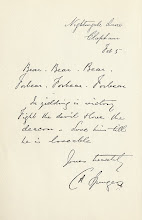
Thursday, November 19, 2009

Will Not Some of You Give Yourselves?


A selection from a letter by Margaret Paton, wife of missionary John Paton, to children in Scotland who had given offerings for their work. Their gifts help pay for a ship called Dayspring, which brought letters and supplies to the missionaries and took them to Australia for special needs. She thanked the children for their financial help and called on some of them to consider coming someday as missionaries. The letter was written in July, 1871.

I have told you a little of what the Dayspring does for the missionaries; but just think of what it has done for the Heathen, by bringing these missionaries to them. I have not time to dwell on this; but there will be ages and ages in eternity for these redeemed Ethiopians to show forth their praise and gratitude to God for sending us to tell them of Him who died for them.

Remember, however, that it is the missionary, and not the mission ship, that brings souls to the Saviour; for important as the Dayspring is, and it is of vital importance, it cannot make known to a single individual the way of salvation through Christ. We must have missionaries, who will go and live among the ‘Darkies,’ learn their language, teach them to read, and show them what it is to live as Christians.

Will not some of you, who have done so well in giving your money to the mission, do infinitely better by giving yourselves some day?

Margaret Paton: Letters from the South Seas, first published in 1894 as Letters and Sketches from the New Hebrides, published by The Banner of Truth Trust in 2003, p. 80.

Tuesday, November 17, 2009

Who Is Sufficient for These Things?


A selection from a letter by John Elias to Rev. Ebenezer Richard, a friend in the ministry of the Gospel. Like most of his letters, Elias wrote to encourage others. He addressed the wonder of God using weak men for the great work of the ministry, and not only encouraged a brother, but surely cheered himself. The letter was written September 16, 1808.

Dear Brother, I wish you much of the Lord’s gracious presence in the great work of the ministry everywhere. I perceive much of my own corruption and unfitness for the Lord’s work. I find my spirit rather far from him and too unconcerned for man’s salvation. I am constrained to exclaim, by considering the magnitude of the work, ‘Who is sufficient for these things?’ But as the Lord hath been pleased to take such humble instruments into his hands, and to put the Gospel treasure in earthen vessels ‘that the excellency of the power may be of God, and not of us,’ there is no reason to be discouraged on account of our great infirmities and unsuitableness. But we should endeavour to surrender ourselves to him; and though weakness itself, yet that weakness, in his hands, shall be ‘stronger than men.’

John Elias: Life, Letters and Essays, by Edward Morgan, first published in 1844, published by the Banner of Truth in 1973, p. 314.

Thursday, November 12, 2009

Sweet and Easy is the Cross of my Lord


A portion of a letter by Samuel Rutherford, to Alexander Gordon, written early in his exile to prison for the cause of Christ in Aberdeen, Scotland, September 5, 1636.

The Lord is with me, I care not what man can do. I burden no man, and I want nothing; no king is better provided than I am; sweet, sweet and easy is the cross of my Lord; all men I look in the face, of whatsoever rank, nobles and poor, acquaintance and strangers, are friendly to me. My Well-beloved is kinder and more warm than ordinary, and cometh and visiteth my soul; my chains are over-gilded with gold… No pen, no words, no engine [ability], can express to you the loveliness of my only, only Lord Jesus…

Letters of Samuel Rutherford: A Selection, The Banner of Truth Trust, the first edition of letters was published in 1664, this selection was published in 1973, p. 42.

Tuesday, November 10, 2009

My Deep and Affectionate Sympathy


A portion of a letter from Robert E. Lee, commanding general of the Confederate army, to his daughter-in-law, Charlotte Wickham Lee. Dorie McCullough Lawson writes, “He had [recently] suffered the loss of his beloved twenty-three-year-old daughter to typhoid fever. Lee wrote the following letter to his daughter-in-law upon learning of the death of his only living grandchild, a baby girl.” The letter was written December 10, 1862, three days prior to the Battle of Fredericksburg.

I heard yesterday, my dear daughter, with the deepest sorrow, of the death of your infant. I was so grateful at her birth. I felt that she would be such a comfort to you, such a pleasure to my dear Fitzhugh, and would fill so full the void still aching in your hearts. But you have now two sweet angels in heaven. What joy there is in the thought! I can say nothing to soften the anguish you must feel, and I know you are assured of my deep and affectionate sympathy. May God give you strength to bear the affliction He has imposed, and produce future joy out of your present misery, is my earnest prayer.

Posterity: Letters of Great Americans to Their Children, Dorie McCullough Lawson, Doubleday, 2004, p. 230.

Saturday, November 7, 2009

Something Surprising


A portion of a letter from David Kinghorn to his son, Joseph Kinghorn, who was studying for the ministry and would later become the pastor of St. Mary’s Baptist Church, Norwich, England. He commented on an associational letter written by Robert Hall, Sr., dealing with the Trinity. He said that Mr. Hall gave “the Arians the smartest whip I ever read” and then offered a warning to his son. The letter was written October 29, 1791:

There is something surprising, that man, who cannot comprehend himself, should think to comprehend deity, and equally so that contradictory things should be pretended to be proved from the sacred Scriptures concerning deity, as if the Scriptures were like a well-tuned fiddle, to play anything.

The Life and Works of Joseph Kinghorn, by Martin Hood Wilkin, reprinted by Particular Baptist Press, 1995, p. 197.

Wednesday, November 4, 2009

If God Has Given Me Christ


A selection from a letter by the Welsh preacher, Thomas Charles, to his wife to be, Miss Sarah Jones. Charles expressed a thought that brought him comfort in the midst of trials that might enable her bare up during times of trial. The letter was written June 5, 1780.

As to your complaints, I shall be always glad to hear them with attention, and esteem myself very happy to bear a part of your burden. I could likewise repeat numberless complaints in return; but instead of that, permit me to mention my ‘cordial,’ which, amidst all my complaints, helps me to many a quiet thought and many a sound sleep, which is—‘If God has given me Christ, what can I have to complain of?’ But then you must know, that I take him as a free gift, and attempt to cast myself wholly upon him; and according to Luther’s advice, throw all I am and do into one heap, and lay it down at the foot of his cross. O! He has a world of merit in his hands for you, for me, and a gracious heart to bestow it…

Thomas Charles’ Spiritual Counsels: Selected from his Letters and Papers, by Edward Morgan, first published in 1836, reprinted by the Banner of Truth, 1993, p. 234.

Thursday, October 29, 2009

I Beseech You to Pray for Me


A letter from C. H. Spurgeon, attached to a printed sermon that was on sale to the public. Sermons were printed each week in The Penny Pulpit. This letter contained information about his recovering health and an appeal for funds to carry on many of the ministries of which he was in charge. It was printed at the end of a sermon from Mark 14:6, entitled, “To Lovers of Jesus: An Example,” which was preached at the Tabernacle on November 2, 1884.

Mentone, [France], April 5, 1885

Dear Friends,

When this letter reaches you I hope I shall have returned to my family, and my people, much refreshed. I can hardly hope to be very long quite free from the disease which afflicts me; yet I do confidently expect a few months of steady service, and I am anxious that upon these the divine blessing may richly descend. I beseech you pray for me.

For more than thirty years these sermons have been published week by week; may I not entreat your supplications that I may be enabled to maintain their freshness, fullness, and power? For this I shall need great help from on high. My own resources are slender enough, but the divine fountain can never run dry.

The church over which I preside is large beyond all precedent, containing more than five thousand members. I entreat your prayers that wisdom and grace may be given me as the Pastor of such a flock. I tremble as I think of my responsibility. Who is sufficient for these things? Beside all this, — there are the Orphanage with its hundreds of little ones, the College with its students for the ministry, the Colportage with its book-selling missionaries, the Evangelists travelling from place to place and proclaiming the living word, and many other minor enterprises. The burden is too great for me unless the Lord’s own power be revealed in my weakness. For these institutions I need money in large measure, and grace beyond all measure. Those who profit by these sermons would act kindly if they would help me with their prayers and their contributions. I need both, and both at this time, in a special manner.

On my return I shall have to prepare for the gathering of the clan, in the form of the College Conference. A great host of ministers will come together to spend a week in holy fellowship and united devotion. If the Lord be with us, it will be a soul-refreshing season, and the brethren will return to their flocks prepared for a great blessing: but without the Spirit of the Lord all will be in vain. By the love of Jesus I implore the special prayers of faithful brethren and sisters. O Lord, send now prosperity! Revive thy work! Revive our own souls, for Jesus’ sake!

Your servant for Christ’s sake,
C. H. Spurgeon.

The Metropolitan Tabernacle, vol. 31, No. 1834, Logos Library System and Ages Software.