A selection from a letter written by William Carey to his good friend and supporter, John Sutcliffe. While Carey mined for jewels in India Sutcliffe helped hold the ropes in England. Carey was known as a “plodder.” This letter shows how he could faithfully plod along in spite of the difficulties and discouragements of the work. The letter was written on January 1, 1806.
I think this past year has been on several accounts the most successful one of the Mission, since its commencement. We have disagreeable things in sufficient number to keep us from security, and to humble us, nor is the success of the Gospel, at all, proportioned to the vast multitude of souls in this country. Yet we have increased and been blessed. Twenty seven natives and three Europeans have been this year added to us by baptism. We have less irregularity, and fewer defections to mourn than in any preceding year, though some instances of both have occurred. We have some growing, useful gifts among our native brethren, and I am mistaken if there be not an increase of true piety among them.
The Journal and Selected Letters of William Carey, collected and edited by Terry G. Carter, Smyth & Helwys, 2000, p. 158.
Monday, December 8, 2008


Friday, December 5, 2008
Lay Hold On Jesus Christ
A selection from a letter by Robert Murray M’Cheyne to someone whom he did not know. He knew her cousin, who asked him to write her a letter encouraging her to believe in Christ. Andrew Bonar, who included several of M’Cheyne’s letters in his Memoir and Remains of M’Cheyne, wrote this heading: “To a Stranger. Intended to lead on one whose face was Zionward, but who was not fully decided.” What evangelistic zeal M’Cheyne possessed! This wasn’t a form letter; it was a person letter to someone he didn’t know yet desired to see them converted. The letter was written in July of 1840.
My dear friend, I do not even know your name; but your cousin has been telling me about your case, and wishes me to write you a line inviting you to lay hold on Jesus Christ, the only refuge for a perishing soul. You seem to have been thinking seriously of your soul for some time. Do remember the words of Peter (2 Pet. 1:10): ‘Give diligence to make your calling and election sure.’ Never rest till you can say what John says (1 John 5:19): ‘We know that we are of God.’ The world always loves to believe that it is impossible to know that we are converted. If you ask them, they will say, ‘I am not sure—I cannot tell;’ but the whole Bible declares we may receive, and know we have received, the forgiveness of sins (see Ps. 32:1; 1 John 2:12). Seek this blessedness—the joy of having forgiveness; it is sweeter than honey and the honeycomb. But where shall I seek it? In Jesus Christ. ‘God hath given to us eternal life, and this life is in His Son. He that hath the Son hath life; and he that hath not the Son hath not life’ (1 John 5:11-12)…
Robert Murray M’Cheyne: Memoir and Remains, Andrew A. Bonar, first published in 1884, reprinted by the Banner of Truth, 1966, pp. 283-84.
My dear friend, I do not even know your name; but your cousin has been telling me about your case, and wishes me to write you a line inviting you to lay hold on Jesus Christ, the only refuge for a perishing soul. You seem to have been thinking seriously of your soul for some time. Do remember the words of Peter (2 Pet. 1:10): ‘Give diligence to make your calling and election sure.’ Never rest till you can say what John says (1 John 5:19): ‘We know that we are of God.’ The world always loves to believe that it is impossible to know that we are converted. If you ask them, they will say, ‘I am not sure—I cannot tell;’ but the whole Bible declares we may receive, and know we have received, the forgiveness of sins (see Ps. 32:1; 1 John 2:12). Seek this blessedness—the joy of having forgiveness; it is sweeter than honey and the honeycomb. But where shall I seek it? In Jesus Christ. ‘God hath given to us eternal life, and this life is in His Son. He that hath the Son hath life; and he that hath not the Son hath not life’ (1 John 5:11-12)…
Robert Murray M’Cheyne: Memoir and Remains, Andrew A. Bonar, first published in 1884, reprinted by the Banner of Truth, 1966, pp. 283-84.
Monday, December 1, 2008
I Cannot Sell My Conscience
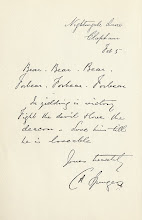
A selection from a letter by C. H. Spurgeon to the co-pastor and deacons of his church, the Metropolitan Tabernacle, London, England. He had withdrawn membership in the Baptist Union because liberalism was tolerated and had been censured for it. He was in Mentone, France for some rest and recuperation when he wrote this letter on November 27, 1887.
The more you know of this controversy [The Downgrade Controversy], the more will your judgements go with me as well as your hearts. It is not possible for me to communicate to any one all that has passed under my knowledge; but I have had abundant reason for every step I have taken, as the day of days will reveal. All over the various churches there is the same evil, in all denominations in measure; and from all sorts of believers comes the same thankful expression of delight that the schemes of errorists have been defeated by pouring light upon them. I cannot at this present tell you what spite has been used against me, or you would wonder indeed; but the love of God first, and your love next, are my comfort and stay. We may, perhaps, be made to feel some of the brunt of the battle in our various funds; but the Lord liveth. Our great Dr. Gill said, ‘Sir, I can be poor, but I cannot sell my conscience,’ and he has left his mantle as well as his chair in our vestry.
The Suffering Letters of C. H. Spurgeon, annotations by Hannah Wyncoll, The Wakeman Trust, 2007, p. 64.
The more you know of this controversy [The Downgrade Controversy], the more will your judgements go with me as well as your hearts. It is not possible for me to communicate to any one all that has passed under my knowledge; but I have had abundant reason for every step I have taken, as the day of days will reveal. All over the various churches there is the same evil, in all denominations in measure; and from all sorts of believers comes the same thankful expression of delight that the schemes of errorists have been defeated by pouring light upon them. I cannot at this present tell you what spite has been used against me, or you would wonder indeed; but the love of God first, and your love next, are my comfort and stay. We may, perhaps, be made to feel some of the brunt of the battle in our various funds; but the Lord liveth. Our great Dr. Gill said, ‘Sir, I can be poor, but I cannot sell my conscience,’ and he has left his mantle as well as his chair in our vestry.
The Suffering Letters of C. H. Spurgeon, annotations by Hannah Wyncoll, The Wakeman Trust, 2007, p. 64.
Friday, November 28, 2008
They Are Born and They Die
A portion of a letter by Martin Luther to his friend, Philip Melanchthon, December, 1535. He wrote to tell him that he should not be deterred from returning to Wittenberg by rumors concerning the plague.
We expect your return, and should a rumor reach you, then endure and overcome it. We hope that, even if there should be any future cases of contagious disease [around here], we will nevertheless have clean air (instead of this Scythian sky). Were it the plague, it would need other symptoms. Everywhere on earth people are mortal; they are born and they die. We cannot all remain alive here on earth, otherwise we will not get yonder.
Luther's Works, Letters III, Vol. 50, #266, edited by J. J. Pelikan, H. C. Oswald and H. T. Lehmann, Fortress Press.
We expect your return, and should a rumor reach you, then endure and overcome it. We hope that, even if there should be any future cases of contagious disease [around here], we will nevertheless have clean air (instead of this Scythian sky). Were it the plague, it would need other symptoms. Everywhere on earth people are mortal; they are born and they die. We cannot all remain alive here on earth, otherwise we will not get yonder.
Luther's Works, Letters III, Vol. 50, #266, edited by J. J. Pelikan, H. C. Oswald and H. T. Lehmann, Fortress Press.
Wednesday, November 26, 2008
The Proofs of Our Having Been Christians
A selection from a letter by James A. Haldane to his aunt, upon hearing of the sudden death of her husband. In writing to comfort her, he commented on the necessity of godly living so as to be prepared for that day when we shall all stand before the Lord. The letter was written August 14, 1804:
I should wish constantly to connect every word I speak and every action I perform with the judgment-seat of Jesus, for according to our words and actions we shall stand or fall. The holiness of our lives, our deadness to the world, and all that is in it, our constant pressing forward to win Christ, and to be found in Him; esteeming everything else but loss and dung; sacrificing to this great object every inclination of our corrupt nature, and every consideration which would for a moment divert our attention from Christ, these and these alone will in the great day of God be the proofs of our having been Christians. If we be risen with Christ, let us seek the things that are above. Yes, we shall infallibly do so, for in that case we must have the spirit of Christ, and where the spirit of Christ dwells there will be conformity to him, whose whole heart and affections were constantly fixed on his heavenly Father.
The Lives of Robert and James Haldane, by Alexander Haldane, first published in 1852, reprinted by The Banner of Truth, 1990, p. 345.
I should wish constantly to connect every word I speak and every action I perform with the judgment-seat of Jesus, for according to our words and actions we shall stand or fall. The holiness of our lives, our deadness to the world, and all that is in it, our constant pressing forward to win Christ, and to be found in Him; esteeming everything else but loss and dung; sacrificing to this great object every inclination of our corrupt nature, and every consideration which would for a moment divert our attention from Christ, these and these alone will in the great day of God be the proofs of our having been Christians. If we be risen with Christ, let us seek the things that are above. Yes, we shall infallibly do so, for in that case we must have the spirit of Christ, and where the spirit of Christ dwells there will be conformity to him, whose whole heart and affections were constantly fixed on his heavenly Father.
The Lives of Robert and James Haldane, by Alexander Haldane, first published in 1852, reprinted by The Banner of Truth, 1990, p. 345.
Monday, November 24, 2008
Building Up and Fortifying the Church
A selection from a letter by Rev. William Still to his congregation, Gilcomston South Church of Scotland, Aberdeen, November, 1960:
The Church’s first task, it seems to me, is to keep being herself in a changing world, and thus to build herself up and fortify herself against the growing onslaughts of evil, as prophesied in history and in each successive generation. This she can only do by being, not evangelically minded, devotionally or convention minded, socially minded, ecumenically minded, or politically minded; but by taking the whole Word of God as her diet, and feeding and building herself up on that. Thus she preserves her strength for every heroic task, including all these, and makes impact, often painful impact, upon all the life of her day.
The Letters of William Still, The Banner of Truth, 1984, pp. 75-76.
The Church’s first task, it seems to me, is to keep being herself in a changing world, and thus to build herself up and fortify herself against the growing onslaughts of evil, as prophesied in history and in each successive generation. This she can only do by being, not evangelically minded, devotionally or convention minded, socially minded, ecumenically minded, or politically minded; but by taking the whole Word of God as her diet, and feeding and building herself up on that. Thus she preserves her strength for every heroic task, including all these, and makes impact, often painful impact, upon all the life of her day.
The Letters of William Still, The Banner of Truth, 1984, pp. 75-76.
Friday, November 21, 2008
More Prayer
A selection from a letter by Elizabeth Prentiss, author of Stepping Heavenward, a book which has touched the hearts of many, to her husband, George Lewis Prentiss, written in October of 1869.
I am not skilled in argument, but my heart sides with God in everything, and my conception of His character is such a beautiful one that I feel that He can not err… The more time we spend upon our knees, in real communion with God, the better we shall comprehend His wonderful nature, and how impossible it is to submit that nature to the rules by which we judge human beings. Every turn in life brings me back to this—more prayer.
More Love to Thee: The Life and Letters of Elizabeth Prentiss, George Lewis Prentiss, reprinted by Solid Ground Christian Books, p. 279.
I am not skilled in argument, but my heart sides with God in everything, and my conception of His character is such a beautiful one that I feel that He can not err… The more time we spend upon our knees, in real communion with God, the better we shall comprehend His wonderful nature, and how impossible it is to submit that nature to the rules by which we judge human beings. Every turn in life brings me back to this—more prayer.
More Love to Thee: The Life and Letters of Elizabeth Prentiss, George Lewis Prentiss, reprinted by Solid Ground Christian Books, p. 279.
Subscribe to:
Posts (Atom)