From Maggie Paton, wife of missionary to the New Hebrides, John Paton, to her sister, about caring for a sick native, November 3, 1875:
His mind was so dark, but he was yearning to know something of that world to which he was hastening, and I felt it so hard to be tongue-tied, for I can’t speak a word of Tannese… I could do little more than mention that blessed Name which is above every name, and point upward; and oh, how eagerly he would look up with his great wistful eyes, and then at me, as if he would fain drink in more!
Letters and Sketches from the New Hebrides, by Maggie Whitecross Paton, printed by Reformation Heritage Books and Sprinkle Publications, 2003, pp. 236-37.
Wednesday, April 30, 2008


Monday, April 28, 2008
God and Joy
A selection from a letter by David Kinghorn to his son Joseph Kinghorn, February 23, 1782:
May the love of God be shed abroad in your heart and ours; I’ve oft thought on those words of Dr. Young, a deity believed is joy begun, a deity adored is joy advanced, a deity beloved is joy matured.
The Life and Works of Joseph Kinghorn, by Martin Hood Wilkin, reprinted by Particular Baptist Press, 1995, p38.
May the love of God be shed abroad in your heart and ours; I’ve oft thought on those words of Dr. Young, a deity believed is joy begun, a deity adored is joy advanced, a deity beloved is joy matured.
The Life and Works of Joseph Kinghorn, by Martin Hood Wilkin, reprinted by Particular Baptist Press, 1995, p38.
Thursday, April 24, 2008
The Salvation of Infants
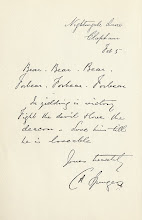
A selection from a letter by C. H. Spurgeon to someone who had inquired of his views regarding the salvation of infants, June 12, 1869:
I have never, at any time in my life, said, believed, or imagined that any infant, under any circumstances, would be cast into hell. I have always believed in the salvation of all infants… I do not believe that, on this earth, there is a single professing Christian holding the damnation of infants; or, if there be, he must be insane, or utterly ignorant of Christianity.
Letters of Charles Haddon Spurgeon, Selected with Notes, by Iain H. Murray, Banner of Truth, p. 150.
I have never, at any time in my life, said, believed, or imagined that any infant, under any circumstances, would be cast into hell. I have always believed in the salvation of all infants… I do not believe that, on this earth, there is a single professing Christian holding the damnation of infants; or, if there be, he must be insane, or utterly ignorant of Christianity.
Letters of Charles Haddon Spurgeon, Selected with Notes, by Iain H. Murray, Banner of Truth, p. 150.
Tuesday, April 22, 2008
Keeping Up Religion in a Hurry of Business
A selection from a letter by Thomas Boston, to his friend Mr. Hog, written September 25, 1721:
The best way that I know for keeping up religion in a hurry of business, is, to look on the business as a duty of the eighth command of our Sovereign Lord, Creator, and Redeemer; and so going about it in compliance with His will, who has allotted to every man their station, and determined the duties of it; to make application to Him ordinarily in your stated addresses to the throne of grace, for wisdom to guide your affairs with discretion, and for the success of them according to His promises thereanent [concerning that]; and actually go about them in dependence on the Lord. Thus, while you served your lawful purposes in the world, you would serve the Lord Christ…
Memoirs of Thomas Boston, first published in 1899, reprinted by the Banner of Truth, 1988, p. 498.
The best way that I know for keeping up religion in a hurry of business, is, to look on the business as a duty of the eighth command of our Sovereign Lord, Creator, and Redeemer; and so going about it in compliance with His will, who has allotted to every man their station, and determined the duties of it; to make application to Him ordinarily in your stated addresses to the throne of grace, for wisdom to guide your affairs with discretion, and for the success of them according to His promises thereanent [concerning that]; and actually go about them in dependence on the Lord. Thus, while you served your lawful purposes in the world, you would serve the Lord Christ…
Memoirs of Thomas Boston, first published in 1899, reprinted by the Banner of Truth, 1988, p. 498.
Sunday, April 20, 2008
A Recommendation for Membership
From the pen of Jonathan Edwards to the Rev. Mr. Stephen Williams, pastor of the church in Long Meadow, recommending Rachel Parsons for membership, February 18, 1745/6, when transference of members “by letter” meant something.
This may certify you that Rachel Parsons (now Bliss) has been admitted a member of this church, in full communion; and so continued, in good standing and without offense during her continuance here. And she having, by the providence of God, been lately removed from hence to dwell at Longmeadow, I would hereby recommend her to be received to the same standing and privileges with you.
Jonathan Edwards: Letters and Personal Writings, edited by George S. Claghorn, vol. 16 in The Works of Jonathan Edwards, Yale University Press, 1998, p. 198.
This may certify you that Rachel Parsons (now Bliss) has been admitted a member of this church, in full communion; and so continued, in good standing and without offense during her continuance here. And she having, by the providence of God, been lately removed from hence to dwell at Longmeadow, I would hereby recommend her to be received to the same standing and privileges with you.
Jonathan Edwards: Letters and Personal Writings, edited by George S. Claghorn, vol. 16 in The Works of Jonathan Edwards, Yale University Press, 1998, p. 198.
Friday, April 18, 2008
What Death Teaches Us
A selection from a letter by Benjamin Morgan Palmer to Sallie Baxter Bird, speaking of the death of his daughter, Marion Louisa, February 19, 1873:
But what does it [death] teach—what great lesson dos our loving Father mean us to gather up and treasure, in this apparent, and unspeakably painful, harshness to us and to her? I will tell you the conviction, which the Holy Spirit seems to be impressing more and more upon my own heart. I have never had before such an overwhelming sense of the testimonial character of human suffering, and of the awful holiness of God as the particular fact to which the witness is borne. Surely it is right—nay, it is supremely right—that God should exhibit, in the very bosom of His grace, His dreadful displeasure against sin. You perceive that I go behind all secondary causes for the origin of suffering. However it may be brought about through fixed and necessary laws, the moral ground of it is to be found in the fact that we are sinners. The curse—the curse—that terrible word which is written as the superscription over a doomed world—rests upon us, and we suffer. When God, therefore, interposes with grace, and turns this curse into discipline, giving us in sorrow and anguish, not the punishment, but the correction of our sin, He is thereby proclaiming His dreadful holiness. He does it, in those whom most conspicuously He saves, that the world may understand that He saves as a holy God. Are we no in danger, while contemplating His infinite compassion and love, or lowering our views?
The Life and Letters of Benjamin Morgan Palmer, by Thomas Cary Johnson, Banner of Truth, p. 397-98.
But what does it [death] teach—what great lesson dos our loving Father mean us to gather up and treasure, in this apparent, and unspeakably painful, harshness to us and to her? I will tell you the conviction, which the Holy Spirit seems to be impressing more and more upon my own heart. I have never had before such an overwhelming sense of the testimonial character of human suffering, and of the awful holiness of God as the particular fact to which the witness is borne. Surely it is right—nay, it is supremely right—that God should exhibit, in the very bosom of His grace, His dreadful displeasure against sin. You perceive that I go behind all secondary causes for the origin of suffering. However it may be brought about through fixed and necessary laws, the moral ground of it is to be found in the fact that we are sinners. The curse—the curse—that terrible word which is written as the superscription over a doomed world—rests upon us, and we suffer. When God, therefore, interposes with grace, and turns this curse into discipline, giving us in sorrow and anguish, not the punishment, but the correction of our sin, He is thereby proclaiming His dreadful holiness. He does it, in those whom most conspicuously He saves, that the world may understand that He saves as a holy God. Are we no in danger, while contemplating His infinite compassion and love, or lowering our views?
The Life and Letters of Benjamin Morgan Palmer, by Thomas Cary Johnson, Banner of Truth, p. 397-98.
Wednesday, April 16, 2008
Death Has Struck Me
A selection from a letter by Robert L. Dabney, expressing the grief he experienced in the death, by diphtheria, of his two sons, written to his brother, December 12, 1855:
Death has struck me with a dagger of ice. He has not only wounded, but benumbed. I believe that Jimmy was too young to be responsible, and that as such, though by nature depraved, he is saved, renewed and glorified by the grace of God; and Bobby, if not also too young to be responsible, which is most probable, showed such sweet and striking evidences of ripening for heaven, that I cannot believe he is anywhere else. Yet believing this as I do firmly, I hardly have life to rejoice in it. But thanks to God, I am not moping nor murmuring. If I could see the blows blessed to myself, my kindred and my friends, I should in time be able to bless God for it; and this is my constant prayer…
The Life and Letters of Robert Lewis Dabney, by Thomas Cary Johnson, first published in 1903, reprinted by the Banner of Truth Trust, 1977, p. 172.
Death has struck me with a dagger of ice. He has not only wounded, but benumbed. I believe that Jimmy was too young to be responsible, and that as such, though by nature depraved, he is saved, renewed and glorified by the grace of God; and Bobby, if not also too young to be responsible, which is most probable, showed such sweet and striking evidences of ripening for heaven, that I cannot believe he is anywhere else. Yet believing this as I do firmly, I hardly have life to rejoice in it. But thanks to God, I am not moping nor murmuring. If I could see the blows blessed to myself, my kindred and my friends, I should in time be able to bless God for it; and this is my constant prayer…
The Life and Letters of Robert Lewis Dabney, by Thomas Cary Johnson, first published in 1903, reprinted by the Banner of Truth Trust, 1977, p. 172.
Subscribe to:
Posts (Atom)