Showing posts with label Robert Lewis Dabney. Show all posts

Monday, June 27, 2011

A Sermon Instead of a Letter

A selection from a letter by Rev. Robert L. Dabney to his older brother, Charles William Dabney. The letter is evangelistic. He longed to see his brother, a distinguished lawyer, come to an open profession of Christ. After writing at length about depravity and the necessity of the new birth, Dabney concluded with an earnest appeal. The letter was written December 23, 1855.

You will say I send you a sermon instead of a letter. Well, I will add one more feature of resemblance; and as the preachers follow their sermons with a prayer for the divine blessing, after I have folded up this lame and halting composition, and directed it to you, I will kneel down, and pray to "the God who seeth in secret," to guide you into his truth, to show you the way of salvation, and place you in it, to bless your little ones and make them his children, and to give the sweetest and best influences of his grace to my dear sister; and may the Lord forgive me that I, so poor and beggarly a sinner, should try to unfold the riches of his grace to one less guilty than myself.

The Life and Letters of Robert Lewis Dabney, by Thomas Cary Johnson, first published in 1903, reprinted by the Banner of Truth Trust, 1977, pp. 184-85.

Friday, May 21, 2010

The Value of a Mother


A selection from a letter by Robert L. Dabney to his mother, who had been sick. The letter expresses his appreciation for her and sets forth her noble character. The letter was written December 2, 1857.

Your sickness was needed to teach us all your value, and the love which we ought to feel and manifest for you. If there ever were children who owed a heavy debt of gratitude to a mother, we are among them; and if there ever was a mother in whom the description of Proverbs ought to be verified, "Her children rise up and call her blessed" [Prov. 31:28], surely our mother is one. I find my best solace in uncertainly to be in praying that the God and Saviour, whose compassions fail not, and who is in Louisa [the county in Virginia she lived in] as truly as in Prince Edward [the county in Virginia he lived in], will soothe all your sufferings, heal your sickness, and make affliction bring forth a far more exceeding weight of glory.

The Life and Letters of Robert Lewis Dabney, by Thomas Cary Johnson, first published in 1903, reprinted by the Banner of Truth Trust, 1977, p. 179.

Friday, February 5, 2010

Think of the Bridge!


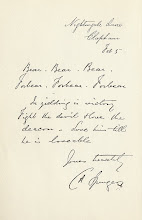
I recently had the privilege of hearing Dr. T. David Gordon speak at Westminster Presbyterian Church, Huntsville, Alabama (by the way, the pastor at WPC, Charlie Wingard, has a blog well worth reading, http://charliewingard.blogspot.com.). Dr. Gordon is the author of a fascinating book, Why Johnny Can’t Preach. Another book, Why Johnny Can’t Sing, is soon to be available. Dr. Gordon makes several good points about letter writing in his book (see the side-bar). He also includes a letter written by C. R. Vaughn to R. L. Dabney that is wonderful in its pointed message of encouragement. I include the portion of the letter quoted by Dr. Gordon, and his introductory information about the letter. The letter was written February 3, 1890.

Dr. Gordon says, “One of the great articulations of this reality in the history of Christian literature [that faith is built by careful, thorough exposition of the person, character, and work of Christ] occurs in a letter written by Clement Read Vaughn to the renowned Southern Presbyterian theologian Robert Lewis Dabney. Dabney moved from Virginia to Austin, Texas, almost twenty years after the Civil war and lived there for another fifteen years. In his latter years, he became blind and weak, and knew his death was near. He wrote to his old friend Vaughan, wondering whether he would have strong enough faith to face his impending death, and Vaughan’s reply was as theologically trenchant as it was pastorally lovely. He wrote back to Dabney and asked Dabney what a traveler would do if he came to a chasm over which a bridge was spanned:”

What does he do to breed confidence in the bridge? He looks at the bridge; he gets down and examines it. He don’t [sic] stand at the bridge-head and turn his thoughts curiously in on his own mind to see if he has confidence in the bridge. If his examination of the bridge gives him a certain amount of confidence, and yet he wants more, how does he make his faith grow? Why, in the same way; he still continues to examine the bridge. Now, my dear old man, let your faith take care of itself for awhile, and you just think of what you are allowed to trust in. Think of the Master’s power, think of his love; think how he is interested in the soul that searches for him, and will not be comforted until he finds him. Think of what he has done, his work. That blood of his is mightier than all the sins of all the sinners that ever lived. Don’t you think it will master yours?...

Now, dear old friend, I have done to you just what I would want you to do to me if I were lying in your place. The great theologian, after all, is just like any other one of God’s children, and the simple gospel talked to him is just as essential to his comfort as it is to a milk-maid or to a plow-boy. May God give you grace, not to lay too much stress on your faith, but to grasp the great ground of confidence, Christ, and all his work and all his personal fitness to be a sinner’s refuge. Faith is only an eye to see him. I have been praying that God would quiet your pains as you advance, and enable you to see the gladness of the gospel at every step. Good-bye. God be with you as he will. Think of the Bridge!

The Life and Letters of Robert Lewis Dabney, by Thomas Cary Johnson, first published in 1903, reprinted by the Banner of Truth Trust, 1977, p. 480. The above letter is found in Why Johnny Can’t Preach, by T. David Gordon, Presbyterian and Reformed Publishing, 2009, pp. 76-77.

Monday, December 14, 2009

My Sense of Duty


A selection from a letter by Robert L. Dabney to the esteemed professor of theology at Princeton Seminary, Charles Hodge. Hodge had been trying to persuade Dabney to leave his teaching post at Union Seminary in order to teach Historical Theology at Princeton. The professorship was vacant due to the unexpected death of J. A. Alexander. Dabney refused the invitation despite the pleas of Hodge and the appeal of being a professor at such a famous school. Having given several reasons why he could not accept the offer, he gave as his last reason for remaining at Union, the call of duty. The letter was written April 10, 1860.

Last, I give no little weight to this thought, that I am most probably deciding as a Christian should, because I am deciding contrary to the promptings of ambition, and, indeed, of nearly all the natural affections of carnality.

In the eyes of the Presbyterians of Virginia, Princeton is ever esteemed venerable and attractive. Do not suppose, my dear sir, that I am insensible to her superiority. The man who goes there and does his duty, will have his name blown much further by the trumpet of fame than mine will ever be. He will be in the focus of national observation, at least, for Presbyterians; I shall remain in comparative obscurity. He will teach the many, I the few; for I do not dream that your Seminary will cease to maintain the preeminence so honorably earned; and especially, the faithful and useful man at Princeton will probably receive that most gratifying of all earthly rewards, a united, enlightened, and steady support on the part of the proper constituency of the Seminary, which Presbyterians in Virginia have not always been accustomed to bestow, even on those who attempted to serve them faithfully.

I have my eyes open to all these things, and because my sense of duty outweighs them, I feel a good confidence that it is conscience, and not carnality, which decides me.


The Life and Letters of Robert Lewis Dabney, by Thomas Cary Johnson, first published in 1903, reprinted by the Banner of Truth Trust, 1977, p. 205.

Monday, June 8, 2009

Preaching to the Soldiers on Sunday


A selection from a letter by Robert L. Dabney to his mother about his new job. General Thomas J. Jackson, better known as “Stonewall,” had appointed Dr. Dabney as his adjutant with the promise that he could preach to the troops on Sundays. Colonel Grigsby, of the Stonewall Brigade, a somewhat profane officer, paid a high compliment to Dabney when he said, “Our parson is not afraid of Yankee bullets, and I tell you he preaches like hell.” Dabney’s letter, written May 6, 1862, gave a brief description of his duties in the Confederate army.

The adjutant is pretty much the General’s secretary; and as he must be near the General’s person, he necessarily shares his comforts. I always eat at the same table, and most frequently sleep in the same military pallet. In general, I may say that he treats me with the greatest kindness and consideration; and while he is exact and exacting in an official point of view to all under him, personally he is almost embarrassingly kind. The bargain is that I shall do his army work in the week, and be at liberty to preach to the soldiers on Sundays.

The Life and Letters of Robert Lewis Dabney, by Thomas Cary Johnson, first published in 1903, reprinted by the Banner of Truth Trust, 1977, p. 264.

Saturday, February 21, 2009

What I Pray For

A selection from a letter by Robert L. Dabney to his sister, Betty. She was suffering from a severe case of bronchitis. The letter was written December 22, 1861. She did not recover from the illness though much prayed for and in the hands of the best medical care. Dabney told his sister how he framed his petitions on her behalf.

You cannot tell how much I have been affected and moved by your sickness. A large part of every prayer I try to offer is for you. Shall I tell you what I pray for? First, that you may possess a sustaining faith, and the ‘the joy of the Lord may be your strength;’ and that patience may have its perfect work in you. Second, that for the sake of mamma, and of all of us, rather than for your own sake, your disease may be speedily rebuked and your health firmly restored.

The Life and Letters of Robert Lewis Dabney, by Thomas Cary Johnson, first published in 1903, reprinted by the Banner of Truth Trust, 1977, p. 248.

Monday, November 3, 2008

An Instrument in Saving Some

A selection from a letter by Robert L. Dabney to his mother. The year was 1868. The South was undergoing great hardships due to Reconstruction. He told his mother that he was filled with “melancholy” because of the “present oppressions.” Yet he rejoiced that there were some things that could not be taken away. The letter was written on February 15, 1868.

The labors of my life seem to be like marks made on a sand beach for the rising tide to wash away, save as I may have been instrumental in saving some souls. That work, thank God, cannot be undone by the malice of men or devils.

The Life and Letters of Robert Lewis Dabney, by Thomas Cary Johnson, first published in 1903, reprinted by the Banner of Truth Trust, 1977, p. 303.

Friday, August 29, 2008

Strike Away

A selection from a letter to Robert L. Dabney by his mentor, Rev. William S. White, of Lexington, Virginia. Dabney was a young pastor and was in depression of spirits. Rev. White wrote to encourage him in the work of preaching. The letter was written on January 26, 1849:

Remember that it is ‘neither the first blow nor the last that fells the oak.’ Therefore, strike away, and the tree will fall and the forest be cleared. I know no means of building up and extending the borders of Zion but the truth studied, learned, communicated, and then followed by prayer. Preach as if your preaching was everything, and then pray as if it were nothing. If I could not rest in this view, I should despair.

The Life and Letters of Robert Lewis Dabney, by Thomas Cary Johnson, first published in 1903, reprinted by the Banner of Truth Trust, 1977, p. 111.

Tuesday, June 3, 2008

Atonement and Faith

A selection from a letter by Robert L. Dabney, to his youngest sister, whom he sought to win to Christ by exhorting her to believe and be saved. The letter was written either in 1840 or 41:

If… you had committed but one sin, some atonement must be made for it, either by your own eternal sufferings or by the obedience and death of an all-sufficient, because an infinite and divine, Saviour. God is pleased to accept the atonement of Christ, and all you have to do is to receive it thankfully, not caviling at the mode or the conditions. This condition, which must be fulfilled before the benefits of the atonement can be enjoyed by you, is one which is evidently proper and suitable to the nature of the case. If you are sensible that you need it, you can formally accept it, in your inmost soul, and at the same time renounce all other hope, and this is the faith in Christ, which is the condition of salvation. By having this faith you do not become any more worthy. It is still sovereign grace in Christ Jesus. But by having this faith you fulfil the condition that God has been pleased to set for you, so that he can then bestow his gift of pardon in accordance with the plan he has been pleased to lay down. Simple as this faith on Jesus is, the carnal mind will not submit to it, and give up all its own hopes, unless by the grace of God constraining it.

The Life and Letters of Robert Lewis Dabney, by Thomas Cary Johnson, first published in 1903, reprinted by the Banner of Truth Trust, 1977, p. 71-72.

Wednesday, April 16, 2008

Death Has Struck Me

A selection from a letter by Robert L. Dabney, expressing the grief he experienced in the death, by diphtheria, of his two sons, written to his brother, December 12, 1855:

Death has struck me with a dagger of ice. He has not only wounded, but benumbed. I believe that Jimmy was too young to be responsible, and that as such, though by nature depraved, he is saved, renewed and glorified by the grace of God; and Bobby, if not also too young to be responsible, which is most probable, showed such sweet and striking evidences of ripening for heaven, that I cannot believe he is anywhere else. Yet believing this as I do firmly, I hardly have life to rejoice in it. But thanks to God, I am not moping nor murmuring. If I could see the blows blessed to myself, my kindred and my friends, I should in time be able to bless God for it; and this is my constant prayer…

The Life and Letters of Robert Lewis Dabney, by Thomas Cary Johnson, first published in 1903, reprinted by the Banner of Truth Trust, 1977, p. 172.