Showing posts with label prayer. Show all posts

Friday, June 24, 2011

In My Old Age

A selection from a letter by Rev. Henry Venn, a minister in the Church of England, to an acquaintance, Mrs. Braiser, who had lost an infant in death. He gave reasons why "our dear children, taken away almost as soon as we see them, are safe in the hands of their merciful Creator and Redeemer." He also spoke of his trials in old age but of the nearness to God in meditation and prayer. The letter was written March 27, 1781.

My health is very much restored; yet I am forced, I think, to pay dearly for it. I am obliged to be on horseback every day, and cannot study and apply as my heart delights to do. I began to make trial of preaching four times one week; but I smarted for it for more than a fortnight; so that I must be content with doing very little indeed in my old age. Oh that I may enjoy more meditation and prayer, and communion with God, till I am with Him, whose Name is most glorious in my eyes, and His service the highest honor… Oh for an overcoming faith, to possess the inheritance of the saints in light, by hope, before we are translated to it!

Letters of Henry Venn, by John Venn, first published in 1835, republished by the Banner of Truth, 1993, pp. 323-34.

Friday, January 21, 2011

Doing Something for Our Lord

A portion of a letter by Henry Venn, Church of England minister, to his friend James Kershaw. Venn had much to say about Lady Huntingdon, a notable woman who used her wealth and influence for the gospel. In commending her as "a star of the first magnitude in the firmament of the Church," Mr. Venn encouraged his friend, and himself, to a life of service for Christ. The letter was written November 5, 1769.

Too apt are we to rest in life received, and not to be every day doing something for our Lord; either earnestly engaging in prayer, speaking affectionately to sinners, overcoming our selfish violent passions, or exercising mercy to our needy brethren; but it is by abounding in every good work, that our light shines before men, and we stand confessed the workmanship of God in Christ. I would urge the duty—and may God press it home effectually upon my own heart?—of "opening our mouths wide," to importune Him for the best gifts; and to live, in the sight of all around us, beyond dispute, zealous conscientious worshippers, and dear obedient children.

Letters of Henry Venn, by John Venn, first published in 1835, republished by the Banner of Truth, 1993, p. 158.

Friday, January 7, 2011

Some Exceedingly Difficult Letters to Answer

A selection from a letter by A. W. Pink to his friend, Lowell Green. Mr. Pink received many letters and responded to them, saying in 1946 that he had written "by hand well over 20,000 letters." He was a pastor and counselor to many by means of correspondence. This letter, which was written July 10, 1939, make clear some of the troubles to which he sought to bring light and comfort.

Of late I have had some exceedingly difficult letters to answer: among them one from a Sister who allowed her heart to run away with her head… She thought she was doing God's will, is now satisfied she was deceived by Satan, and wanting to know how the promptings of the Holy Spirit may be distinguished from those of the Evil One.

Another from a preacher of many years' experience: had a nervous breakdown; eventually went to a "Prayer Healer" (a servant of the Devil), since which the spirit of prayer has been stifled in his own soul, all assurance of salvation gone, so that he no longer dares to preach to others.

What saddens me so much is that there seem to be so very few today unto whom these poor souls can turn for helpful counsel. Many who can preach gospel, doctrinal and prophetic sermons appear to be quite incapable of entering into the experiences of the perplexed and distressed and giving them "a word in season" [Isa. 50:4]. Unless pastors are Divinely qualified to be doctors of souls they are "physicians of no value," as Job [13:4] had to say unto those who failed to diagnose his case and minister to him in his trouble. Such "qualification" cannot be acquired in any Seminary or Bible School.

The Life of Arthur W. Pink, Revised and Enlarged Edition, Iain H. Murray, Banner of Truth, 2004, p. 216.

Wednesday, December 8, 2010

Live For God and All Will Be Well

A portion of a letter from Edmund Botsford, pastor of Georgetown Baptist Church, Georgetown, South Carolina, to a young pastor friend, John Roberts. Botsford exhorted John and his new wife to talk freely to one another on spiritual subjects and to form the habit of praying together. With a bit of humor he told Mrs. Roberts if John was too backwards to converse with her, to let him know and he would scold him soundly! The letter was written November 24, 1802.

I sincerely wish you and the dear young lady with which you are connected, the best of blessings. Do, my dear young friend, from the first, make free to talk with the wife of your bosom, and that frequently, on divine subjects. Get her to pray with you; often be on your knees together, and do tell her from me, from your real friend, I beg her, I entreat her, not only to join you in prayer, but pray herself with you. O my young friends, do be praying husband and wife. Do not let shame prevent. O Mrs. Roberts, I earnestly entreat you to pray in secret with your husband; do my dear child get into the habit of praying with your husband; and if you find him backward to converse with you on spiritual subjects, let me know, and I will scold him soundly. I tell you both, live for God, and all will be well.

Memoirs of Elder Edmund Botsford, compiled and edited by Charles D. Mallary, first printed in 1832, now printed by Particular Baptist Press, Springfield, Missouri, 2004, p. 119.

Friday, May 21, 2010

The Value of a Mother


A selection from a letter by Robert L. Dabney to his mother, who had been sick. The letter expresses his appreciation for her and sets forth her noble character. The letter was written December 2, 1857.

Your sickness was needed to teach us all your value, and the love which we ought to feel and manifest for you. If there ever were children who owed a heavy debt of gratitude to a mother, we are among them; and if there ever was a mother in whom the description of Proverbs ought to be verified, "Her children rise up and call her blessed" [Prov. 31:28], surely our mother is one. I find my best solace in uncertainly to be in praying that the God and Saviour, whose compassions fail not, and who is in Louisa [the county in Virginia she lived in] as truly as in Prince Edward [the county in Virginia he lived in], will soothe all your sufferings, heal your sickness, and make affliction bring forth a far more exceeding weight of glory.

The Life and Letters of Robert Lewis Dabney, by Thomas Cary Johnson, first published in 1903, reprinted by the Banner of Truth Trust, 1977, p. 179.

Monday, May 10, 2010

Seeing the Hand of God


A selection from a letter by David Kinghorn to his friend, Henry Dawson, who had recently moved to another village and therefore another church. He wrote words of encouragement regarding providence and prayer. In the years following, Mr. Kinghorn wrote his son, Joseph, when a student at the Baptist college in Bristol and then the pastor of St. Mary's Baptist Church, Norwich, many valuable and instructive letters. This letter to the former member of his church was written December 3, 1781.

…As the Lord's way is in the deep waters, and his footsteps are not known until his purposes break forth in his providence, and manifest his design to us, by their accomplishment, it is no wonder, that we should often think, that he writeth bitter things against us, even when he is bringing about the greatest good; and is no proof, that because judgment is not speedily executed against an evil work, that it will not be executed at all; so neither is it a proof, that because prayer is not immediately answered, therefore it is not accepted. The time when, the place where, and the means by which, God accomplishes his purposes, fulfills his promises, and grants our requests, are often quite out of our sight. This indeed makes the hand of God more manifest, for if we had our desires fulfilled in our own way, and agreeable to our own mind, in many respects, we should be at a loss to see the hand of God. To prevent which, and that we may not lose the comfort, nor himself the glory of his own works, he crosses his hands in his providence, and withholds from us, in our way, what he gives in his own.

The Life and Works of Joseph Kinghorn, vol. 3, compiled and edited by Terry Wolever, Particular Baptist Press, 2010, pp. 294-95.

Wednesday, April 7, 2010

Thinking Too Lightly of the Conversion of Sinners


A selection from a letter by Mary Winslow (1774-1854). No name or date is given but what a convicting letter regarding the lack of general concern believers have for the lost. She points to her own carelessness and then exhorts her correspondent, as well as herself, to be a faithful witness for Christ.


I think the best of God's saints think too lightly of the conversion of sinners; and I take shame to myself that it has not had the influence upon my own mind that it ought to have had. Oh, how much and how deeply have I had cause to mourn over my lack of faithfulness to an immortal soul I knew was traveling the downward road that leads to eternal death; and yet, from fear of offending, have withheld the truth, or have merely satisfied myself with some general hints, unsatisfactory and unconvincing! Did we really believe that ever unconverted person we met with dying so, would be lost forever, should we not be in earnest to warn that soul to flee from the wrath to come? Should we not avail ourselves of every favourable opportunity of praying for them, expostulating with them, and beseeching them to consider their latter end and turn to the Lord that they might be saved? I know there is much wisdom to be exercised to know how and when to speak, all of which the Lord will give to those who are earnest in asking for it. May the Lord make us faithful, myself in particular.

Heaven Opened: A Selection from the Correspondence of Mrs. Mary Winslow, edited by her son, Octavius Winslow, 1864, reprinted by Reformation Heritage Books, 2001, pp. 175-76.

Thursday, March 4, 2010

Walking by Faith


A selection from a letter by Mary Winslow (1774-1854) to a friend. She spoke of a minister who had many needs in providing for his family but who was trusting in the Lord. She then wrote about the importance of living by faith. Not date is given for the letter.

How good it is to walk by faith. I am certain it is the right road to glory; no other would do us equal good. Faith in Jesus brings us countless blessings to the soul, and glory to God the Father. No wonder, then, the Lord tries the little we have, that it may be increased, and that every other grace might grow in proportion. We never should value a throne of grace as we ought to do if our faith was not tried. Jesus is very precious, and I am most graciously permitted in His name to have free access to the heart of God, my Father and your Father.

Heaven Opened: A Selection from the Correspondence of Mrs. Mary Winslow, edited by her son, Octavius Winslow, 1864, reprinted by Reformation Heritage Books, 2001, pp. 290-91.

Monday, October 19, 2009

A Little Fire for the Devil


A selection of a letter from Martin Luther to his wife, Katie. He was hoping to return home soon. He reported on a fire that raged in the Thuringian Forest. He believed the devil was behind the damage done. He then asked Katie to pray and have the children to pray against the attacks of the devil. The letter was written July 26, 1540.

Pray, and have [the children] pray against that horrible Satan who most violently attacks us not only in soul and body but also in property and honor. May Christ our Lord come down from heaven and also start a little fire for the devil and his companions which the devil would be unable to extinguish. Amen.

Luther's Works, Letters III, Vol. 50, edited by J. J. Pelikan, H. C. Oswald and H. T. Lehmann, Fortress Press, letter # 293.

Saturday, September 19, 2009

I Tremble Yet Rejoice


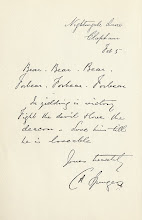
A portion of a letter by Charles Haddon Spurgeon, written to his parents after getting settled in school at Newmarket. He hadn’t been long converted and was joyous of knowing Christ but struggled spiritually because he didn’t want to bring disgrace on his Saviour. He was not yet 16 years old when he wrote this letter, January 30, 1850.

How sweet is prayer! I would be always engaged in it. How beautiful is the Bible! I never loved it so before; it seems to me as necessary food. I feel that I have not one particle of spiritual life in me but what the Spirit placed there. I feel that I cannot live if He depart; I tremble and fear lest I should grieve Him. I dread lest sloth or pride should overcome me, and I should dishonour the gospel by neglect of prayer, or the Scriptures, or by sinning against God. Truly, that will be a happy place where we shall get rid of sin and this depraved corrupt nature. When I look at the horrible pit and the hole from which I have been digged, I tremble lest I should fall into it, and yet rejoice that I am on the King’s highway.

The Letters of Charles Haddon Spurgeon, collected and collated by his son, Charles Spurgeon, first published in 1923, p. 13, now available electronically by Logos Research Systems, Inc.

Friday, September 4, 2009

A Prayer and a Hymn


A selection from a letter by Mary Jones, wife of the Rev. Charles Colcock Jones, to her granddaughter, Mary. She sent a prayer that she might say before a meal and a hymn for her to memorize. The letter was written March 30, 1864.

I am very much pleased to hear that you go to Sunday school and love your teacher. You must obey all she tells you, and always say your lessons well… The other day we went to Flemington, and Willie and Jimmie both repeated a beautiful hymn they had just learned, and did not miss a word of it—the hymn your mother and Uncle Charles and Uncle Joe used to say when they were small; so that Grandmama remembered it, and now writes it from memory for you and Brother to learn to say to me when I come up. Cousin Marion Glen, one of my dear friends, has been a week with me, and her niece Miss Laleah Dunwody, and she said a sweet little grace for Little Sister to learn; and I write it down here for you to say when there is no one to ask a blessing:

Lord, bless this food which now I take
To do me good, for Jesus’ sake
.

And this is the hymn:

My Heavenly Father, all I see
Around me and above
Sends forth a hymn of praise to Thee
And speaks Thy boundless love.

The clear blue sky is full of Thee,
The woods so dark and lone.
The soft south wind, the sounding sea
Worship the Holy One.

The humming of the insect throng,
The prattling, sparkling rill,
The birds with their melodious song
Repeat Thy praises still.

And Thou dost hear them every one;
Thou also hearest me.
I know that I am not alone
When I but think of Thee
.

The Children of Pride: A True Story of Georgia and the Civil War, edited by Robert Manson Myers, Yale University Press, 1972, pp. 1155-56. Iain Murray makes reference to this book of letters in a chapter on the Jones’s in his recent book, Heroes (published by The Banner of Truth Trust).

Friday, July 31, 2009

Pray For Me

A selection from a letter by John Newton to William Bull. He asked his friend to pray for him in his old age. He was soon to have his 76th birthday and desired to glorify the Lord in the days remaining to him. He wanted to practice what he had preached to others. The letter was written August 1, 1800 [he lived another seven years, dying December 21, 1807).

The almanack tells me that if I live till Monday next, I shall enter my seventy-sixth year. I believe you will pray for me on that day. My eyes, ears, and legs likewise admonish me that I grow older. My writing days seem almost over; I cannot well see to write; but I make an effort to send you one letter more, which may probably be the last you will receive.

I have requested your prayers; shall I tell you what to ask for? You need not pray for my sudden removal, for I have as little reason as most people to be weary of life; and, through mercy, I feel at present quite willing to live my appointed time. Nor need you pray for my long continuance here, for I see little except my profession and ministry worth living for another day. But pray that I may be enabled to leave the time and manner of my dismission entirely in the Lord’s hands; that if He sees fit to summon me suddenly, I may be willing to go without delay; and that if He is pleased to lay me aside, I may be as willing to retire and wait his time.

Pray likewise for me that no gross imprudence or misconduct may stain the latter part of my life, but that I may be enabled to exemplify in myself what I have labored to inculcate upon others from the pulpit. I have observed in some good men and good ministers improprieties in their latter days, which I have been willing to ascribe rather to the infirmities of old age than to a defect in real grace. I pray daily to be preserved from these, and I request your assistance. I have known good men in advanced life garrulous, peevish, dogmatic, self-important, with some symptoms of jealousy, and perhaps envy, towards those who are upon the increase while they feel themselves decreasing. Do, my friend, pray earnestly that it may not be so with me, but that I may retire, if laid aside, like a thankful guest from a plentiful table, and may rejoice to see others coming forward to serve the Lord (I hope better and more successfully) when I can serve him no longer…

Letters of John Newton: with Biographical Sketches and Notes, by Josiah Bull, first published in 1869, reprinted by the Banner of Truth, 2007, pp. 313-314.

Friday, July 17, 2009

O the Strength of Prayer!


A selection from a letter by the Puritan preacher, Joseph Alleine (1634-1668), to his congregation from prison. He was ejected from the Church of England for nonconformity in 1662 and was arrested and imprisoned because he continued to preach. While in prison he wrote his congregation numerous letters. He expresses thanks to his beloved people in this letter for their intercessions on his behalf. He had been sick but felt the strength of their prayers. No date is given for the letter.

You have wrestled with the Lord for me, you have wrestled me out of the very jaws of death itself. O the strength of prayer! Surely it is stronger than death. See that you even honour the power and prevalency of prayer. Oh be in love with prayer, and have high and venerable thoughts of it. What distresses, diseases, deaths, can stand before it? Surely I live by prayer. Prayer hath given a resurrection to this body of mine, when physicians and friends had given up their hopes.

Life and Letters of Joseph Alleine, by Rev. Richard Baxter, Theodosia Alleine, and others, with a new introduction by Joel R. Beeke and Herb Samworth, Reformation Heritage Books, reprinted in 2003, p. 227.

Friday, May 8, 2009

The Difference Between Liberals and Conservatives


A selection from a letter by Rev. William Still to his congregation, Gilcomston South Church of Scotland, Aberdeen, July, 1980. He wrote about the curse and failure of liberalism in churches.

The difference between liberals and conservatives is simply that we take the words of the Bible seriously and believe them, and that seems to work! For when the authority of the Word is harnessed to the power of the Holy Spirit through prayer (it is not always in conservative or Reformed circles!) – dare we mention prayer! – the church is quickened, numbers are added, the Christian life of worship, study, prayer and service becomes soberly exciting.

The Letters of William Still, The Banner of Truth, 1984, p. 178.

Saturday, April 18, 2009

Widows and Prayer

A portion of a letter written by Augustine of Hippo (354-430) to Faltonia Proba, a widow of the wealthiest man in the Roman Empire. She had asked him about prayer. He wrote a letter to her which has become a classic on prayer.

I haven’t forgotten your request, and what I promised you, to write you about praying to God… I can’t tell you what great joy your request gives me, for I see what real concern you have about prayer. Can you not realize that there can be no worthier occupation as a widow than prayer? As the Apostle admonishes: “a woman who is a true widow in her desolation, wholly trust in the Lord, giving all her days and nights to prayer.” It might seem strange to have prayer as your first priority, when you are noble and rich from a worldly perspective, and indeed the mother of so many children. But you are spiritually wise enough to recognize living in this world, with this kind of life, no heart can be free from anxiety.

Letters of Faith Through the Seasons, James M. Houston, Honor Books, 2006, vol. 1, p. 272. The letter of Augustine on prayer in this volume is “a paraphrased series of selections from his long response” on prayer.

Monday, March 30, 2009

I Beg Your Prayers

A selection from a letter by C. H. Spurgeon to a member of the Pastors’ College Association. Having made comments about an upcoming conference, he requested prayer that he might receive help from the Lord by the preaching. The letter was written March 10, 1890.

Our hope is that brief addresses and short prayers will prove more fruitful than longer discourses might have been. If every brother who speaks is filled with the Spirit of God, we shall have no profitless talk; and if all who are coming would aim to be so filled, we should have a wealth of spiritual profiting.

Personally I beg your prayers. There is much to wear away the soul just now, and we need that text to be true in our experience ‘he restoreth my soul.’ I know that I need the visitation of the Lord to refresh my spirit. Do we not each one need it? What if we should each one get it? How good for ourselves, for our churches, our hearers! Oh that the Lord may come very near us, and clothe us with power from on high!

Letters of Charles Haddon Spurgeon, Selected with Notes, by Iain H. Murray, Banner of Truth, pp. 126-27.

Monday, March 2, 2009

Take Heed That You Watch Unto Prayer

A selection from a letter by the reformer John Calvin to the church of Geneva, of which he had been pastor until banished by the civil authorities. He was in Strasbourg preaching to a community of exiles. It would be three years before he returned to Geneva. His letter was filled with spiritual advice and heart-warming consolation. It was written October 1, 1538.

Above all, take heed that you watch unto prayer; for if your whole expectation rests upon God, as it ought, there is good reason to infer that your heart should be daily lifted up to heaven in calling upon the Lord, and earnestly supplicating the mercy which you hope to obtain from himself. Understand, moreover, that if he delays to grant the desire of his children, and does not immediately manifest himself in the time of need for their deliverance, it is generally because he wishes to stir them up and urge them on to supplicate his favour. However confident we may be in making a vain-glorious boast of putting our trust in him, it will be of no avail while we do not offer any proof of it, by flying to him as our refuge, in prayer. Besides, it is a matter of tried experience, that there is never such an earnest fervency of stayed affection and ardour in our prayers as there ought to be, save when we persevere therein without ceasing.

John Calvin: Tracts and Letters, edited by Jules Bonnet and translated by David Constable, first published by the Presbyterian Board of Publication, 1858, republished by The Banner of Truth Trust, 2009, vol. 4, p. 88.

Saturday, February 21, 2009

What I Pray For

A selection from a letter by Robert L. Dabney to his sister, Betty. She was suffering from a severe case of bronchitis. The letter was written December 22, 1861. She did not recover from the illness though much prayed for and in the hands of the best medical care. Dabney told his sister how he framed his petitions on her behalf.

You cannot tell how much I have been affected and moved by your sickness. A large part of every prayer I try to offer is for you. Shall I tell you what I pray for? First, that you may possess a sustaining faith, and the ‘the joy of the Lord may be your strength;’ and that patience may have its perfect work in you. Second, that for the sake of mamma, and of all of us, rather than for your own sake, your disease may be speedily rebuked and your health firmly restored.

The Life and Letters of Robert Lewis Dabney, by Thomas Cary Johnson, first published in 1903, reprinted by the Banner of Truth Trust, 1977, p. 248.

Friday, November 21, 2008

More Prayer

A selection from a letter by Elizabeth Prentiss, author of Stepping Heavenward, a book which has touched the hearts of many, to her husband, George Lewis Prentiss, written in October of 1869.

I am not skilled in argument, but my heart sides with God in everything, and my conception of His character is such a beautiful one that I feel that He can not err… The more time we spend upon our knees, in real communion with God, the better we shall comprehend His wonderful nature, and how impossible it is to submit that nature to the rules by which we judge human beings. Every turn in life brings me back to this—more prayer.

More Love to Thee: The Life and Letters of Elizabeth Prentiss, George Lewis Prentiss, reprinted by Solid Ground Christian Books, p. 279.