Showing posts with label friendship. Show all posts

Tuesday, June 14, 2011

Truth is the Object of Your Inquiry

A selection from a letter by John Newton to Thomas Scott. Both men were neighbors and ministers in the Anglican Church but Scott was unconverted. He entered the ministry for a comfortable career, not because he knew Jesus Christ as Savior and Lord and wished to proclaim the gospel. The two began a correspondence that eventually led to Scott's conversion. In this letter, Newton commented on some objections that Scott had set forth. The letter was written August 11, 1775.

Your objections neither displease nor weary me. While truth is the object of your inquiry, the more freedom you use with me the better. Nor do they surprise me; for I have formerly made the like objections myself. I have stood upon your ground, and I continue to hope you will one day stand upon mine. As I have told you more than once, I do not mean to dictate to you, or to wish you to receive anything upon my ipse dixit [because I said it]; but, in the simplicity of friendship, I will give you my thoughts from time to time upon the points you propose, and leave the event to the divine blessing.

Letters of John Newton: with Biographical Sketches and Notes by Josiah Bull, first published in 1869, republished by the Banner of Truth, 2007, p. 253.

Friday, October 15, 2010

It Is Enough That I Live And Die With Christ

This is the last letter written by John Calvin. It was written to his longtime friend, William Farel. Calvin died May 27, 1564, age 55. Farel died the next year, September 13, 1565, age 76. After Calvin's death, Farel wrote a friend, "Oh why was I not taken away in his stead, and he preserved to the church which he has so well served, and in combats harder than death? He has done more and with greater promptitude than any one, surpassing not only the others but himself. Oh, how happily he has run a noble race! May the Lord grant that we run like him, and according to the measure of grace that has been dealt out to us." Calvin's letter is a moving testimony of his gratitude to God for his friend and a deep expression of his own personal devotion to Christ. It was written from Geneva, May 2, 1564.

Farewell, my most excellent and upright brother; and since it is the will of God that you should survive me in the world, live mindful of our intimacy, which, as it was useful to the church of God, so the fruits of it await us in heaven. I am unwilling that you should fatigue yourself for my sake. I draw my breath with difficulty, and every moment I am in expectation of breathing my last. It is enough that I live and die for Christ, who is to all his followers a gain both in life and death. Again I bid you and your brethren Farewell.

John Calvin: Tracts and Letters, edited by Jules Bonnet and translated by David Constable, first published by the Presbyterian Board of Publication, 1858, republished by The Banner of Truth Trust, 2009, vol. 7, p. 364.

Monday, July 5, 2010

While I Breathe I Shall Be Your Friend


The conclusion of a letter from John Adams to Thomas Jefferson. These political opponents in early life, one from Massachusetts and the other from Virginia, both crafters of the Declaration of Independence and Constitution, became friends after their days in political life. They carried on an extensive correspondence until the year they died. One of the quirks of history is that their deaths occurred on the same day, which happened to be July 4, 1826, the 50th anniversary of signing of the Declaration of Independence. This letter was written February 25, 1825. It is a deep token of friendship but contains no word of hope or mercy in Christ.

I wish your health may continue to the last much better than mine. The little strength of mind and the considerable strength of body that I once possessed appear to be all gone, but while I breathe I shall be your friend. We shall meet again, so wishes and so believes your friend, but if we are disappointed we shall never know it.

The Adams-Jefferson Letters: The Complete Correspondence Between Thomas Jefferson & Abigail & John Adams, edited by Lester J. Cappon, The University of North Carolina Press, 1959, p. 610.

Wednesday, June 16, 2010

Tribute to a Warrior for Christ

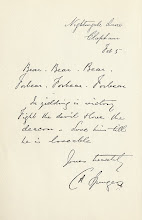
A selection from a letter by Sinclair Ferguson, to Susan Marshall, whose husband John had recently passed away. Mr. Ferguson and Mr. Marshall both served together for a number of years on the board of the Banner of Truth Trust. It was my pleasure to hear John Marshall preach on several occasions. He was a powerful preacher of the gospel. He was pastor of the Alexandra Road Congregational Church in Hemel Hempstead, England, for over 40 years. He died August 29, 2003. This letter was written shortly after his death.

Earlier in the year, as John preached at the closing session of the Leicester Ministers' Conference – with such grace and unction – I was overtaken by a sense that perhaps the explanation for the unusual occasion it was might be that it would be the last time many of his friends would ever hear him preach. I do wish you could have been there to have heard him, such was the blessing of his ministry. It now seems to me to have been a little intimation of the Lord's love for him, when John himself seemed to grow in grace, assurance, joy in proclaiming Christ, confidence in the gospel.

John was such a warrior – and now he has placed his sword in tribute at Christ's feet. Yet to me on a personal level he was full of kindness, friendship, encouragement, full of good fun, full of a seriousness of spirit that was a model to me. Thank you for sharing him with me.

John E. Marshall: Life and Writings, John J. Murray, The Banner of Truth Trust, 2005, pp. 80-81.

Friday, June 4, 2010

The Grand Object of Education


A letter by Ernest Reisinger, to the son of a distinguished seminary professor and friend, who was graduating from High School. Mr. Reisinger sent him a gift and a letter of encouragement and challenge. I am sure this young man's parents were thankful for the godly counsel and wisdom given to him by this distinguished correspondent. The letter was written June 1, 1990.

My dear friend _____,

Congratulations on completing your High School education. I pray that you will always remember the grand object of your education, that is, that it contributes to the glory of God who gave you your existence, talents and gifts. On Him, also, you are dependent for their preservation. It is most reasonable, therefore, that these powers, gifts and talents should be empowered to His service for ever. I am enclosing a little gift for your graduation present.

You will soon be leaving the influence of a Christian home and godly parents; therefore, you will face new temptations and dangers. May our Lord be pleased to help, guide and protect you.

_____, the most important counsel I could give you, or any young Christian man, is this, never to make an intimate friend of anyone who is not a friend of your God. I do not mean that you have nothing to do with anyone but true Christians, but be very careful in your choice of friends. Ask the question, Will this friendship benefit my spiritual life? Follow the example of David who said, "I am a companion of all them that fear thee, and of them that keep thy precepts" (Psa. 119:63).

May our Father in heaven keep you safe from all harm, give you diligence in your studies and fortitude, wisdom in all your decisions, integrity in your living and a Christ-like example to others.

Your old friend,
Ernest C. Reisinger
P.S. Try hard to find a good church to attend.

Ernest C. Reisinger: A Biography, by Geoffrey Thomas, The Banner of Truth Trust, 2002, pp. 152-53.

Tuesday, September 15, 2009

Reputation


A portion of a letter by John Calvin to his fellow reformer, Melanchthon. The letter reveals Calvin’s high regard and love for his friend, but he wrote to rebuke him for giving up ground that had been gained in the Reformation. Calvin addressed Melanchthon’s weakness in character in the desire to maintain a good reputation above adherence to the truth. The letter was written June 18, 1559.

Although I am fully persuaded that the fear of death never compelled you in the very least to swerve from the right path, yet I am apprehensive that it is just possible, that another species of fear may have proved too much for your courage. For I know how much you are horrified at the charge of rude severity. But we must remember, that reputation must not be accounted by the servants of Christ as of more value than life. We are no better than Paul was, who held fearlessly on his way through ‘evil and good report’ [2 Cor. 6:8]. It is indeed a hard and disagreeable thing to be reckoned turbulent and inflexible,—men who would rather see the whole world in ruin, than condescend to any measure of moderation. But your ears should have been deaf to such talk long ago. I have not so bad an opinion of you, nor will I do you the injustice, to suppose that you resemble the ambitious, and hang upon the popular breath. Yet I have no doubt but that you are occasionally weakened by those goadings…

You know why I am so vehement. I had rather die with you a hundred times, than see you survive the doctrines surrendered by you…

Adieu, most illustrious sir, and ever worthy of my hearty regard. May the Lord continue to guide you by his Spirit, and sustain you by his might; may his protection guard you. Amen.

John Calvin: Tracts and Letters, edited by Jules Bonnet and translated by David Constable, first published by the Presbyterian Board of Publication, 1858, republished by The Banner of Truth Trust, 2009, vol. 5, pp. 273-74.

Monday, March 16, 2009

Let Us Be Thankful, Trustful, and Hopeful

A selection from a letter by John A. Broadus to his dear friend and co-laborer in teaching, J. P. Boyce. The letter was written from Greenville, South Carolina, on January 24, 1876. It was his 49th birthday.

This is my birthday. We have entered, you and I, on our fiftieth year of life. Each of us could look back with sore lamenting and might be tempted to repining, but let us try to be thankful instead, to be trustful too, and hopeful. For one thing I give thanks at this moment, as often before, that God has given me such a bosom friend as you.

Life and Letters of John Albert Broadus, by Archibald Thomas Robertson, 1901, reprint by Gano Books, p. 299.