Showing posts with label church. Show all posts

Thursday, July 14, 2011

A Firmer Grip Than Ever

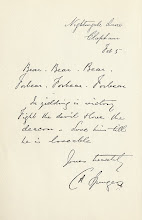
A portion of a letter from Charles Haddon Spurgeon, written to his congregation, four weeks prior to his death. His church was the Metropolitan Tabernacle, London, England. He was writing from Menton, France, where he had gone to recover from illness. But recovery was not meant to be. He had gone through the valley of the shadow of death just a short while before, but his health was now worse. He wanted his flock to know that the gospel he had preached for over 40 years was still his hope and joy, and should be theirs too. The letter was written January 6, 1892.

I feel my mind grasping with firmer grip than ever that everlasting gospel which for so many years I have preached to you. We have not been deceived. Jesus does give rest to those who come to him, he does save those who trust him, he does photograph his image on those who learn of him. I hate the Christianised infidelity of the modern school more than ever, as I see how it rends away from sinful man his last and only hope. Cling to the gospel of forgiveness through the substitutionary sacrifice, and spread it with all your might, each one of you, for it is the only cure for bleeding hearts.

The Suffering Letters of C. H. Spurgeon, annotations by Hannah Wyncoll, Wakeman Trust, 2007, pp. 118-19.

Thursday, June 16, 2011

Pedocommunion - The Bible Knows No Such Custom

A selection from a letter by Joseph Kinghorn, pastor of St. Mary's Baptist Church, Norwich, England, to his parents, with whom he had extensive correspondence. He asked his parents a series of penetrating questions about a pedobaptist's proposal to bring infants to the Lord's Table, that are relevant for the 21st Century. Some today, who baptize infants, also receive them for communion. Thankfully, the PCA recently took a strong stand against pedocommunion. Kinghorn speaks to this matter as it relates to the baptism of children. The letter was written April 2, 1792.

One of our Independents, Mr. Newton [not John Newton], has publicly proposed to his people to bring all their children to the Lord's Supper, as baptized persons, thinking they have as much right to one ordinance as to another. Now this is consistent.

But does it not make the absurdity of infant baptism appear greater? Can those have any right to church privileges, who cannot be supposed to make a credible profession of religion? Is not the tendency of this practice contrary to that inquiry and sober decision which ought to distinguish a man's actions, when he takes a part as a professor of Christianity? Is he who has always been in the church, he knows not why or when, likely to make, or has he the opportunity of making, his religious conduct so much his own, as if he had first believed, and then acted upon that belief? Is not this the strongest chain ever yet forged to connect the church and the world together, and to make the connection so intimate as to destroy the very essence of a Christian church? Is it not contrary to the tenor of the New Testament, where an attention to the Lord's Supper is described as not only the effect of professed faith, but also consequent on that examination which must necessarily be personal? And is not the best thing we can say of it, this—the Bible knows no such custom?

The Life and Works of Joseph Kinghorn, by Martin Hood Wilkin, reprinted by Particular Baptist Press, 1995, p. 208.

Monday, September 13, 2010

Have I Any Room for Hope?


A letter from T. W. Medhurst to C. H. Spurgeon. The young Medhurst had attended a few services at the New Park Street Church to hear the new pastor, who was quite young himself. Spurgeon preached from Hosea 6:3 on a particular Lord's Day evening. Medhurst came under conviction of sin. In trouble of soul, he wrote the pastor a letter, inquiring if there was any hope for him. It was written July 2, 1854 (I will post Spurgeon's reply in the next post).

Dear Sir,

Will you be kind enough candidly to inform me whether I have any room for hope that I belong to the elect family of God, whether Jesus Christ His Son has died for me, while my affections are in the world? I try to pray, but cannot. I make resolutions only to break them. I from time to time listen to you when you speak of the glory set apart for the saints, when you describe their joys and their feelings, but I feel myself as having nothing to do with them. O sir, that Sunday morning when you spoke of the hypocrite, I felt that you described me!

I go to chapel to hear the Word preached, I return home, and make resolutions; I go to work, then out into the world, and forget all until the time for preaching comes again. I read the Bible, but do not feel interested; it seems no more to me than a book I have before read,—dry and insipid. Christ has said that, of all who come to Him, He will not send any away. How am I to come? I feel that I cannot come. I would if I could, but I cannot. At times, I think that I will give it all up, that I will not go to chapel any more; yet when the time comes, I cannot stay away, but feel compelled to go again once more. Do, dear sir, tell me, how am I to find Jesus? How am I to know that He died for me, and that I belong to His family? Dear sir, tell me, am I a hypocrite?

I remain,
Dear sir,
Yours to serve in anxiety,
T. W. MEDHURST

C. H. Spurgeon's Autobiography, Compiled from his diary, letters, and records, by his wife and his private secretary, Volume 2, 1854-1860, p. 141f, from the electronic edition by Logos Research Systems, Inc., 2009.

Friday, June 4, 2010

The Grand Object of Education


A letter by Ernest Reisinger, to the son of a distinguished seminary professor and friend, who was graduating from High School. Mr. Reisinger sent him a gift and a letter of encouragement and challenge. I am sure this young man's parents were thankful for the godly counsel and wisdom given to him by this distinguished correspondent. The letter was written June 1, 1990.

My dear friend _____,

Congratulations on completing your High School education. I pray that you will always remember the grand object of your education, that is, that it contributes to the glory of God who gave you your existence, talents and gifts. On Him, also, you are dependent for their preservation. It is most reasonable, therefore, that these powers, gifts and talents should be empowered to His service for ever. I am enclosing a little gift for your graduation present.

You will soon be leaving the influence of a Christian home and godly parents; therefore, you will face new temptations and dangers. May our Lord be pleased to help, guide and protect you.

_____, the most important counsel I could give you, or any young Christian man, is this, never to make an intimate friend of anyone who is not a friend of your God. I do not mean that you have nothing to do with anyone but true Christians, but be very careful in your choice of friends. Ask the question, Will this friendship benefit my spiritual life? Follow the example of David who said, "I am a companion of all them that fear thee, and of them that keep thy precepts" (Psa. 119:63).

May our Father in heaven keep you safe from all harm, give you diligence in your studies and fortitude, wisdom in all your decisions, integrity in your living and a Christ-like example to others.

Your old friend,
Ernest C. Reisinger
P.S. Try hard to find a good church to attend.

Ernest C. Reisinger: A Biography, by Geoffrey Thomas, The Banner of Truth Trust, 2002, pp. 152-53.

Monday, January 18, 2010

Be a Consistent and Exemplary Christian


A selection from a letter by Rev. Daniel Baker to his former church in Washington, D. C. Baker pastored the Second Presbyterian Church for six years before being called to pastor a church in Savannah, Georgia. Soon after getting settled in Georgia, he wrote a letter to the congregation in Washington to tell them about his new sphere of ministry and to encourage them to go on for Christ. The letter was written May 13, 1828.

Dear brethren, let me beseech you once more, as I have often done before, to walk worthy of the Lord unto all pleasing; to live blamelessly and harmlessly as the children of God, without rebuke. O, it is a great matter to be a consistent and exemplary Christian! It pleases God, brings credit to religion, and peace and comfort to our own soul. The time is gone by for me, in any official capacity, to press these things upon you, for I am no longer you pastor; but, as an absent friend and Christian brother, I would call to remembrance the things which ye have heard.

Making Many Glad: The Life and Labours of Daniel Baker, prepared by his son, Rev. William M. Baker, first published in 1858, reprinted by the Banner of Truth Trust, 2000, pp. 118-19.

Monday, November 24, 2008

Building Up and Fortifying the Church

A selection from a letter by Rev. William Still to his congregation, Gilcomston South Church of Scotland, Aberdeen, November, 1960:

The Church’s first task, it seems to me, is to keep being herself in a changing world, and thus to build herself up and fortify herself against the growing onslaughts of evil, as prophesied in history and in each successive generation. This she can only do by being, not evangelically minded, devotionally or convention minded, socially minded, ecumenically minded, or politically minded; but by taking the whole Word of God as her diet, and feeding and building herself up on that. Thus she preserves her strength for every heroic task, including all these, and makes impact, often painful impact, upon all the life of her day.

The Letters of William Still, The Banner of Truth, 1984, pp. 75-76.