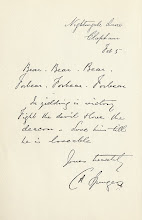
A portion of a letter by John Newton to his beloved wife, Mary. They were married for 40 years and loved each other dearly. He feared at times that he sinned in idolizing her. This letter was written when she was away from him for a short while. It conveys his deep love for her but acknowledges their need to love above all others, the Lord Jesus Christ, who loved them so very much. The letter was written July 12, 1764.
I am well, and as comfortably settled as I can desire, during your absence. I feel the want of your company, but hope to bear it without anxiety. I cannot wish to love you less; I hope it is impossible. But I wish for us both, that our regard may be sanctified, and kept in due subordination. While I rejoice, that we are so happily sensible of what we owe to each other, I have cause to mourn that our love to him should be so faint and disproportionate. His love to us passes knowledge. He loved us, when we were enemies, with a love, expensive and interesting, beyond expression; a love, that exposed him to ignominy and torture, that cost him his blood and his life; a love, that makes over to those who believe in him, all the riches of grace and glory.
The Works of John Newton, volume 5, first printed in 1820, reprinted by the Banner of Truth Trust, 1985, p. 543. Logos Bible Software has recently incorporated Newton's works in their vast electronic library.
Showing posts with label marriage. Show all posts
Tuesday, January 25, 2011
Wednesday, December 8, 2010
Live For God and All Will Be Well
A portion of a letter from Edmund Botsford, pastor of Georgetown Baptist Church, Georgetown, South Carolina, to a young pastor friend, John Roberts. Botsford exhorted John and his new wife to talk freely to one another on spiritual subjects and to form the habit of praying together. With a bit of humor he told Mrs. Roberts if John was too backwards to converse with her, to let him know and he would scold him soundly! The letter was written November 24, 1802.
I sincerely wish you and the dear young lady with which you are connected, the best of blessings. Do, my dear young friend, from the first, make free to talk with the wife of your bosom, and that frequently, on divine subjects. Get her to pray with you; often be on your knees together, and do tell her from me, from your real friend, I beg her, I entreat her, not only to join you in prayer, but pray herself with you. O my young friends, do be praying husband and wife. Do not let shame prevent. O Mrs. Roberts, I earnestly entreat you to pray in secret with your husband; do my dear child get into the habit of praying with your husband; and if you find him backward to converse with you on spiritual subjects, let me know, and I will scold him soundly. I tell you both, live for God, and all will be well.
Memoirs of Elder Edmund Botsford, compiled and edited by Charles D. Mallary, first printed in 1832, now printed by Particular Baptist Press, Springfield, Missouri, 2004, p. 119.
I sincerely wish you and the dear young lady with which you are connected, the best of blessings. Do, my dear young friend, from the first, make free to talk with the wife of your bosom, and that frequently, on divine subjects. Get her to pray with you; often be on your knees together, and do tell her from me, from your real friend, I beg her, I entreat her, not only to join you in prayer, but pray herself with you. O my young friends, do be praying husband and wife. Do not let shame prevent. O Mrs. Roberts, I earnestly entreat you to pray in secret with your husband; do my dear child get into the habit of praying with your husband; and if you find him backward to converse with you on spiritual subjects, let me know, and I will scold him soundly. I tell you both, live for God, and all will be well.
Memoirs of Elder Edmund Botsford, compiled and edited by Charles D. Mallary, first printed in 1832, now printed by Particular Baptist Press, Springfield, Missouri, 2004, p. 119.
Labels:
communication,
Edmund Botsford,
John Roberts,
marriage,
prayer
Wednesday, August 18, 2010
True Marriage Multiplies Joy
A selection from a letter by Rev. Benjamin Morgan Palmer to Anna, a young girl who had become like a daughter to him. She was engaged to be married and asked Rev. Palmer to perform the wedding ceremony. He agreed to leave New Orleans and make his way to New York for the wedding. But he gave her some marital counsel in his letter of acceptance and promised to give her more advice upon his arrival. The letter was written August 2, 1866.I am not sorry that you are to marry. With such a wealth of love as your broad, warm heart contains, it would be an injury and a wrong to you not to fill all the relations which call for love. I accept all you tell me of Mr. Carter—and from other sources I hear that he is all the word gentleman implies. Knit to the man who is worthy of you, and with a true love between you, life will be brighter and happier to the end. I say it deliberately and upon knowledge, that a true marriage multiplies the joys of a life a thousand fold—and that despite all the sacrifices and sorrows that may be incident thereto. Take the joy with a grateful heart, renewing the consecration of yourself to our loving Redeemer, and trust Him for grace to bear every bitterness which His holy will may hereafter allot for your discipline.
The Life and Letters of Benjamin Morgan Palmer, by Thomas Cary Johnson, first published in 1906, published by The Banner of Truth, 1987, pp. 374-75.
Labels:
Anna,
B. M. Palmer,
joy,
love,
marriage,
sacrifices,
sorrows
Wednesday, August 19, 2009
The Heart Wants a Companion

A portion of a letter from Joseph Kinghorn to his father about marriage. A quick P.S. was added to his father’s last letter, “This day thirty-two years ago we were married.” Joseph, pastor of a leading Baptist church in the county of Norfolk, England, was single. He once was engaged but things didn’t work out so he remained unmarried all his days. But he understood the bliss of married life and expressed it in his letter, which was written, probably in early May of 1797.
Terry Wolever, book editor for Particular Baptist Press, pointed out this letter to me in a phone conversation yesterday. Terry, who wrote the forward to the book that contains this letter, is scheduled to give a paper on Joseph Kinghorn at the Baptist Spirituality Conference, which is being held August 24-25 at the Andrew Fuller Center for Baptist Studies, Louisville, Kentucky (see http://www.andrewfullercenter.org/ for more information).
I was struck with your relation of the anniversary of thirty-two years marriage. May that day often find you both in health and happiness. There is a solitariness in single life; the heart wants a companion, a friend to whom all can be told is not to be met with in our common intercourse. I dare say if I had a wife I loved, and who loved me, I should tell what now lies buried till it is forgotten.
Terry Wolever, book editor for Particular Baptist Press, pointed out this letter to me in a phone conversation yesterday. Terry, who wrote the forward to the book that contains this letter, is scheduled to give a paper on Joseph Kinghorn at the Baptist Spirituality Conference, which is being held August 24-25 at the Andrew Fuller Center for Baptist Studies, Louisville, Kentucky (see http://www.andrewfullercenter.org/ for more information).
I was struck with your relation of the anniversary of thirty-two years marriage. May that day often find you both in health and happiness. There is a solitariness in single life; the heart wants a companion, a friend to whom all can be told is not to be met with in our common intercourse. I dare say if I had a wife I loved, and who loved me, I should tell what now lies buried till it is forgotten.
What are generally called friends are very valuable. I own it, and I have many I esteem, yet there is an intercourse of sentiment of a higher kind, and which it seems impossible to enjoy but where the interest and happiness of two are completely made one. You will be this time suspect that I am at least half in love, perhaps courting, etc. No; but I could not help saying what I have, from the circumstance you mention.
The Life and Works of Joseph Kinghorn, by Martin Hood Wilkin, reprinted by Particular Baptist Press, 1995, p. 270.
Wednesday, May 6, 2009
Jeems Is Willin'

A letter written to Jefferson Davis, the president of the Confederacy during the War Between the States (1861-1865), by a girl who wanted him to give her fiancé permission for a leave of absence from the army so they could get married.
Dear Mr. President:
I want you to let Jeems C., of company oneth, 5th South Carolina Regiment, come home and get married. Jeems is willin’, I is willin’, his mammy says she is willin’, but Jeems’s capt’in, he ain’t willin’. Now when we are all willin’ ‘ceptin Jeems’ captain, I think you might let up and let Jeems come. I’ll make him go straight back when he’s done got married and fight just as hard as ever.
Your affectionate friend, etc.
The Road to Appomattox, by Bell Irvin Wiley, published by Atheneum, 1968, p. 8. Mr. Wiley says that the president wrote on the letter, “Let Jeems go.” Mrs. Davis latter said, “Jeems went home, married the affectionate correspondent of Mr. Davis, returned to his regiment, and did fight as well as ever.” Wiley is also the author of two other excellent books, Johnny Reb and Billy Yank, both of which contain numerous letters from soldiers.
Dear Mr. President:
I want you to let Jeems C., of company oneth, 5th South Carolina Regiment, come home and get married. Jeems is willin’, I is willin’, his mammy says she is willin’, but Jeems’s capt’in, he ain’t willin’. Now when we are all willin’ ‘ceptin Jeems’ captain, I think you might let up and let Jeems come. I’ll make him go straight back when he’s done got married and fight just as hard as ever.
Your affectionate friend, etc.
The Road to Appomattox, by Bell Irvin Wiley, published by Atheneum, 1968, p. 8. Mr. Wiley says that the president wrote on the letter, “Let Jeems go.” Mrs. Davis latter said, “Jeems went home, married the affectionate correspondent of Mr. Davis, returned to his regiment, and did fight as well as ever.” Wiley is also the author of two other excellent books, Johnny Reb and Billy Yank, both of which contain numerous letters from soldiers.
Wednesday, April 1, 2009
My Creed as to Matrimony
A selection from a letter by B. M. Palmer to R. H. Reid, a young man in the ministry whom he had taught and was a mentor. Reid had asked Rev. Palmer for advice regarding marriage. He hesitated to offer advice on this subject but after consulting with Mrs. Palmer, did so anyway, even recommending a young lady in his congregation for consideration! The letter was written from Columbia, South Carolina, May 1, 1850.
… I have but two suggestions on the general subject; for really my creed as to matrimony is exceedingly simple. The first is, commit this selection of a wife to Providence, and wait until you are caught… My second suggestion is, do not surrender yourself blindly to the impulses of the taste and heart, but weigh in the balance of a sound judgment the qualities of any who may have caught you by the horns… A good wife is from the Lord; therefore deliver yourself in this to the guiding of his Providence. The great secret of a happy choice may be given in a single sentence: it consists in uniting the taste and the judgment equally in the selection. Let the former be the active power, going forward in the choice; and let the latter be the satisfying power, indorsing or else vetoing, as the case may be. If both are satisfied, there is not much danger of forming a connexion that will be regretted hereafter.
The Life and Letters of Benjamin Morgan Palmer, by Thomas Cary Johnson, first published in 1906, reprinted by The Banner of Truth Trust, 1987, pp. 145-46.
… I have but two suggestions on the general subject; for really my creed as to matrimony is exceedingly simple. The first is, commit this selection of a wife to Providence, and wait until you are caught… My second suggestion is, do not surrender yourself blindly to the impulses of the taste and heart, but weigh in the balance of a sound judgment the qualities of any who may have caught you by the horns… A good wife is from the Lord; therefore deliver yourself in this to the guiding of his Providence. The great secret of a happy choice may be given in a single sentence: it consists in uniting the taste and the judgment equally in the selection. Let the former be the active power, going forward in the choice; and let the latter be the satisfying power, indorsing or else vetoing, as the case may be. If both are satisfied, there is not much danger of forming a connexion that will be regretted hereafter.
The Life and Letters of Benjamin Morgan Palmer, by Thomas Cary Johnson, first published in 1906, reprinted by The Banner of Truth Trust, 1987, pp. 145-46.
Friday, January 23, 2009
The Loss of My Beloved Pearce!
A selection from a letter by Sarah Pearce, wife of Samuel Pearce, pastor of the Cannon Street Baptist Church in Birmingham, England. She was writing to her friend, Francis Franklin, about the recent death of her 18 month-old son, Samuel. She also mentioned how terribly she missed her husband who had died a year earlier at the age of 33. The letter was written July 11, 1800.
Oh could I feel but half the resignation respecting the loss of my beloved Pearce! But I cannot. Still bleeds the deep, deep wound; and a return to Birmingham is a return to the most poignant feelings. I wish however to resign him to the hand that gave and that had an unquestionable right to take away. Be still then every tumultuous passion, and know that he who hath inflicted these repeated strokes is God; that God whom I desire to reverence under every painful dispensation, being persuaded that what I know not now, I shall know hereafter.
The Christian Lover: The Sweetness of Love and Marriage in the Letters of Believers, by Michael Haykin, with Victoria J. Haykin, Reformation Trust Publishing, 2009, p. 68.
Oh could I feel but half the resignation respecting the loss of my beloved Pearce! But I cannot. Still bleeds the deep, deep wound; and a return to Birmingham is a return to the most poignant feelings. I wish however to resign him to the hand that gave and that had an unquestionable right to take away. Be still then every tumultuous passion, and know that he who hath inflicted these repeated strokes is God; that God whom I desire to reverence under every painful dispensation, being persuaded that what I know not now, I shall know hereafter.
The Christian Lover: The Sweetness of Love and Marriage in the Letters of Believers, by Michael Haykin, with Victoria J. Haykin, Reformation Trust Publishing, 2009, p. 68.
Monday, December 22, 2008
Real Religion
A portion of a letter by William Jay to his fiancée, Miss Anne Davies. They were married on January 6, 1791, Mr. Roland Hills performing the service. The date is not given for this letter but it was written not long before the wedding. Mr. Jay expressed the kind of marriage he hoped for.
Yes, my love, let us determine to live as strangers and pilgrims here, and plainly declare by our profession and conduct that we seek a better country, that is a heavenly. Not when we shall be incapable of pursuing this world, and when our gust for earthly pleasure shall be abated by old age; but now while our affections are so warm, and when so many are carried away by the vanity of the world and the pride of life, let us unreservedly dedicate ourselves to God, and present ourselves as a living sacrifice, holy and acceptable to God, which is our reasonable service. Nothing but real religion can make us holy and happy in any situation or relation. In proportion as it prevails we shall find heaven begun below.
The Autobiography of William Jay, first published in 1854 and reprinted by The Banner of Truth Trust, 1974, p. 483.
Yes, my love, let us determine to live as strangers and pilgrims here, and plainly declare by our profession and conduct that we seek a better country, that is a heavenly. Not when we shall be incapable of pursuing this world, and when our gust for earthly pleasure shall be abated by old age; but now while our affections are so warm, and when so many are carried away by the vanity of the world and the pride of life, let us unreservedly dedicate ourselves to God, and present ourselves as a living sacrifice, holy and acceptable to God, which is our reasonable service. Nothing but real religion can make us holy and happy in any situation or relation. In proportion as it prevails we shall find heaven begun below.
The Autobiography of William Jay, first published in 1854 and reprinted by The Banner of Truth Trust, 1974, p. 483.
Labels:
John Newton and William Jay,
marriage,
real religion
Subscribe to:
Posts (Atom)