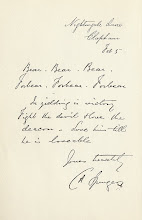
A selection from a letter by the one-eyed Baptist preacher of Wales, Christmas Evans, to a young preacher with advice on how to have a successful ministry. The letter was probably written towards the end of his life, which occurred in 1838.
Remember this, that you cannot commit some loved sin in private, and perform the work of the ministry in public, with facility and acceptance. For a preacher to fall into sin, be it a secret one, and to live in it, is as fatal, ultimately, as the cutting of Samson’s hair. Be strong in the grace that is in Christ Jesus against all corruption.
Christmas Evans: The Life and Times of the One-Eyed Preacher of Wales, by Tim Shenton, Evangelical Press, 2001, p. 445.
Wednesday, December 17, 2008


Monday, December 15, 2008
The Need for Real Unction
A selection from a letter by Thomas Chalmers to his friend, Charles Bridges, author and pastor in Suffolk, England. Chalmers was professor of divinity at the University of Edinburgh. He wanted for himself and for his students more than orthodoxy; he desired that they be energized by the Spirit for their Gospel labors. The letter was written January 2, 1834.
I deeply feel my need of effort and prayer, that my whole course may be more and more spiritualized, assured as I am of the possibility of delivering all the lessons of theology in the strictest form of sound words, and with the fullest adherence to the letter of the truth as it is in Jesus, while the real unction and vitality of the Gospel spirit may be altogether wanting.
Letters of Thomas Chalmers, edited by William Hanna, first published 1853, reprinted by The Banner of Truth, 2007, p. 324.
Friday, December 12, 2008
Where Are You Going, My Dear Child?
A letter by Rev. Daniel Baker to his daughter. He was away from home preaching meetings in North Carolina. When away from home he usually wrote his children, and when he did, he often exhorted them to think of eternity and the need for professing faith in Christ. This letter was written in 1834.
My daughter, remember your father and mother are going to heaven; where are you going, my dear child? Are you willing to be separated from your parents in that eternity which is hastening on? Take care of your soul for if you lose that, what have you got beside?
Making Many Glad: The Life and Labours of Daniel Baker, by William M. Baker, first published in 1858, reprinted by the Banner of Truth, 2000, p. 194.
Wednesday, December 10, 2008
She Is Gone To Heaven
A selection from a letter by John A. Broadus to his wife, Maria, after the death of his beloved sister, Carry Whitescarver. He was grieved over her passing but thankful that she had lived an exemplary life and had gone to be with the Lord. The letter was written September 1, 1852.
May her holy life, and this her hopeful, happy death be the life and death of her so unworthy, yet so richly-blessed, ‘baby’ brother! Oh, that sister was dear to me, dearer than any knew, dearer than I knew myself, yet she is gone! But then, she is gone to heaven; and I can hope, humbly and trustingly, that by the grace of God I shall see my sister Carry again, and part from her no more. My dear Maria, be a Christian, with all your heart, now.
Life and Letters of John Albert Broadus, by Archibald Thomas Robertson, 1901, reprint by Gano Books, p. 100.
Monday, December 8, 2008
A Successful Year
A selection from a letter written by William Carey to his good friend and supporter, John Sutcliffe. While Carey mined for jewels in India Sutcliffe helped hold the ropes in England. Carey was known as a “plodder.” This letter shows how he could faithfully plod along in spite of the difficulties and discouragements of the work. The letter was written on January 1, 1806.
I think this past year has been on several accounts the most successful one of the Mission, since its commencement. We have disagreeable things in sufficient number to keep us from security, and to humble us, nor is the success of the Gospel, at all, proportioned to the vast multitude of souls in this country. Yet we have increased and been blessed. Twenty seven natives and three Europeans have been this year added to us by baptism. We have less irregularity, and fewer defections to mourn than in any preceding year, though some instances of both have occurred. We have some growing, useful gifts among our native brethren, and I am mistaken if there be not an increase of true piety among them.
The Journal and Selected Letters of William Carey, collected and edited by Terry G. Carter, Smyth & Helwys, 2000, p. 158.
Friday, December 5, 2008
Lay Hold On Jesus Christ
A selection from a letter by Robert Murray M’Cheyne to someone whom he did not know. He knew her cousin, who asked him to write her a letter encouraging her to believe in Christ. Andrew Bonar, who included several of M’Cheyne’s letters in his Memoir and Remains of M’Cheyne, wrote this heading: “To a Stranger. Intended to lead on one whose face was Zionward, but who was not fully decided.” What evangelistic zeal M’Cheyne possessed! This wasn’t a form letter; it was a person letter to someone he didn’t know yet desired to see them converted. The letter was written in July of 1840.
My dear friend, I do not even know your name; but your cousin has been telling me about your case, and wishes me to write you a line inviting you to lay hold on Jesus Christ, the only refuge for a perishing soul. You seem to have been thinking seriously of your soul for some time. Do remember the words of Peter (2 Pet. 1:10): ‘Give diligence to make your calling and election sure.’ Never rest till you can say what John says (1 John 5:19): ‘We know that we are of God.’ The world always loves to believe that it is impossible to know that we are converted. If you ask them, they will say, ‘I am not sure—I cannot tell;’ but the whole Bible declares we may receive, and know we have received, the forgiveness of sins (see Ps. 32:1; 1 John 2:12). Seek this blessedness—the joy of having forgiveness; it is sweeter than honey and the honeycomb. But where shall I seek it? In Jesus Christ. ‘God hath given to us eternal life, and this life is in His Son. He that hath the Son hath life; and he that hath not the Son hath not life’ (1 John 5:11-12)…
Robert Murray M’Cheyne: Memoir and Remains, Andrew A. Bonar, first published in 1884, reprinted by the Banner of Truth, 1966, pp. 283-84.
Monday, December 1, 2008
I Cannot Sell My Conscience
A selection from a letter by C. H. Spurgeon to the co-pastor and deacons of his church, the Metropolitan Tabernacle, London, England. He had withdrawn membership in the Baptist Union because liberalism was tolerated and had been censured for it. He was in Mentone, France for some rest and recuperation when he wrote this letter on November 27, 1887.
The more you know of this controversy [The Downgrade Controversy], the more will your judgements go with me as well as your hearts. It is not possible for me to communicate to any one all that has passed under my knowledge; but I have had abundant reason for every step I have taken, as the day of days will reveal. All over the various churches there is the same evil, in all denominations in measure; and from all sorts of believers comes the same thankful expression of delight that the schemes of errorists have been defeated by pouring light upon them. I cannot at this present tell you what spite has been used against me, or you would wonder indeed; but the love of God first, and your love next, are my comfort and stay. We may, perhaps, be made to feel some of the brunt of the battle in our various funds; but the Lord liveth. Our great Dr. Gill said, ‘Sir, I can be poor, but I cannot sell my conscience,’ and he has left his mantle as well as his chair in our vestry.
The Suffering Letters of C. H. Spurgeon, annotations by Hannah Wyncoll, The Wakeman Trust, 2007, p. 64.
Subscribe to:
Posts (Atom)