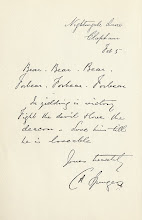
A selection from a letter by the Scottish Presbyterian professor, Thomas Chalmers, to John Ryland, Baptist pastor in Northampton, England. Chalmers was writing to express thanks to Ryland for sending him a copy of the book he had written on the life of Andrew Fuller and for a copy of a pamphlet he had written on Antinomianism. Many Calvinists were attracted to Antinomianism and Ryland's refutation of this dangerous, insipient error was greatly appreciated by Chalmers. The letter was written from Glasgow, February 18, 1818.
I can assure you that I read the latter ["Antinomianism"] with much interest and pleasure. It revived all my recollections of the excellent Jonathan Edwards, to whose principles on the subject of Freewill I have long been a decided convert. You have given a very clear and judicious exposition indeed, of the perfect consistency which obtains between the absolute sovereignty of God on the one hand, and the fitness of bringing forward the urgency of Gospel calls and Gospel invitations on the other. I trust that your performance will do much good. It reminds me of your conversation when I had the pleasure of meeting you at Bristol, and which I shall not soon forget. I feel greatly indebted to you for the question you proposed to put to him who said, "I have come unto Christ,"—"What have you gotten from Him?"
Letters of Thomas Chalmers, edited by William Hanna, first published 1853, reprinted by The Banner of Truth, 2007, p. 320.
Showing posts with label Thomas Chalmers. Show all posts
Thursday, December 23, 2010
Thursday, November 4, 2010
Sustaining Hope
A selection from a letter by Thomas Chalmers to a close friend, Jane Morton. Having already written a letter of sympathy to her upon the death of her daughter, he writes again to help steady her soul with the comfort of the Lord, but he cautions her not to sorrow as those who have no hope. The letter was written October 19, 1845.
I observe from your letter of the 1st, that you still dwell on the thoughts of your dear Catherine, and I would not forbid this; mellowed and mixed up as these thoughts are with the sustaining hope that you will meet her again. The Gospel does not lay an interdict upon your sorrow, though it would dissuade you against being swallowed up of too much grief. But you have fled to the best refuge; and He who is touched with the fellow-feeling of our infirmities, knows how to adapt His succor to the necessities of all who trust in Him.
Letters of Thomas Chalmers, edited by William Hanna, first published 1853, reprinted by The Banner of Truth, 2007, pp. 248-49.
I observe from your letter of the 1st, that you still dwell on the thoughts of your dear Catherine, and I would not forbid this; mellowed and mixed up as these thoughts are with the sustaining hope that you will meet her again. The Gospel does not lay an interdict upon your sorrow, though it would dissuade you against being swallowed up of too much grief. But you have fled to the best refuge; and He who is touched with the fellow-feeling of our infirmities, knows how to adapt His succor to the necessities of all who trust in Him.
Letters of Thomas Chalmers, edited by William Hanna, first published 1853, reprinted by The Banner of Truth, 2007, pp. 248-49.
Labels:
death,
hope,
Jane Morton,
sorrow,
succor,
Thomas Chalmers
Tuesday, July 20, 2010
A Very Bright Constellation
A selection from a letter by Thomas Chalmers, Scottish Presbyterian preacher and professor, to J. E. Ryland of Northampton, England. Ryland's grandfather and father were luminaries in the Baptist constellation of great preachers in the later part of the 18th Century and the first part of the 19th Century. Dr. Chalmers shows his appreciation for the Baptist of that era. Ryland had written to Chalmers about the death of the well-known English essayist of Baptist persuasion, John Foster. Chalmer's letter was written from Edinburgh, November 17, 1842.
I ever had the greatest veneration both for him [John Foster] and Mr. [Robert] Hall, who along with Dr. [John] Ryland [Jr.], Andrew Fuller, Drs. [William] Carey, [Joshua] Marshman, and [William] Ward, made up altogether a very bright constellation, and which serves to signalize the Baptists of England more than any other denomination which I at present recollect.
Letters of Thomas Chalmers, edited by William Hanna, first published 1853, reprinted by The Banner of Truth, 2007, p. 322.
Labels:
Andrew Fuller,
Baptist luminaries,
Foster,
Hall,
John Ryland,
Marshman,
Thomas Chalmers,
Ward,
William Carey
Tuesday, February 23, 2010
The Disinterested Love of God

A selection from a letter by Thomas Chalmers, the Scottish preacher and professor, to the Rev. J. W. Cunningham of Harrow, London. He asked his friend if he had any acquaintance with a doctrine taught by some well-known American divines that he called “the doctrine of the disinterested love of God.” Chalmers feared it would hinder the liberty of men to preach the gospel freely and that it would introduce a requirement for sinners to meet in order to be accepted by God. The letter was written January 8, 1818.
Have you ever attended to the doctrine of the disinterested love of God? I fear that Edwards, Witherspoon, and the American divines have a little darkened the freeness of the Gospel offer by their speculations on the subject. They seem to put all the discredit of selfishness on the love of gratitude, and would suspend the act of acceptance by faith, till somehow or other it could be made contemporaneous with the dawn of love to God on account of His own excellencies. This I do think is a forbidding of those whom God has not forbidden, and I cannot but preach the Gospel without reserve to all men in every state of moral disease.
Letters of Thomas Chalmers, edited by William Hanna, first published 1853, reprinted by The Banner of Truth, 2007, p. 281.
Have you ever attended to the doctrine of the disinterested love of God? I fear that Edwards, Witherspoon, and the American divines have a little darkened the freeness of the Gospel offer by their speculations on the subject. They seem to put all the discredit of selfishness on the love of gratitude, and would suspend the act of acceptance by faith, till somehow or other it could be made contemporaneous with the dawn of love to God on account of His own excellencies. This I do think is a forbidding of those whom God has not forbidden, and I cannot but preach the Gospel without reserve to all men in every state of moral disease.
Letters of Thomas Chalmers, edited by William Hanna, first published 1853, reprinted by The Banner of Truth, 2007, p. 281.
Saturday, September 26, 2009
A Country Beyond the Grave

A selection from a letter by Thomas Chalmers to a close friend, Jane Morton. Mrs. Morton’s daughter, Catherine, had recently died and Chalmers wrote to extend his sympathy and offer a word of comfort. He contemplated the day of his own death and charged Jane to join him in proper preparation for meeting the Lord. The letter was written May 4, 1845.
I am now more than half way from sixty to seventy; and certain it is, that though free of any specific complaint, there has been a general decay of strength during the last year, which tells me that I should forthwith set my house in order, and be in readiness for the coming of the Lord.
But this readiness is a duty which lies upon all of every age and condition; and may the death over which we have been called to mourn bring the lesson forcibly home to us. May the event be sanctified and blessed to all your family. Though in itself not joyous but grievous, may it yield to you and yours the peaceable fruits of righteousness. Let us stand, my dear Jane, more disengaged than ever from a world that will soon pass away; and with the feeling that we are strangers and pilgrims here, let our doings plainly declare that we seek a country beyond the grave—that we are looking forward to a city which hath foundations, whose builder and maker is God.
Letters of Thomas Chalmers, edited by William Hanna, first published 1853, reprinted by The Banner of Truth, 2007, p. 248.
I am now more than half way from sixty to seventy; and certain it is, that though free of any specific complaint, there has been a general decay of strength during the last year, which tells me that I should forthwith set my house in order, and be in readiness for the coming of the Lord.
But this readiness is a duty which lies upon all of every age and condition; and may the death over which we have been called to mourn bring the lesson forcibly home to us. May the event be sanctified and blessed to all your family. Though in itself not joyous but grievous, may it yield to you and yours the peaceable fruits of righteousness. Let us stand, my dear Jane, more disengaged than ever from a world that will soon pass away; and with the feeling that we are strangers and pilgrims here, let our doings plainly declare that we seek a country beyond the grave—that we are looking forward to a city which hath foundations, whose builder and maker is God.
Letters of Thomas Chalmers, edited by William Hanna, first published 1853, reprinted by The Banner of Truth, 2007, p. 248.
Labels:
comfort,
death,
heaven,
Jane Morton,
readiness,
Thomas Chalmers
Tuesday, June 16, 2009
The Time is Short

A selection from a letter by Thomas Chalmers to an unconverted friend, a professor of mathematics, whom he often exhorted to become a Christian. He once told him, “I have long had the utmost regard for you. There is not a human being whom, without the circle of my relationship, I like nearly so well.” This part of the letter was written September 13, 1846, just after he had returned from conducting religious services for the elderly at a hospital.
I have returned from my household sermon to the old people. The text was, “The time is short;” but, in addition to this argument, I endeavoured to press home the growing callousness of the heart to the invitations of the Gospel; yet, nevertheless, the perfect freeness of that Gospel, the benefits and immunities of which are theirs if they will; and on their acceptance of these, they will receive a new heart here, and the joys of an unfading inheritance hereafter.
It is my earnest prayer that God may thus dispose and enable you to receive that truth which is to be found in His Word, and which, if gifted by the Spirit to understand it, you will find to be the power and wisdom of God unto salvation.
Letters of Thomas Chalmers, edited by William Hanna, first published 1853, reprinted by The Banner of Truth, 2007, p. 365.
I have returned from my household sermon to the old people. The text was, “The time is short;” but, in addition to this argument, I endeavoured to press home the growing callousness of the heart to the invitations of the Gospel; yet, nevertheless, the perfect freeness of that Gospel, the benefits and immunities of which are theirs if they will; and on their acceptance of these, they will receive a new heart here, and the joys of an unfading inheritance hereafter.
It is my earnest prayer that God may thus dispose and enable you to receive that truth which is to be found in His Word, and which, if gifted by the Spirit to understand it, you will find to be the power and wisdom of God unto salvation.
Letters of Thomas Chalmers, edited by William Hanna, first published 1853, reprinted by The Banner of Truth, 2007, p. 365.
Saturday, March 14, 2009
What To Believe
A selection from a letter by Thomas Chalmers to a lady that a friend asked him to write regarding the state of her soul. The letter was written February, 1826. Mr. Chalmers sought to answer objections about the gospel that this woman had raised.
But, generally, you complain that you are ignorant of how to go—how to believe. Now, this has long been a stumbling-block to many; their thoughts are how they are to believe, when their thoughts should be what they should believe. They look inwardly for the object of faith. “For every one thought,” says Richard Baxter, “that he casts downwardly upon himself, he should cast ten upwardly and outwardly upon Jesus, and upon the glorious truths of the Gospel.” You say that you have no doubts of the freeness of Christ’s salvation, and of His willingness to save you. Dwell upon this; persist in this; stand in the Gospel attitude of looking upon Jesus, and light will at length arise without you.
Letters of Thomas Chalmers, edited by William Hanna, first published 1853, reprinted by The Banner of Truth, 2007, pp. 301-02.
But, generally, you complain that you are ignorant of how to go—how to believe. Now, this has long been a stumbling-block to many; their thoughts are how they are to believe, when their thoughts should be what they should believe. They look inwardly for the object of faith. “For every one thought,” says Richard Baxter, “that he casts downwardly upon himself, he should cast ten upwardly and outwardly upon Jesus, and upon the glorious truths of the Gospel.” You say that you have no doubts of the freeness of Christ’s salvation, and of His willingness to save you. Dwell upon this; persist in this; stand in the Gospel attitude of looking upon Jesus, and light will at length arise without you.
Letters of Thomas Chalmers, edited by William Hanna, first published 1853, reprinted by The Banner of Truth, 2007, pp. 301-02.
Labels:
defense of the faith,
evangelism,
Thomas Chalmers
Monday, December 15, 2008
The Need for Real Unction
A selection from a letter by Thomas Chalmers to his friend, Charles Bridges, author and pastor in Suffolk, England. Chalmers was professor of divinity at the University of Edinburgh. He wanted for himself and for his students more than orthodoxy; he desired that they be energized by the Spirit for their Gospel labors. The letter was written January 2, 1834.
I deeply feel my need of effort and prayer, that my whole course may be more and more spiritualized, assured as I am of the possibility of delivering all the lessons of theology in the strictest form of sound words, and with the fullest adherence to the letter of the truth as it is in Jesus, while the real unction and vitality of the Gospel spirit may be altogether wanting.
Letters of Thomas Chalmers, edited by William Hanna, first published 1853, reprinted by The Banner of Truth, 2007, p. 324.
I deeply feel my need of effort and prayer, that my whole course may be more and more spiritualized, assured as I am of the possibility of delivering all the lessons of theology in the strictest form of sound words, and with the fullest adherence to the letter of the truth as it is in Jesus, while the real unction and vitality of the Gospel spirit may be altogether wanting.
Letters of Thomas Chalmers, edited by William Hanna, first published 1853, reprinted by The Banner of Truth, 2007, p. 324.
Friday, November 7, 2008
The Valuable Experiences of Brainerd and Elliot
A selection from a letter by Thomas Chalmers to “a young Clergyman,” giving him advice for the work of the ministry. Chalmers advised the young minister to model his ministry after the lives of two great missionaries to the American Indians – David Brainerd and John Elliot. The letter was written November 12, 1838.
It is a most valuable experience of Brainerd—that the regular distribution of time is essential to one’s religious prosperity; and of Elliot—that through faith in Christ Jesus, it is in the power of prayer and of pains to do everything.
Letters of Thomas Chalmers, edited by William Hanna, first published 1853, reprinted by The Banner of Truth, 2007, pp. 311-12.
It is a most valuable experience of Brainerd—that the regular distribution of time is essential to one’s religious prosperity; and of Elliot—that through faith in Christ Jesus, it is in the power of prayer and of pains to do everything.
Letters of Thomas Chalmers, edited by William Hanna, first published 1853, reprinted by The Banner of Truth, 2007, pp. 311-12.
Monday, August 18, 2008
Speaking About Religion or Possessing Religion?
A selection from a letter by Thomas Chalmers to is friend, William Wilberforce, member of the English Parliament. The letter was written June 25, 1822:
We had a visit from Mr. Gray of Sunderland lately, one of the good men of the Church of England. It is truly refreshing to have a visit from such; it always puts me in mind of a saying of Brainerd’s, that he has heard hundreds speak about religion, but not above one or two speak religion. We Scotch speak about it—look at the matter intellectually—come forth with our didactic and metaphysical speculations about the thing; but the evangelical English, as far as I can observe, possess the thing; and possessing it, they have by far the most effective ingredient of good preaching, which is the personal piety of the preacher himself.
Letters of Thomas Chalmers, edited by William Hanna, first published 1853, reprinted by The Banner of Truth, 2007, pp 98-99.
We had a visit from Mr. Gray of Sunderland lately, one of the good men of the Church of England. It is truly refreshing to have a visit from such; it always puts me in mind of a saying of Brainerd’s, that he has heard hundreds speak about religion, but not above one or two speak religion. We Scotch speak about it—look at the matter intellectually—come forth with our didactic and metaphysical speculations about the thing; but the evangelical English, as far as I can observe, possess the thing; and possessing it, they have by far the most effective ingredient of good preaching, which is the personal piety of the preacher himself.
Letters of Thomas Chalmers, edited by William Hanna, first published 1853, reprinted by The Banner of Truth, 2007, pp 98-99.
Friday, July 18, 2008
All Are Warranted to Approach
An evangelistic letter from Thomas Chalmers to a friend whom he longed to see converted, written November 13, 1825:
My Very Dear Sir,
I have no peculiar mode of addressing the Gospel to any one class of human creatures. It is a wide and general proclamation of mercy to all, and whatever the age or condition of the sinner, still he is welcome to Christ; and coming unto Him he shall in no wise be cast out. All are warranted to approach, even with boldness, to that throne of grace where they shall receive both mercy to pardon and grace to help in every time of need.
It is a wonders plea that the Psalmist urges for pardon, “Pardon mine iniquity, for it is great.” That greatness of transgression, which would preclude the hope of forgiveness from an earthly superior whom we had offended, is the very argument which we are encouraged to make use of in praying for pardon from Him, whose thoughts are not as our thoughts, and whose ways are not as our ways. May you, my dear Sir, and all with whom you are connected, have great peace and joy in thus believing; and sure I am, that when Gospel peace enters, Gospel holiness will follow in its train. Have you read Romaine’s “Treatises on Faith?”—they are very precious.—Believe me, my dear Sir, yours truly,
Thomas Chalmers
Letters of Thomas Chalmers, edited by William Hanna, first published 1853, reprinted by The Banner of Truth, 2007, p. 298.
My Very Dear Sir,
I have no peculiar mode of addressing the Gospel to any one class of human creatures. It is a wide and general proclamation of mercy to all, and whatever the age or condition of the sinner, still he is welcome to Christ; and coming unto Him he shall in no wise be cast out. All are warranted to approach, even with boldness, to that throne of grace where they shall receive both mercy to pardon and grace to help in every time of need.
It is a wonders plea that the Psalmist urges for pardon, “Pardon mine iniquity, for it is great.” That greatness of transgression, which would preclude the hope of forgiveness from an earthly superior whom we had offended, is the very argument which we are encouraged to make use of in praying for pardon from Him, whose thoughts are not as our thoughts, and whose ways are not as our ways. May you, my dear Sir, and all with whom you are connected, have great peace and joy in thus believing; and sure I am, that when Gospel peace enters, Gospel holiness will follow in its train. Have you read Romaine’s “Treatises on Faith?”—they are very precious.—Believe me, my dear Sir, yours truly,
Thomas Chalmers
Letters of Thomas Chalmers, edited by William Hanna, first published 1853, reprinted by The Banner of Truth, 2007, p. 298.
Friday, March 28, 2008
The Terms and the Treaty of Reconciliation
From the pen of Thomas Chalmers, to his friend, Mr. Duncan, a professor of Mathematics, whom he exhorted to become a Christian, written on Sept. 13, 1846:
There is a precise, definite, and let me add, only and exclusive way laid down for the attainment of [eternal life] – a way authoritatively pointed out and prescribed by Heaven. He who hath the Son hath life; he who hath not the Son hath not life. Christ says of Himself, “I am the way, the truth, and the life – by me, if any man enter in, he shall be saved,” and, “No man cometh unto the Father but by the Son.” Let us not quarrel with this way, more especially as it is open to all of us: “Whosoever cometh unto me shall not be cast out,” “Believe in the Lord Jesus Christ and you shall be saved.” It is for God, the offended party, and not for us, the offenders, to dictate the terms and the treaty of reconciliation. Heaven grant that you may be led henceforth to bestow an earnest heed on the Word of His testimony till the day dawn and the day-star arise in your heart.
Letters of Thomas Chalmers, edited by William Hanna, first published 1853, reprinted by The Banner of Truth, 2007, p. 364.
There is a precise, definite, and let me add, only and exclusive way laid down for the attainment of [eternal life] – a way authoritatively pointed out and prescribed by Heaven. He who hath the Son hath life; he who hath not the Son hath not life. Christ says of Himself, “I am the way, the truth, and the life – by me, if any man enter in, he shall be saved,” and, “No man cometh unto the Father but by the Son.” Let us not quarrel with this way, more especially as it is open to all of us: “Whosoever cometh unto me shall not be cast out,” “Believe in the Lord Jesus Christ and you shall be saved.” It is for God, the offended party, and not for us, the offenders, to dictate the terms and the treaty of reconciliation. Heaven grant that you may be led henceforth to bestow an earnest heed on the Word of His testimony till the day dawn and the day-star arise in your heart.
Letters of Thomas Chalmers, edited by William Hanna, first published 1853, reprinted by The Banner of Truth, 2007, p. 364.
Monday, January 14, 2008
Fears and Corruptions
A selection from a letter by Thomas Chalmers, Free Church of Scotland minister, to Jane Morton, February 6, 1824:
I am more persuaded than ever of the nothingness of man, that his wisdom consists in reliance upon God, in closing with Him as his reconciled Father in Christ Jesus, and casting the whole burden both of his fears and of his corruptions on that Saviour whose blood should wholly dissipate the one, and wholly cleanse from the other.
Letters of Thomas Chalmers, edited by William Hanna, first published 1853, reprinted by The Banner of Truth, 2007, pp. 189-190.
I am more persuaded than ever of the nothingness of man, that his wisdom consists in reliance upon God, in closing with Him as his reconciled Father in Christ Jesus, and casting the whole burden both of his fears and of his corruptions on that Saviour whose blood should wholly dissipate the one, and wholly cleanse from the other.
Letters of Thomas Chalmers, edited by William Hanna, first published 1853, reprinted by The Banner of Truth, 2007, pp. 189-190.
Tuesday, November 20, 2007
Preparation for Heaven
From the pen of Thomas Chalmers, to his friend Mrs. Jane Morton, March 20, 1840:
I have now entered on threescore, and desire to give up the remainder of my days on earth to a busy work of preparation for Heaven—a work of greatest difficulty, nay, impracticable, without the aids of that Spirit who alone can help our infirmities, and perfect strength in weakness.
Letters of Thomas Chalmers, edited by William Hanna, first published 1853, reprinted by The Banner of Truth, 2007, p. 227.
I have now entered on threescore, and desire to give up the remainder of my days on earth to a busy work of preparation for Heaven—a work of greatest difficulty, nay, impracticable, without the aids of that Spirit who alone can help our infirmities, and perfect strength in weakness.
Letters of Thomas Chalmers, edited by William Hanna, first published 1853, reprinted by The Banner of Truth, 2007, p. 227.
Monday, September 24, 2007
Mortality
From the pen of Thomas Chalmers, to his friend Robert Brown, April 17, 1832, upon the death of Brown’s mother:
Nothing brings home more experimentally to my heart the lesson of my native carnality than the constant need which there is of having the doctrine of mortality so repeatedly told to me; and it does shew how prone we are to cleave to the dust of a perishable world, that though told of death over and over again, yet do we persist in living here as if here we were to live forever.
Letters of Thomas Chalmers, edited by William Hanna, first published 1853, reprinted by The Banner of Truth, 2007, p. 181.
Nothing brings home more experimentally to my heart the lesson of my native carnality than the constant need which there is of having the doctrine of mortality so repeatedly told to me; and it does shew how prone we are to cleave to the dust of a perishable world, that though told of death over and over again, yet do we persist in living here as if here we were to live forever.
Letters of Thomas Chalmers, edited by William Hanna, first published 1853, reprinted by The Banner of Truth, 2007, p. 181.
Subscribe to:
Posts (Atom)