Showing posts with label sin. Show all posts

Friday, June 3, 2011

A Beautiful World Ravaged by War

A portion of a letter written by Robert E. Lee, commander of the Confederate army, to his wife, Mary. He comments on the beautiful countryside of Culpeper, Virginia, which had been ravaged by war. He laments the degradation that man had brought to God's creation. The letter was written June 9, 1863. The Battle of Gettysburg would commence in four weeks time.

The country here looks very green and pretty notwithstanding the ravages of war. What a beautiful world God in His loving kindness to His creatures has given us. What a shame that man endowed with reason and a knowledge of right should mar His gifts. May He soon change the hearts of men, shew them their sins and enable them to repent and be forgiven.

The Wartime Papers of Robert E. Lee, edited by Clifford Dowdey, The Da Capo Press, 1961, document #466, p. 507.

Wednesday, March 9, 2011

It Is Best to Fall Into His Hands

A selection from a letter by J. C. Philpot to his friend, Mr. Tanner. Philpot was a Strict Baptist pastor and editor of the Gospel Standard magazine. His letters are filled with spiritual counsel of a high quality. He began this letter by reminding his friend that it is better "to suffer from the Lord than to sin against the Lord." The letter was written November 22, 1861.

Our coward flesh shrinks from every affliction and trial, and even though we may have proved in times past that there has been a blessing couched in them, yet our heart murmurs and frets under the weight of the cross. But the Lord, like a wise parent, does not consult us as to where, when, or how He may lay on the chastising stroke. It is best, therefore, to fall into His hands, and to lie at His feet begging that He will sanctify to us every afflicting stroke, not lay upon us more than we can bear, and remove the trial when it has done its appointed work. Of one thing I am very sure, that it is far better to suffer from the Lord than to sin against the Lord. There is no evil which we need really fear except sin; and, though the Lord, in tender mercy, forgives His erring, wandering children, yet He makes them all deeply feel that indeed it is an evil and a bitter thing to sin against Him.

Letters by the Late Joseph Charles Philpot with a Brief Memoir of His Life and Labours, London, 1871, p. 338.

Monday, December 20, 2010

Sins That Have Always Attended Me

A portion of a letter from William Carey, missionary to India, to one of his dear friends and chief supporters in England, John Ryland. Jeremy Walker, pastor of Maidenbower Baptist Church, Crawley, England, posted this excerpt on his excellent blog, The Wanderer (http://eardstapa.wordpress.com/). In the letter Carey laments his weaknesses and sins. We would do well to examine our own lives for surely the same sins that plagued him are true of us.

I am convinced that some sins have always attended me, as if they made a part of my constitution; among these I reckon pride, or rather vanity,—an evil which I have detected frequently, but have never been free from to this day. Indolence in divine things is constitutional: few people can think what necessity I am constantly under of summoning all my resolution to engage in any thing which God has commanded. This makes me peculiarly unfit for the ministry, and much more so for the office of a missionary. I now doubt seriously, whether persons of such a constitution should be engaged in the Christian ministry. This, and what I am going to mention, fill me with continued guilt. A want of character and firmness has always predominated in me. I have not resolution enough to reprove sin, to introduce serious and evangelical conversation in carnal company, especially among the great, to whom I have sometimes access. I sometimes labor with myself long, and at last cannot prevail sufficiently to break silence; or, if I introduce a subject, want resolution to keep it up, if the company do not show a readiness thereto.

Memoir of William Carey D.D., by Eustace Carey, first published in 1836, pp. 37-38.

Monday, September 20, 2010

Give Thanks

A portion of a letter by William Still, pastor of Gilcomston South Church in Aberdeen Scotland, from 1945 to 1997. He wrote a letter monthly to his congregation to exhort, encourage, admonish, and teach them God's word in light of current events. This selection appeared on the blog of Charlie Wingard (http://charliewingard.blogspot.com/) pastor of Westminster Presbyterian Church, Huntsville, Alabama, on Friday, September 17, 2010.

If you see the grace of God working in your life, and if you recognize material blessings that have come your way as a consequence, do not forget to thank Him. It is sad when there is nothing for which we feel grateful to God, but it is serious when there is something and we fail to show gratitude, and it is tragic when we are so busy asking for more that we forget to thank Him for what we have received.

The Letters of William Still, The Banner of Truth, 1984, pp. 34-35.

Thursday, July 15, 2010

Turn Your Eyes Upon Christ


A selection from a letter by Rev. William Still to his congregation, Gilcomston South Church of Scotland, Aberdeen, October, 1972. He warned his people about the devil and sin, stating that many Christians dismissed Satan and his wiles to readily. He also encouraged them to keep their eyes on Christ and not be caught up in a negative ministry.

… I think men in their preaching, teaching, and writing can become too preoccupied with the world situation and with the evils of the present day. Some are in a ferment concerning insidious influences in the Kirk and in the land who would have every one as hot and bothered as they are over such things. But that agitated frame of mind is far from being the strong bulwark against the spiritual disintegration of Christ's church in the land that some think it is. Some have given their lives to combat the world's evils and have worn themselves out accomplishing nothing because their eyes were on the wrong thing, namely, evils in men. Turn your eyes upon Christ, and He will soon let you see who your enemy really is, and will help you to bind him and rescue souls from his grip. Mere denunciation and fevered polemic will never effectively combat the ills in the Kirk and in society, although, of course, we admit the validity and necessity of protest. But the consistent building up of Christ's people in their most holy and glorious faith will combat these ills and increase the area in the Kirk, and then in the land, where the fruits of that upbuilding will be seen…

The Letters of William Still, The Banner of Truth, 1984, pp. 133-34.

Tuesday, March 2, 2010

The Disease and the Remedy


A portion of a letter by Robert Murray M’Cheyne to a friend of a friend, a person whom he had never met. M’Cheyne bid him to look to Christ. Throughout the letter he called on him to look at particular passages from Scripture. The heart of an evangelist is evident in M’Cheyne’s correspondence. He ended the letter with an appeal; “I pray for you, that you may spiritually see Jesus and be glad—that you may go to Him and find rest.” The letter was written March 20, 1840.

I do not even know your name, but I think I know something of the state of your soul. Your friend has been with me, and told me a little of your mind; and I write a few lines just to bid you look to Jesus and live.

Look at Num. 21:9, and you will see your disease and your remedy. You have been bitten by the great serpent. The poison of sin is through and through your whole heart, but Christ as been lifted up on the cross that you may look and live [Jn 3:14-15]. Now, do not look so long and so harassingly at your own heart and feelings. What will you find there but the bite of the serpent? You were shapen in iniquity, and the whole of your natural life has been spent in sin. The more God opens your eyes, the more you will feel that you are lost in yourself. This is your disease. Now for the remedy.

Look to Christ; for the glorious Son of God so loved lost souls, that He took on Him a body and died for us—bore our curse, and obeyed the law in our place. Look to Him and live. You need no preparation, you need no endeavours, you need no duties, you need no strivings, you only need to look and live.

Robert Murray M’Cheyne: Memoir and Remains, Andrew A. Bonar, first published in 1884, reprinted by the Banner of Truth, 1966, pp. 278-79.

Wednesday, January 13, 2010

Religion and Politics


A selection from a letter by John Newton to John Ryland, Jr. Mr. Newton had exchanged letters with David Williamson on the subject of religion and politics. The letters had been published in a book, Political Debate upon Christian Principles. He wished Ryland to peruse the book. Newton was of the opinion that engaging in political speculation was a waste of time for pastors. The letter was written November 6, 1793.

The times are awfully dark, but the Lord reigns. I understand not the prophecies yet unfulfilled, but I know that they must be fulfilled, and I expect light will spring out of darkness. I shall hardly live to see it. However, it shall be well with the righteous. I am or would be of no sect or party, civil or religious; but a lover of mankind. It is my part to mourn over sin, and the misery which sin causes, to be humbled for my own sins especially, to pray for peace, and to preach the gospel. Other things I leave to those who have more leisure and ability, and I leave the whole to Him who does all things well!

Wise Counsel: John Newton’s Letter to John Ryland, Jr., edited by Grant Gordon, The Banner of Truth Trust, 2009, letter #59, p. 296.

Monday, December 28, 2009

Preaching Grace


A portion of a letter by Martin Luther to Philip Melanchthon. The bulk of the letter contains Luther’s views on celibacy and communion but he concludes with a word about sin and forgiveness. Luther appears to encourage licentiousness but his intentions lay elsewhere. The great reformer meant to highlight the greatness of Christ’s atonement. However, it is easy to see why others misunderstood his meaning. The letter was written August 1, 1521.

If you are a preacher of grace, then preach a true and not a fictitious grace; if grace is true, you must bear a true and not a fictitious sin. God does not save people who are only fictitious sinners. Be a sinner and sin boldly, but believe and rejoice in Christ even more boldly, for he is victorious over sin, death, and the world. As long as we are here [in this world] we have to sin. This life is not the dwelling place of righteousness, but, as Peter says, we look for new heavens and a new earth in which righteousness dwells. It is enough that by the riches of God’s glory we have come to know the Lamb that takes away the sin of the world. No sin will separate us from the Lamb, even though we commit fornication and murder a thousand times a day. Do you think that the purchase price that was paid for the redemption of our sins by so great a Lamb is too small? Pray boldly—you too are a mighty sinner.

Luther's Works, Vol. 48, Letters I, edited by J. J. Pelikan, H. C. Oswald and H. T. Lehmann, Fortress Press, letter # 91, p. 283.

Thursday, December 24, 2009

The Saviour of the Helpless


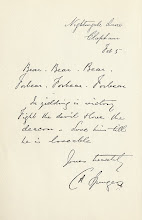
A portion of a letter from C. H. Spurgeon to William Cooper, one of his former pupils at Newmarket. Spurgeon himself was very young but wrote this young boy about the need of coming to Christ. The letter was written from Cambridge in 1851.

Perhaps you intend to think about religion after you have enjoyed sin a little longer; or (but surely you are not so foolish) possibly you think that you are too young to die. But who knows whether that future time will be afforded, and who said that you can turn to Christ just when you please? Your heart is deceitful above all things, and your natural depravity so great that you will not turn to God. Trust not, then, to resolutions made in your own strength, they are but wind; nor to yourself, who are but a broken reed; nor to your own heart, or you are a fool. There is no way of salvation but Christ; you cannot save yourself, having no power even to think one good thought; neither can your parents’ love and prayers save you; none but Jesus can, He is the Saviour of the helpless, and I tell you that He died for all such as feel their vileness, and come to Him for cleansing.

The Letters of Charles Haddon Spurgeon, first published in 1923, published in electronic format by Logos Research Systems, Inc., 2009, p. 173.

Thursday, November 26, 2009

The Origin of Sin


A selection from a letter by J. C. Philpot, the Strict and Particular Baptist pastor and editor of the Gospel Standard magazine, to a man that had asked his opinion of a book by William Tucker, Predestination, Calmly Considered from Principles of Reason. Mr. Philpot replied that the doctrine of predestination was a matter of divine revelation, not reason. He also repudiated a false doctrine of sin set forth in the book. The letter was written April 2, 1867:

…He speaks of the existence of sin being in consequence of the sovereign appointment of God. Now I do not believe that this is Scripture doctrine, nor do I know a single passage even bearing that way. I fully believe that the entrance of sin into the world, and of death by sin, was according to the permissive will of God, for without it it could not have entered; but not appointed by Him in the same way as what is good, for such an assertion, reason how we may, would make sin being a creature and such metaphysical subtleties are mere sophism.

Two things are very evident; first, that sin is a most dreadful evil, hateful to God, and calling down His displeasure and righteous punishment; and secondly, that there is no remedy for this dreadful evil, except through the incarnation and bloodshedding of the Son of God. Here I rest, not being willing to trouble my mind with daring reasonings of men destitute of godliness, and here I advise you to rest too.

Letters and Memoir of Joseph Charles Philpot, first published in 1871, reprinted by Baker Book House, 1981, p. 469.

Friday, May 22, 2009

O William! Consider Your Dangerous Situation


A selection from a letter by Rev. Edmund Botsford, Baptist pastor in South Carolina and member of the Charleston Association of Churches, to William B. Johnson, an unconverted young man. This is the conclusion to a letter that was hard-hitting about the young man’s sin. Johnson was later converted and became most useful in the kingdom of Christ. The letter was written August 15, 1803.

If you do not turn to him [Christ] with your whole heart, his justice will light on you, he will execute eternal punishment upon you. When I tell you these things, you can evade the force of them, and your natural politeness prevents you from unbecoming behavior; but you go away, and sin again, and do not the things you are required. I tell you, if you continue this practice, the eternal God will be aroused to anger, and swear you shall not enter his rest. When you are summoned to his bar, you must obey; then no evasion will do; you must answer to all that is alleged against you. And how will you answer? In the name of God, how will you answer? O William! If ever grace reaches your poor, blind, hard, unbelieving heart, you will have a worse opinion of it than any other person can. I sincerely wish you may make the discovery in time, but believe me, I greatly fear for you. I consider you in a dangerous situation. I shall not think it strange to see you at the left hand of the Judge, when we shall all make our appearance at his bar. God grant it may be otherwise. If it should be, a great change must take place.

The Memoirs of Elder Edmund Botsford, originally printed by W. Riley Charleston, South Carolonia, 1832, published by Particular Baptist Press, compiled and edited by Charles D. Mallary, with additional footnotes, illustrations and an index, 2004, pp. 124-125.

Wednesday, December 17, 2008

The Fatality of Sin in Private

A selection from a letter by the one-eyed Baptist preacher of Wales, Christmas Evans, to a young preacher with advice on how to have a successful ministry. The letter was probably written towards the end of his life, which occurred in 1838.

Remember this, that you cannot commit some loved sin in private, and perform the work of the ministry in public, with facility and acceptance. For a preacher to fall into sin, be it a secret one, and to live in it, is as fatal, ultimately, as the cutting of Samson’s hair. Be strong in the grace that is in Christ Jesus against all corruption.

Christmas Evans: The Life and Times of the One-Eyed Preacher of Wales, by Tim Shenton, Evangelical Press, 2001, p. 445.