Monday, June 29, 2009

Different Shades of Calvinism


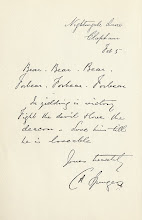
A portion of a letter by Andrew Fuller to his wife. He was in the north of England, on his way to Scotland, speaking about and raising money for the mission work of William Carey in India. He wrote to her from York of a doctrinal conversation about Calvinism that he had with a Mr. Richardson and a Mr. Overton. The letter was written August 31, 1802.

R. There are different shades of Calvinism, I suppose, amongst you?

F. Yes; there are three by which we commonly describe; namely, the high, the moderate, and the strict Calvinists. The first are, if I may so speak, more Calvinistic than Calvin himself; in other words, bordering on Antinomianism.

R. Have you many of these?

F. Too many.

O. Do they not reckon you a legal preacher?

F. Yes; at this very time I am represented, throughout the religious circles of London, as an Arminian.

R. On what ground?

F. What I have written in a note in the Gospel its own Witness.

R. I remember that note. We all approve of it, and think it agrees with the doctrine held by our Church. But what do you call a moderate Calvinist?

F. One that is a half Arminian, or, as they are called with us, Baxterians.

R. And what [is] a strict Calvinist?

F. One that really holds the system of Calvin. I do not believe everything that Calvin taught, nor anything because he taught it; but I reckon strict Calvinism to be my own system.

The Works of Andrew Fuller, edited by Andrew Gunton Fuller, first published in 1841, republished by The Banner of Truth Trust, 2007, p. lxvii.

Saturday, June 27, 2009

What We Need Most


A selection from a letter by Rev. J. H. Thornwell, to R. J. Breckinridge about the low state of spiritual life in the Presbyterian denomination to which they belonged, and the solution to what ailed her. The letter was written January 17, 1842.

I am satisfied that what of all things we need most, is a revival of pure religion in all our churches. The cause of Missions lags, and all our interests decay, because the Spirit of Life, to a mournful extent, is withdrawn from our congregations. The Church has almost dwindled down into a secular corporation; and the principles of this world, a mere carnal policy, which we have nick-named prudence, presides in our councils. Until she becomes a spiritual body, and aims at spiritual ends by appointed means, and makes faith in God the impulsive cause of her efforts, our Zion can never arise and shine, and become a joy and a praise in the whole earth. It is my fervent prayer that God would bless us, and that right early.

The Life and Letters of James Henley Thornwell, first published in 1875, republished by the Banner of Truth, 1974, p. 228.

Wednesday, June 24, 2009

Influence From On High In Preaching


A selection from a letter by J. W. Alexander to his friend, John Hall. These two men carried on personal correspondence for 40 years (1819-1859). Alexander wrote Hall 800 letters which were published after his death. In this letter, written when Alexander was pastor of New York City’s Duane Street Presbyterian Church, which later moved and was known as the Fifth Avenue Presbyterian Church, he shared his views of what kind of preaching was needed. The letter was written December 31, 1846.

What we seem to want here, is not polish or literature in sermons, but something earnest, real, and affectionate; something to make the people hear as if some truth of transcendent present interest was set forth. Never was I more convinced that in order to this there is nothing so necessary as a direct and specific influence from on High. Rhetorical interest is impotent. There was great interest under the Finneyitish revivals, but it was not evangelical, and I am working among its bitter fruits every day. There is a wonderful vitality and permanency in experience which is built on the preaching of Christ. The style of sermons in the Scottish Free Church seems to be the thing. When the new-divinity converts grow cold, they are colder than ice, nothing but a biting censoriousness. I had no idea, even in Jersey [when professor at Princeton], of the modifications wrought in the religion of this city, by the overwrought revivalism of past years. Some, even of those who were once fiery, have degenerated into pulpit-metaphysicians, subtle and elegant.

The Life of J. W. Alexander: Forty Years of Familiar Letters, volume 2, 1844-1859, by John Hall, first published in 1860, republished by Audubon Press, 2008, p. 62.

Tuesday, June 23, 2009

Cause to Bless and Adore God

A portion of a letter by Henry Venn, Church of England minister, to a friend in the ministry, Rev. James Stillingfleet. Several regular attendees had moved away and numbers were low at Lord’s Day meetings, but he continued to preach faithfully and cry out to God for blessing. Great blessing had attended his ministry in a former church in Yorkshire, but the church he was now minister of in Huntingdonshire, was not as responsive to the Word. The letter was written October 9, 1782.

My small parish is very much altered for the worse, within these few years. Three farmers, in whose families there were some hopeful hearers, are removed; and a fourth is upon the point of removing. They have been succeeded by men of a very profane spirit: scarcely will they ever come to church. To this add the departure of a few, in the faith of Christ, I trust. I preach therefore, now, to a handful of people indeed! However, I have cause to bless and adore God, that I can and do cry unto Him, to awake, and glorify His word; and wait in hope He will, before it is long, come down and work mightily, for His own Name’s sake.

Letters of Henry Venn, by John Venn, first published in 1835, republished by the Banner of Truth, 1993, p. 351.

Thursday, June 18, 2009

Death to Me


A portion of a letter from James Renwick, a Covenanter known as the last Scottish martyr. He opposed the imposition of Episcopacy upon the Presbyterians and fought for Scottish liberty. This was his last letter, written on the day of his execution, February 17, 1688. It was written to his friend, Sir Robert Hamilton.

This being my last day upon earth, I thought it my duty to send you this my last salutation. The Lord hath been wonderfully gracious to me since I came to prison, He hath assured me of His salvation, helped me to give a testimony for Him, and own before His enemies all that I have taught, and strengthened me to resist and repel many temptations and assaults, O praise to His name…

But I must break off. I go to your God and my God. DEATH TO ME IS AS A BED TO THE WEARY. Now, be not anxious; the Lord will maintain His cause, and own His people. He will show His glory yet in Scotland…

The Life and Letters of James Renwick: The Last Scottish Martyr, by Rev. W. H. Carslaw, published by Solid Ground Christian Books, taken from the 1893 edition, pp. 264-65.

Tuesday, June 16, 2009

The Time is Short


A selection from a letter by Thomas Chalmers to an unconverted friend, a professor of mathematics, whom he often exhorted to become a Christian. He once told him, “I have long had the utmost regard for you. There is not a human being whom, without the circle of my relationship, I like nearly so well.” This part of the letter was written September 13, 1846, just after he had returned from conducting religious services for the elderly at a hospital.

I have returned from my household sermon to the old people. The text was, “The time is short;” but, in addition to this argument, I endeavoured to press home the growing callousness of the heart to the invitations of the Gospel; yet, nevertheless, the perfect freeness of that Gospel, the benefits and immunities of which are theirs if they will; and on their acceptance of these, they will receive a new heart here, and the joys of an unfading inheritance hereafter.

It is my earnest prayer that God may thus dispose and enable you to receive that truth which is to be found in His Word, and which, if gifted by the Spirit to understand it, you will find to be the power and wisdom of God unto salvation.

Letters of Thomas Chalmers, edited by William Hanna, first published 1853, reprinted by The Banner of Truth, 2007, p. 365.

Friday, June 12, 2009

We Do Not Preach for Money


A selection from a letter by Rev. Daniel Baker to his close friend, Rev. John S. Galloway, pastor in Springfield, Ohio, about an invitation to leave his pastorate in Tuscaloosa, Alabama, for a ministry in Texas. He mentions that he was having some difficulties in his present situation because his salary was not paid promptly. Baker did shortly thereafter move to Texas and had a very fruitful ministry there. The letter was written July 15, 1839.

In an interview with Dr. John Breckinridge, some time since, he expressed a desire that I should go to Texas. He was pleased to say he thought I could do much good there; that I might organize a hundred churches, &c. What do you think of the scheme? My brother, I am in many respects pleasantly situated here, but my field of usefulness is not as large as I could wish it, and I am kept in a very unpleasant state on account of my salary not being promptly paid. We do not preach for money, and yet without it we cannot support our families, nor pay our debts.

Making Many Glad: The Life and Labours of Daniel Baker, by William M. Baker, first published in 1858, reprinted by the Banner of Truth, 2000, pp. 218-19.