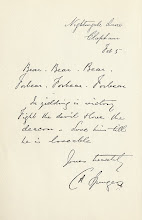
A selection from a letter by John Newton to William Bull. He asked his friend to pray for him in his old age. He was soon to have his 76th birthday and desired to glorify the Lord in the days remaining to him. He wanted to practice what he had preached to others. The letter was written August 1, 1800 [he lived another seven years, dying December 21, 1807).
The almanack tells me that if I live till Monday next, I shall enter my seventy-sixth year. I believe you will pray for me on that day. My eyes, ears, and legs likewise admonish me that I grow older. My writing days seem almost over; I cannot well see to write; but I make an effort to send you one letter more, which may probably be the last you will receive.
 I have requested your prayers; shall I tell you what to ask for? You need not pray for my sudden removal, for I have as little reason as most people to be weary of life; and, through mercy, I feel at present quite willing to live my appointed time. Nor need you pray for my long continuance here, for I see little except my profession and ministry worth living for another day. But pray that I may be enabled to leave the time and manner of my dismission entirely in the Lord’s hands; that if He sees fit to summon me suddenly, I may be willing to go without delay; and that if He is pleased to lay me aside, I may be as willing to retire and wait his time.
Pray likewise for me that no gross imprudence or misconduct may stain the latter part of my life, but that I may be enabled to exemplify in myself what I have labored to inculcate upon others from the pulpit. I have observed in some good men and good ministers improprieties in their latter days, which I have been willing to ascribe rather to the infirmities of old age than to a defect in real grace. I pray daily to be preserved from these, and I request your assistance. I have known good men in advanced life garrulous, peevish, dogmatic, self-important, with some symptoms of jealousy, and perhaps envy, towards those who are upon the increase while they feel themselves decreasing. Do, my friend, pray earnestly that it may not be so with me, but that I may retire, if laid aside, like a thankful guest from a plentiful table, and may rejoice to see others coming forward to serve the Lord (I hope better and more successfully) when I can serve him no longer…
Letters of John Newton: with Biographical Sketches and Notes, by Josiah Bull, first published in 1869, reprinted by the Banner of Truth, 2007, pp. 313-314.
The almanack tells me that if I live till Monday next, I shall enter my seventy-sixth year. I believe you will pray for me on that day. My eyes, ears, and legs likewise admonish me that I grow older. My writing days seem almost over; I cannot well see to write; but I make an effort to send you one letter more, which may probably be the last you will receive.
 I have requested your prayers; shall I tell you what to ask for? You need not pray for my sudden removal, for I have as little reason as most people to be weary of life; and, through mercy, I feel at present quite willing to live my appointed time. Nor need you pray for my long continuance here, for I see little except my profession and ministry worth living for another day. But pray that I may be enabled to leave the time and manner of my dismission entirely in the Lord’s hands; that if He sees fit to summon me suddenly, I may be willing to go without delay; and that if He is pleased to lay me aside, I may be as willing to retire and wait his time.
Pray likewise for me that no gross imprudence or misconduct may stain the latter part of my life, but that I may be enabled to exemplify in myself what I have labored to inculcate upon others from the pulpit. I have observed in some good men and good ministers improprieties in their latter days, which I have been willing to ascribe rather to the infirmities of old age than to a defect in real grace. I pray daily to be preserved from these, and I request your assistance. I have known good men in advanced life garrulous, peevish, dogmatic, self-important, with some symptoms of jealousy, and perhaps envy, towards those who are upon the increase while they feel themselves decreasing. Do, my friend, pray earnestly that it may not be so with me, but that I may retire, if laid aside, like a thankful guest from a plentiful table, and may rejoice to see others coming forward to serve the Lord (I hope better and more successfully) when I can serve him no longer…
Letters of John Newton: with Biographical Sketches and Notes, by Josiah Bull, first published in 1869, reprinted by the Banner of Truth, 2007, pp. 313-314.