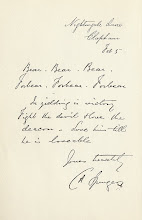
A selection from a letter by the beloved hymn writer, Francis Ridley Havergal, to a pastor friend and his wife. She wrote of the joy that she had in teaching a 90 year-old blind woman, Mrs. Lane, verses from the Bible and the good these texts did for the old lady. Miss Havergal expressed what the old woman, who lived alone, said to her about these verses. What power and comfort there is in the Word of God! The letter was written in 1871.
"Oh dear, Miss, this summer's gone too quick for me; it made the time pass so pleasant, having all them beautiful texts. I couldn't tell you how it's passed away the time.
There's 'I am poor and needy, but the Lord thinketh upon me.' There's a many as don't think about a poor old blind body like me, but the Lord does; and that must be for me, Miss, because I'm very poor, Miss, just like it says in the verse.
And then there's 'When thou passest through the waters, I will be with thee.' That's my companion, I call it, Miss; you wouldn't believe what company that is to me, and it seems to take me through all my little troubles of every day; I don't think that's been out of my mind an hour since you learnt it me.
Ah! I know what came next – 'Having loved His own which were in the world, He loved them unto the end.' That was right, wasn't it, Miss? I couldn't say it rightly at first, but I've got it faster than any now, since you taught it me over again; that's always my comfort when I feel so sinking like, and I think perhaps it's the end coming near, and then He'll love me unto the end.
But that last one I learnt – 'Thine eyes shall see the King in His beauty' – that is beautiful; oh, it is a beauty! My poor eyes, Miss, that can't see you, it says they shall see Him; to think of that now! Well, to be sure now!"
And the dear old woman's voice lowered, murmuring on in broken exclamations of happy anticipation, till she seemed almost to forget her visitor's presence.
Letters by the Late Frances Ridley Havergal, edited by her sister, Maria V. G. Havergal, first published in 1885, reprinted by Kessinger Publishing’s Legacy Reprints, pp. 105-06.
Showing posts with label Frances Ridley Havergal. Show all posts
Wednesday, July 7, 2010
Wednesday, July 1, 2009
Nobody Knows But Jesus

A selection from a letter by the beloved hymn writer, Francis Ridley Havergal, to a young correspondent who needed encouragement in the midst of a great trial. The letter was written in 1877.
I can most fully enter into your somewhat complicated trials. I will hand on to you what comforted me exceedingly a night or two ago, though not a text. It is the refrain of an old slave hymn, ‘Nobody knows but Jesus!’ Does it not draw one very near to feel that? Say that to yourself next time you feel troubled, and have no relief of telling it to a human ear. It is so sweet. Just a secret between one’s own sore heart and the dear Lord’s loving heart!
Another thought struck me for you as to the special trial you tell me of. ‘Consider Him, who endured such contradiction!’ [Hebrews 12:3]. There is a whole mine of cheer and help in that. And consider further—if it is a far keener trial to see—‘enduring’ it than if you only had it to bear. ‘Consider’ how God the Father for His great love wherewith He loved us, saw and endured all the contradiction of sinners to His dear Son, and let them go on contradicting and never interfered, and let Him endure it to the bitter end, all because He loved us, so He ‘spared not His own Son’ even in this.
Letters by the Late Frances Ridley Havergal, edited by her sister, Maria V. G. Havergal, first published in 1885, reprinted by Kessinger Publishing’s Legacy Reprints, p. 92.
Friday, December 26, 2008
Such a Victory
A selection from a letter by Francis Ridley Havergal, the beloved hymn writer, to a clerical friend and his wife, written on Christmas day, 1873.
Several times lately I have felt literally overwhelmed and overpowered with the realization of God’s unspeakable goodness to me. I say it deliberately, and with thankfulness and joy for which I have no words; I have not a fear, or a doubt, or a care, or a shadow of a shadow upon the sunshine of my heart. Every day brings some quite new cause for praise; only today He has given me such a victory as I never had before, in a very strong temptation, lifted me above it in a way I never experienced yet. And I believe He will ‘keep’ me henceforth as I never before believed possible.
Letters by the Late Frances Ridley Havergal, edited by her sister, Maria V. G. Havergal, first published in 1885, reprinted by Kessinger Publishing, p. 139.
Labels:
Frances Ridley Havergal,
God's goodness,
temptation
Wednesday, August 6, 2008
I Cannot Write Without Him
A selection from a letter by the beloved hymn writer, Francis Ridley Havergal, to a friend who had written to thank her for two of her hymns. The letter was written October 30, 1874.
What you tell me of the Lord setting His manifested seal upon two of my hymns, “O thou chosen Church of Jesus,” and Certainly I will be with thee,” made me feel very unworthy and very thankful, and (I cannot help saying it) sent a new thrill of love through my heart to Him who is so good to me. If you ever sing my hymns again, will you send up a prayer that I may more and more rejoice in the truths which they feebly represent; and, if it be our Master’s will, that He would give me yet many more powerful messages of song, for I cannot write without Him.
Letters by the Late Frances Ridley Havergal, edited by her sister, Maria V. G. Havergal, first published in 1885, reprinted by Kessinger Publishing, p. 218.
Friday, May 30, 2008
Never
A selection from a letter by the beloved hymn writer, Francis Ridley Havergal to a friend, written in 1871:
I feel very much inclined to send you this text: “I will never leave thee, nor forsake thee.” Because that takes in all “the way.” For if true now, it must have always been true, even when most imperfectly recognised. And we cannot get beyond “never.”
Letters by the Late Frances Ridley Havergal, edited by her sister, Maria V. G. Havergal, first published in 1885, reprinted by Kessinger Publishing, p. 177.
Friday, April 4, 2008
The Precious Blood
A selection from a letter by Francis Ridley Havergal, to a clerical friend and his wife, written on Christmas day, 1873:
I do not know how one could bear the clearer sight of the sinfulness without the clearer sight, too, of the Precious Blood and its full cleansing power. I had only learnt half of 1 John 1:9, but oh how precious the “and” now is!
Letters by the Late Frances Ridley Havergal, edited by her sister, Maria V. G. Havergal, first published in 1885, reprinted by Kessinger Publishing, p. 138.
Wednesday, January 23, 2008
I Heard Spurgeon
A selection from a letter by Frances Ridley Havergal to her sister, Maria, written in the summer of 1867:
I heard Spurgeon on Sunday A.M. Magnificant! I don’t recollect ever hearing anything finer… That “Tabernacle” is certainly one of the most remarkable sights in the world—the end of the season and London half empty, but it was thronged, and always is, twice every Sunday; and more than half are men, and intellectual-looking ones too.
Letters by the Late Frances Ridley Havergal, edited by her sister, Maria V. G. Havergal, first published in 1885, reprinted by Kessinger Publishing, p. 64.
Subscribe to:
Posts (Atom)