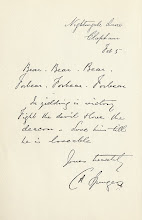
A portion of a letter from Andrew Fuller (1754-1815) to a young minister about preaching. Fuller wrote several letters to this person under the title, "Thoughts on Preaching." The emphasis in this paragraph is the need for searching the Scriptures for one's own benefit, not just to find sermons.
To understand the Scriptures in such a manner as profitably to expound them, it is necessary to be conversant with them in private; and to mix, not only faith, but the prayer of faith, with what we read. There is a great difference between reading the Scriptures as a student, in order to find something to say to the people, and reading them as a Christian, with a view to get good from them to one’s own soul. That which is gained in the latter of these ways is, beyond all comparison, of the greatest use, both to ourselves and others. That which we communicate will freeze upon our lips, unless we have first applied it to ourselves; or, to use the language of Scripture, "tasted, felt, and handled the word of life."
The Works of Andrew Fuller, "Thoughts on Preaching," volume 1, letter 1, p. 713.
Showing posts with label Scripture. Show all posts
Wednesday, September 21, 2011
Thursday, July 22, 2010
The Good Old Wine of Distinguishing Grace
A selection from a letter by the well-known hymn writer and preacher of the gospel, Augustus Toplady, to a Mr. Bottomley, who had sent him a paper that he had written expressing his acceptance of Calvinistic doctrine. Toplady encouraged him to continue to search the Scriptures and with the light given to him, to throw off the errors of Arminianism. The letter was written December 3, 1768.
I verily hope and believe that that most gracious Being who has led you thus far, will go on to translate you farther and farther into the light and liberty of his children. As I once took occasion to tell you, it is much the same with mistakes in matters of judgment, as it was with the two disciples in the dungeon of Philippi [Acts 16:26]: first the prison shakes and next the doors fly open. I am heartily glad that you are shaken as to the system you have long embraced and trust that it is preclusive to your deliverance from it…
Chiefly keep your eye fixed on the Scriptures and derive by humble, earnest, waiting prayer, all your light and knowledge thence. One thing I am very clear in, that if you reduce your ideas to the standard of Scripture, and make this the model of those, suffering the unerring word of revelation to have the casting vote, and turning your mind into the gospel mould, you must and will eventually throw the idol of Arminianism, in all its branches, to the moles and to the bats. You will no longer dwell with Mesech, nor have your habitation among the tents of Kedar. Having tasted the good old wine of distinguishing grace, you will no longer have any relish for the new scheme of grace without a plan, and of a random salvation; for you will both know and acknowledge that the old is better.
The Works of Augustus Toplady, Bookshelf Publications, reprint from the 1794 edition, pp. 832-33.
Wednesday, July 7, 2010
All Them Beautiful Texts
A selection from a letter by the beloved hymn writer, Francis Ridley Havergal, to a pastor friend and his wife. She wrote of the joy that she had in teaching a 90 year-old blind woman, Mrs. Lane, verses from the Bible and the good these texts did for the old lady. Miss Havergal expressed what the old woman, who lived alone, said to her about these verses. What power and comfort there is in the Word of God! The letter was written in 1871.
"Oh dear, Miss, this summer's gone too quick for me; it made the time pass so pleasant, having all them beautiful texts. I couldn't tell you how it's passed away the time.
There's 'I am poor and needy, but the Lord thinketh upon me.' There's a many as don't think about a poor old blind body like me, but the Lord does; and that must be for me, Miss, because I'm very poor, Miss, just like it says in the verse.
And then there's 'When thou passest through the waters, I will be with thee.' That's my companion, I call it, Miss; you wouldn't believe what company that is to me, and it seems to take me through all my little troubles of every day; I don't think that's been out of my mind an hour since you learnt it me.
Ah! I know what came next – 'Having loved His own which were in the world, He loved them unto the end.' That was right, wasn't it, Miss? I couldn't say it rightly at first, but I've got it faster than any now, since you taught it me over again; that's always my comfort when I feel so sinking like, and I think perhaps it's the end coming near, and then He'll love me unto the end.
But that last one I learnt – 'Thine eyes shall see the King in His beauty' – that is beautiful; oh, it is a beauty! My poor eyes, Miss, that can't see you, it says they shall see Him; to think of that now! Well, to be sure now!"
And the dear old woman's voice lowered, murmuring on in broken exclamations of happy anticipation, till she seemed almost to forget her visitor's presence.
Letters by the Late Frances Ridley Havergal, edited by her sister, Maria V. G. Havergal, first published in 1885, reprinted by Kessinger Publishing’s Legacy Reprints, pp. 105-06.
"Oh dear, Miss, this summer's gone too quick for me; it made the time pass so pleasant, having all them beautiful texts. I couldn't tell you how it's passed away the time.
There's 'I am poor and needy, but the Lord thinketh upon me.' There's a many as don't think about a poor old blind body like me, but the Lord does; and that must be for me, Miss, because I'm very poor, Miss, just like it says in the verse.
And then there's 'When thou passest through the waters, I will be with thee.' That's my companion, I call it, Miss; you wouldn't believe what company that is to me, and it seems to take me through all my little troubles of every day; I don't think that's been out of my mind an hour since you learnt it me.
Ah! I know what came next – 'Having loved His own which were in the world, He loved them unto the end.' That was right, wasn't it, Miss? I couldn't say it rightly at first, but I've got it faster than any now, since you taught it me over again; that's always my comfort when I feel so sinking like, and I think perhaps it's the end coming near, and then He'll love me unto the end.
But that last one I learnt – 'Thine eyes shall see the King in His beauty' – that is beautiful; oh, it is a beauty! My poor eyes, Miss, that can't see you, it says they shall see Him; to think of that now! Well, to be sure now!"
And the dear old woman's voice lowered, murmuring on in broken exclamations of happy anticipation, till she seemed almost to forget her visitor's presence.
Letters by the Late Frances Ridley Havergal, edited by her sister, Maria V. G. Havergal, first published in 1885, reprinted by Kessinger Publishing’s Legacy Reprints, pp. 105-06.
Labels:
blind woman,
comfort,
Frances Ridley Havergal,
memorization,
Scripture
Monday, January 11, 2010
Never Wearying

A selection from a letter by John Calvin to the persecuted brethren in France. The Reformed churches were slated for destruction by the powers that be. Calvin wrote a common letter to exhort them “not to faint” or withdraw “from the combat.” After setting forth many reasons and encouragements to be faithful to the Lord, Calvin called on them to find help in the reading of the word. The letter was written from Geneva in June, 1559.
We have here briefly touched on what should be your conduct during this fiery trial. The main point is that each of you should diligently exercise himself in the reading of the word, and that you mark and retain the exhortations that are addressed to you by the mouth of God, to serve him with all perseverance, never wearying, whatever befall you.
John Calvin: Tracts and Letters, edited by Jules Bonnet and translated by David Constable, first published by the Presbyterian Board of Publication, 1858, republished by The Banner of Truth Trust, 2009, vol. 7, p. 54.
We have here briefly touched on what should be your conduct during this fiery trial. The main point is that each of you should diligently exercise himself in the reading of the word, and that you mark and retain the exhortations that are addressed to you by the mouth of God, to serve him with all perseverance, never wearying, whatever befall you.
John Calvin: Tracts and Letters, edited by Jules Bonnet and translated by David Constable, first published by the Presbyterian Board of Publication, 1858, republished by The Banner of Truth Trust, 2009, vol. 7, p. 54.
Labels:
John Calvin,
persecution,
perseverance,
promises,
Scripture
Tuesday, September 29, 2009
A Happy State

A selection from a letter by Henry Venn, Church of England minister, to his son, Rev. John Venn. He stated his satisfaction with Christ as Lord and Saviour and his contentment with a life of preaching the whole counsel of God. The letter was written January 1, 1796.
I have to tell you—and would, if it were with my last breath—that I can wish for nothing more than I now find Christ is to me. And though I discover, more than ever, most lamentable defects in my preaching, and cannot place the smallest confidence in the multitudes to whom God has been pleased to make His Word a blessing by my mouth and pen, yet I am absolutely certain that I have preached the very doctrine that Christ and His Apostles did. The whole Word of God is equally acceptable to me—not less those parts which are the fortress of Arminians, Perfectionists, and Antinomians, than the others; so that I am, and have been for thirty-five years, in the happy state of not being tempted to wrest any Scripture, or pervert it, in order to make it favour my own tenets.
Letters of Henry Venn, by John Venn, first published in 1835, republished by the Banner of Truth, 1993, pp. 531-32.
I have to tell you—and would, if it were with my last breath—that I can wish for nothing more than I now find Christ is to me. And though I discover, more than ever, most lamentable defects in my preaching, and cannot place the smallest confidence in the multitudes to whom God has been pleased to make His Word a blessing by my mouth and pen, yet I am absolutely certain that I have preached the very doctrine that Christ and His Apostles did. The whole Word of God is equally acceptable to me—not less those parts which are the fortress of Arminians, Perfectionists, and Antinomians, than the others; so that I am, and have been for thirty-five years, in the happy state of not being tempted to wrest any Scripture, or pervert it, in order to make it favour my own tenets.
Letters of Henry Venn, by John Venn, first published in 1835, republished by the Banner of Truth, 1993, pp. 531-32.
Labels:
Christ,
errors,
Henry Venn,
John Venn,
Scripture
Wednesday, April 8, 2009
Call No Man Master

A selection from a letter by John Newton to John Campbell, a friend in Scotland. Newton spoke of the danger of making too much of great men, especially of their writings. Better search the Scriptures ourselves than be dependent solely on man’s authority. Such a word needs to be heard today given the tendency by some to make idols out of learned theologians and powerful preachers. The letter was written in 1803.
Study the text of the good word of God. Beware of leaning too hard on human authority, even the best; you may get useful hints from sound divines, but call no man master. There are mixtures of infirmity, and the prejudices of education or party, in the best of writers. What is good in them they obtained from the fountain of truth, the scriptures; and you have as good a right to go to the fountain head yourself.
Heroes, Iain H. Murray, The Banner of Truth Trust, 2009, p. 111. Mr. Murray takes this portion of Newton’s letter from Letters and Occasional Remarks by John Newton, edited by John Campbell, published in 1809.
Study the text of the good word of God. Beware of leaning too hard on human authority, even the best; you may get useful hints from sound divines, but call no man master. There are mixtures of infirmity, and the prejudices of education or party, in the best of writers. What is good in them they obtained from the fountain of truth, the scriptures; and you have as good a right to go to the fountain head yourself.
Heroes, Iain H. Murray, The Banner of Truth Trust, 2009, p. 111. Mr. Murray takes this portion of Newton’s letter from Letters and Occasional Remarks by John Newton, edited by John Campbell, published in 1809.
Labels:
human authority,
John Campbell,
John Newton,
Scripture
Subscribe to:
Posts (Atom)