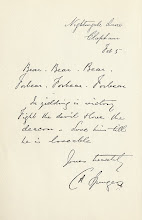
A selection from a letter by John Newton to John Ryland, Jr. Newton made reference to Ryland's son, John Tyler Ryland, who was about one year old at the time, who was gravely ill. Mr. Newton expressed his hope that all might be well with the lad and exhorted his father to do the same. The letter was written October 26, 1787.
I hope your little boy will live to be a comfort to you; perhaps he may preach the gospel, when you can no longer speak. However this may be, devote and entrust him to the Lord, and he will take care of him. Sufficient to the present day is the evil thereof [Matthew 6:34]. Why should you burden yourself by looking a great while forward to peradventures and possibilities? Hope the best; and when you meet with a dark cloud, wait and expect to see, in due time, a rainbow painted upon it, or a light and glory springing out of it.
Wise Counsel: John Newton’s Letter to John Ryland, Jr., edited by Grant Gordon, The Banner of Truth Trust, 2009, letter #40, pp. 194-95.
Showing posts with label comfort. Show all posts
Tuesday, April 26, 2011
Hope the Best
Labels:
care,
comfort,
family,
hope,
John Newton,
John Ryland,
Matthew 6:34,
sickness,
trust
Wednesday, November 10, 2010
Christ's Beauty and Love
A selection from a letter by Jonathan Edwards to Lady Mary Pepperrell. Edwards had visited her husband, Sir William Pepperrell, and had found her to be in deep sorrow because of the death of her only son. When Edwards left, she asked him to write her, so he did. He penned a letter, as he said, on "the subject which above all others appeared to me to be a proper and sufficient source of consolation to one under your heavy affliction: and this was the Lord Jesus Christ." He developed two main points in his letter – "the infinite worthiness" of Christ and Christ's "great and unparalleled love to us." What sweet comfort this letter breathes! It was written from Stockbridge [Massachusetts], November 28, 1751.
Now, Madam, let us consider what suitable provision God has made for our consolation under all our afflictions in giving us a Redeemer of such glory and such love, especially when it is considered what were the ends of that great manifestation of his beauty and love in his death. He suffered that we might be delivered. His soul was exceeding sorrowful even unto death, to take away the sting of sorrow and that we might have everlasting consolation. He was oppressed and afflicted that we might be supported. He was overwhelmed in the darkness of death and of hell, that we might have the light of life. He was cast into the furnace of God's wrath, that we might swim in the rivers of pleasure. His heart was overwhelmed in a flood of sorrow and anguish, that our hearts might be filled and overwhelmed with a flood of eternal joy.
Jonathan Edwards: Letters and Personal Writings, edited by George S. Claghorn, vol. 16 in The Works of Jonathan Edwards, Yale University Press, 1998, p. 418.
Now, Madam, let us consider what suitable provision God has made for our consolation under all our afflictions in giving us a Redeemer of such glory and such love, especially when it is considered what were the ends of that great manifestation of his beauty and love in his death. He suffered that we might be delivered. His soul was exceeding sorrowful even unto death, to take away the sting of sorrow and that we might have everlasting consolation. He was oppressed and afflicted that we might be supported. He was overwhelmed in the darkness of death and of hell, that we might have the light of life. He was cast into the furnace of God's wrath, that we might swim in the rivers of pleasure. His heart was overwhelmed in a flood of sorrow and anguish, that our hearts might be filled and overwhelmed with a flood of eternal joy.
Jonathan Edwards: Letters and Personal Writings, edited by George S. Claghorn, vol. 16 in The Works of Jonathan Edwards, Yale University Press, 1998, p. 418.
Labels:
afflictions,
Christ,
comfort,
consolation,
death,
Jonathan Edwards,
Lady Pepperrell
Monday, August 16, 2010
Your Little Child Was Born for Eternity
A letter from John Elias to a relative, the Rev. W. Roberts, who had lost an infant girl in death. The parents were naturally grieving and Rev. Elias offered sympathy and encouragement to them under such distressing circumstances. I can well imagine how this letter must have been read many times over in their days of sorrow. The letter was written July 12, 1838.
I hope you both shall have much strength from above to bear under the trial that is so painful to flesh and blood. To be enabled to view the secret movements of the good and wise providence of God towards us, would afford great calmness and ease of mind. He does all things right, they cannot be better; and he can bring us to see that, and to reconcile us to his proceedings, though so disagreeable to our natural feelings.
To lose dear infants, and to commit them to the dust, is most poignant bitterness. But some meet with more distressing circumstances in the conduct of those that are spared! Your little child was born for eternity; it is her dwelling, her home. The Lord has been pleased to remove her there, according to his eternal counsel, sooner than you expected. Who can say how great was his goodness in this act? She was taken out of the reach of many temptations, and out of many evils and sorrow.
You have no need to be uncomfortable as to the state of the child; your heavenly Father took her to himself. It was very distressing to you and her mother to behold her affliction; it was becoming to mourn and to sympathize; but now, she being dead, arise and wash away your tears, and worship God (2 Samuel 12:20). May the Lord give you help in the time of need, may he support and comfort you!
John Elias: Life, Letters and Essays, by Edward Morgan, first published in 1844, published by the Banner of Truth in 1973, pp. 219-220.
Labels:
comfort,
death,
eternal counsels,
heaven,
infant daughter,
John Elias,
wise providence
Wednesday, July 7, 2010
All Them Beautiful Texts
A selection from a letter by the beloved hymn writer, Francis Ridley Havergal, to a pastor friend and his wife. She wrote of the joy that she had in teaching a 90 year-old blind woman, Mrs. Lane, verses from the Bible and the good these texts did for the old lady. Miss Havergal expressed what the old woman, who lived alone, said to her about these verses. What power and comfort there is in the Word of God! The letter was written in 1871.
"Oh dear, Miss, this summer's gone too quick for me; it made the time pass so pleasant, having all them beautiful texts. I couldn't tell you how it's passed away the time.
There's 'I am poor and needy, but the Lord thinketh upon me.' There's a many as don't think about a poor old blind body like me, but the Lord does; and that must be for me, Miss, because I'm very poor, Miss, just like it says in the verse.
And then there's 'When thou passest through the waters, I will be with thee.' That's my companion, I call it, Miss; you wouldn't believe what company that is to me, and it seems to take me through all my little troubles of every day; I don't think that's been out of my mind an hour since you learnt it me.
Ah! I know what came next – 'Having loved His own which were in the world, He loved them unto the end.' That was right, wasn't it, Miss? I couldn't say it rightly at first, but I've got it faster than any now, since you taught it me over again; that's always my comfort when I feel so sinking like, and I think perhaps it's the end coming near, and then He'll love me unto the end.
But that last one I learnt – 'Thine eyes shall see the King in His beauty' – that is beautiful; oh, it is a beauty! My poor eyes, Miss, that can't see you, it says they shall see Him; to think of that now! Well, to be sure now!"
And the dear old woman's voice lowered, murmuring on in broken exclamations of happy anticipation, till she seemed almost to forget her visitor's presence.
Letters by the Late Frances Ridley Havergal, edited by her sister, Maria V. G. Havergal, first published in 1885, reprinted by Kessinger Publishing’s Legacy Reprints, pp. 105-06.
"Oh dear, Miss, this summer's gone too quick for me; it made the time pass so pleasant, having all them beautiful texts. I couldn't tell you how it's passed away the time.
There's 'I am poor and needy, but the Lord thinketh upon me.' There's a many as don't think about a poor old blind body like me, but the Lord does; and that must be for me, Miss, because I'm very poor, Miss, just like it says in the verse.
And then there's 'When thou passest through the waters, I will be with thee.' That's my companion, I call it, Miss; you wouldn't believe what company that is to me, and it seems to take me through all my little troubles of every day; I don't think that's been out of my mind an hour since you learnt it me.
Ah! I know what came next – 'Having loved His own which were in the world, He loved them unto the end.' That was right, wasn't it, Miss? I couldn't say it rightly at first, but I've got it faster than any now, since you taught it me over again; that's always my comfort when I feel so sinking like, and I think perhaps it's the end coming near, and then He'll love me unto the end.
But that last one I learnt – 'Thine eyes shall see the King in His beauty' – that is beautiful; oh, it is a beauty! My poor eyes, Miss, that can't see you, it says they shall see Him; to think of that now! Well, to be sure now!"
And the dear old woman's voice lowered, murmuring on in broken exclamations of happy anticipation, till she seemed almost to forget her visitor's presence.
Letters by the Late Frances Ridley Havergal, edited by her sister, Maria V. G. Havergal, first published in 1885, reprinted by Kessinger Publishing’s Legacy Reprints, pp. 105-06.
Labels:
blind woman,
comfort,
Frances Ridley Havergal,
memorization,
Scripture
Thursday, April 1, 2010
Let Others See What Is In You
Paul Wolfe concludes a portion of a letter from Samuel Rutherford to a woman whose husband had died, in his book, My God is True! He also gives some background information on Rutherford himself. His comments and the portion from Rutherford's letter help stay the soul in difficult times.
"Throughout his life Rutherford carried on a remarkable ministry of letter-writing to members of the congregation he served, as well as to other friends and family members, using pen and post to encourage them with the truths of the gospel. Today we have over three hundred of Rutherford's letters preserved.
"On September 14, 1634, Rutherford wrote to a woman whose husband had died just two days before. Rutherford knew from personal experience that the death of one's spouse ranks high among sorrows (his first wife had died in 1630), and he acknowledged this in his letter to her. He wrote, 'I must out of some experience say, the mourning for the husband of your youth be, by God's own mouth, the heaviest worldly sorrow (Joel 1:8).' He knew that her was a grief not to be treated lightly or dismissed. Yet he also knew that the Lord was at work to bring about good. In particular, Rutherford trusted that the loss of her husband would serve as a heart test that would show others where her deepest joy was to be found. He urged her, in the midst of her sorrow, to:
'Let God, and men, and angels now see what is in you. The Lord hath pierced the vessel; it will be known whether there be in it wine or water. Let your faith and patience be seen, that it may be known your only beloved, first and last, hath been Christ.'
"Those are stirring and challenging words. He wanted this woman to appreciate the fact that her joy was now on trial as a result of her husband's death. It was her heart that was now being tested and revealed. God and men and angels were watching. Of course, God already knew what was in her heart, but men and angels needed to see it, and in any case the all-knowing God was still worthy of a faithful display. And Rutherford was confident that she would make just such a display. He knew her well enough to know that the results of her test would be heartening. He wrote:
'I am now expecting to see, and that with joy and comfort, that which I hoped of you since I knew you fully, even that ye have laid such strength upon the Holy One of Israel, that ye defy troubles, and that your soul is a castle that may be besieged, but cannot be taken.'
"As it was with those who read the Apostle Peter's letter [1 Peter 1:6-9], so it was with this woman who read Rutherford's letter: her loss had not made her joyful; rather, it would have the effect of revealing the joy in Christ that she already had."
Letters of Samuel Rutherford, The Banner of Truth Trust, reprinted 1984, pp. 100-101. My God is True: Lessons Learned Along Cancer's Dark Road, Paul D. Wolfe, The Banner of Truth Trust, 2009, pp. 73-74.
Labels:
comfort,
death,
joy in Christ,
Paul D. Wolfe,
Samuel Rutherford,
sorrow
Tuesday, February 9, 2010
Alarming and Anxious Thoughts About Death

A selection from a letter by the Welsh preacher, Thomas Charles, to Sally Jones, who would later become his wife. Many letters were exchanged between them that increased their understanding of one another and led to a deeper love, though he loved her long before she loved him. She had confided in him in a previous letter how alarming death was. He responded with Biblical counsel and a personal testimony. The letter was written March 1, 1780.
I feelingly sympathize with you when you inform me that the thoughts of death are alarming to you. It was the case with me for many sorrowful years. But, through the abundant goodness of my Heavenly Father, it is not generally the case with me at present. That Scripture, 1 Cor. 15:25, 26, was very remarkably blessed to me for the removing of all the very alarming and anxious thoughts about death which till then deprived me of lasting comfort. Death is considered there not so much our enemy as Christ’s, and he must reign till he hath put all enemies under his feet; and though death will be the last enemy, yet death must be destroyed.
I saw I had nothing to do but enjoy the victory, Christ is engaged to conquer. The victory is obtained by the arm of omnipotence, and we shall, ere long, bear the palm in our hands as a token of it. Till that happy time arrives may it be our constant care and study to live in the fear and to the glory of him who hath thus loved us, and vanquished our strong enemies for us.
The Christian Lover: The Sweetness of Love and Marriage in the Letters of Believers, by Michael A. G. Haykin with Victoria J. Haykin, Reformation Trust Publishing, a division of Ligonier ministries, 2009, p. 52.
I feelingly sympathize with you when you inform me that the thoughts of death are alarming to you. It was the case with me for many sorrowful years. But, through the abundant goodness of my Heavenly Father, it is not generally the case with me at present. That Scripture, 1 Cor. 15:25, 26, was very remarkably blessed to me for the removing of all the very alarming and anxious thoughts about death which till then deprived me of lasting comfort. Death is considered there not so much our enemy as Christ’s, and he must reign till he hath put all enemies under his feet; and though death will be the last enemy, yet death must be destroyed.
I saw I had nothing to do but enjoy the victory, Christ is engaged to conquer. The victory is obtained by the arm of omnipotence, and we shall, ere long, bear the palm in our hands as a token of it. Till that happy time arrives may it be our constant care and study to live in the fear and to the glory of him who hath thus loved us, and vanquished our strong enemies for us.
The Christian Lover: The Sweetness of Love and Marriage in the Letters of Believers, by Michael A. G. Haykin with Victoria J. Haykin, Reformation Trust Publishing, a division of Ligonier ministries, 2009, p. 52.
Labels:
1 Cor. 15,
comfort,
fear of death,
Sally Jones,
testimony,
Thomas Charles,
victory
Thursday, December 17, 2009
Sad Errors

A letter from George Whitefield to the Welsh evangelist, Howell Harris. Whitefield was in Boston but expecting to return to England soon. He wrote of concerns with the theology of John Wesley and his influence on friends at Fetters Lane Society. The letter was written September 24, 1740.
And is dear Brother H[owell] H[arris] yet alive in body and soul? Blessed be God, who causes those that wait on him to renew their strength. I rejoice in your success; may you mount with wings like eagles, walk and not be weary, run and not be faint! You shall not be taken or hurt, till the appointed hour is come.
I hope your conversation was blessed to dear Mr. W[esley]. O that the LORD may batter down his freewill, and compel him to own his sovereignty and everlasting love! Some of F[etters] Lane society, I fear, are running into sad errors; but this happens for our trial, especially mine. Those that before, I suppose, would have plucked out their eyes for me, now I suspect, I shall see very shy, and avoiding me. This is my comfort, the LORD is a never-failing friend; his truth will make its way in spite of all carnal reasoning. O pray for me that I may have the spirit of judgment and a sound mind…
Letters of George Whitefield: For the Period 1734-1742, The Banner of Truth Trust, 1976, reprinted from The Works of George Whitefield, 1771, p. 210.
And is dear Brother H[owell] H[arris] yet alive in body and soul? Blessed be God, who causes those that wait on him to renew their strength. I rejoice in your success; may you mount with wings like eagles, walk and not be weary, run and not be faint! You shall not be taken or hurt, till the appointed hour is come.
I hope your conversation was blessed to dear Mr. W[esley]. O that the LORD may batter down his freewill, and compel him to own his sovereignty and everlasting love! Some of F[etters] Lane society, I fear, are running into sad errors; but this happens for our trial, especially mine. Those that before, I suppose, would have plucked out their eyes for me, now I suspect, I shall see very shy, and avoiding me. This is my comfort, the LORD is a never-failing friend; his truth will make its way in spite of all carnal reasoning. O pray for me that I may have the spirit of judgment and a sound mind…
Letters of George Whitefield: For the Period 1734-1742, The Banner of Truth Trust, 1976, reprinted from The Works of George Whitefield, 1771, p. 210.
Saturday, September 26, 2009
A Country Beyond the Grave

A selection from a letter by Thomas Chalmers to a close friend, Jane Morton. Mrs. Morton’s daughter, Catherine, had recently died and Chalmers wrote to extend his sympathy and offer a word of comfort. He contemplated the day of his own death and charged Jane to join him in proper preparation for meeting the Lord. The letter was written May 4, 1845.
I am now more than half way from sixty to seventy; and certain it is, that though free of any specific complaint, there has been a general decay of strength during the last year, which tells me that I should forthwith set my house in order, and be in readiness for the coming of the Lord.
But this readiness is a duty which lies upon all of every age and condition; and may the death over which we have been called to mourn bring the lesson forcibly home to us. May the event be sanctified and blessed to all your family. Though in itself not joyous but grievous, may it yield to you and yours the peaceable fruits of righteousness. Let us stand, my dear Jane, more disengaged than ever from a world that will soon pass away; and with the feeling that we are strangers and pilgrims here, let our doings plainly declare that we seek a country beyond the grave—that we are looking forward to a city which hath foundations, whose builder and maker is God.
Letters of Thomas Chalmers, edited by William Hanna, first published 1853, reprinted by The Banner of Truth, 2007, p. 248.
I am now more than half way from sixty to seventy; and certain it is, that though free of any specific complaint, there has been a general decay of strength during the last year, which tells me that I should forthwith set my house in order, and be in readiness for the coming of the Lord.
But this readiness is a duty which lies upon all of every age and condition; and may the death over which we have been called to mourn bring the lesson forcibly home to us. May the event be sanctified and blessed to all your family. Though in itself not joyous but grievous, may it yield to you and yours the peaceable fruits of righteousness. Let us stand, my dear Jane, more disengaged than ever from a world that will soon pass away; and with the feeling that we are strangers and pilgrims here, let our doings plainly declare that we seek a country beyond the grave—that we are looking forward to a city which hath foundations, whose builder and maker is God.
Letters of Thomas Chalmers, edited by William Hanna, first published 1853, reprinted by The Banner of Truth, 2007, p. 248.
Labels:
comfort,
death,
heaven,
Jane Morton,
readiness,
Thomas Chalmers
Subscribe to:
Posts (Atom)