Showing posts with label gospel. Show all posts

Tuesday, September 27, 2011

No Inclination to Turn Back

A portion of a letter by the missionary to the Indians in Oklahoma, Isaac McCoy (1784-1846), to a critic, a Mr. Samuel Dedman of Pike County, Indiana, who opposed his plans to live among the Indians and give his life, if necessary, in reaching them with the gospel. The letter was written on January 12, 1820.

I assure you, my brother, that every opposing difficulty, the opposition of the association not expected, has only tended to increase my missionary ardour. May my merciful God forgive me if I be wrong, and set me right. I would rather be a missionary to the Indians, than fill the President's chair, or sit on the throne of Alexander, emperor of Russia. I would rather preach Jesus to the poor Indians in a bark camp, than address the thousands who assemble in Sansom Street meeting house, Philadelphia [the General Missionary Convention had been held there, May 7, 1817]. Something has turned my attention towards the Indians, and every feeling of my soul is enlisted in their cause, yet still I may be wrong. But I feel not the least inclination to turn back, but would drive on with the vehemence of Peter, the meekness of Moses, and the wisdom of Solomon.

Kansas Historical Quarterly, "Isaac McCoy and the Treaty of 1821," by Lela Barnes, vol. 5, no. 2, p. 128. Thanks to Gary Long of Particular Baptist Press for sending me a digitized copy of this letter.

Wednesday, August 31, 2011

I Really Don't Like This Guy

A portion of a letter written by a forty-three-year old black man from Tennessee, to John MacArthur. This gentleman had been influenced by the Black Power movement and had turned away from Christianity. In listening to MacArthur preaching on the Grace to You radio broadcast, he was converted and began to live for Christ.

I bought into the teaching against a "white" Jesus, and the pro-Black teachings became my religion… When I first heard you on radio about nine years ago, I thought to myself, "I really don't like this guy and what he is saying." I was pretty sure you were white. Then one day I heard you preach on forgiveness of sins and love, and the veil was lifted from my eyes. Up until then, I had never truly heard the gospel preached, never truly understood the holiness of God. The Word of God began to have an incredible impact on me as I listened to your preaching daily. By God's grace, I've been living for Him, studying His Word, and listening to your broadcast for the last nine years.

John MacArthur: Servant of the Word and Flock, Iain H. Murray, The Banner of Truth Trust, 2011, p. 180.

Thursday, July 14, 2011

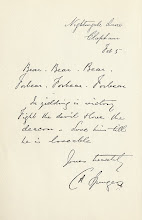
A Firmer Grip Than Ever

A portion of a letter from Charles Haddon Spurgeon, written to his congregation, four weeks prior to his death. His church was the Metropolitan Tabernacle, London, England. He was writing from Menton, France, where he had gone to recover from illness. But recovery was not meant to be. He had gone through the valley of the shadow of death just a short while before, but his health was now worse. He wanted his flock to know that the gospel he had preached for over 40 years was still his hope and joy, and should be theirs too. The letter was written January 6, 1892.

I feel my mind grasping with firmer grip than ever that everlasting gospel which for so many years I have preached to you. We have not been deceived. Jesus does give rest to those who come to him, he does save those who trust him, he does photograph his image on those who learn of him. I hate the Christianised infidelity of the modern school more than ever, as I see how it rends away from sinful man his last and only hope. Cling to the gospel of forgiveness through the substitutionary sacrifice, and spread it with all your might, each one of you, for it is the only cure for bleeding hearts.

The Suffering Letters of C. H. Spurgeon, annotations by Hannah Wyncoll, Wakeman Trust, 2007, pp. 118-19.

Friday, October 29, 2010

What a Danger

A portion of a letter by Martin Luther to Cardinal Albrecht against the sale of indulgences, one of the biggest money making schemes ever invented by religious men. Forgiveness of sins were promised on the payment of money into the coffers of the Roman Catholic Church. Roland Bainton called the sale of indulgences "the bingo of the sixteenth century." With much grace and humility Luther pleaded for this practice to cease. This letter was written on the same day that Luther posted his Ninety-five Theses to the door of the Castle Church in Wittenberg, October 31, 1517.

The first and only duty of the bishops… is to see that the people learn the gospel and the love of Christ. For on no occasion has Christ ordered that indulgences should be preached, but he forcefully commanded the gospel to be preached. What a horror, what a danger for a bishop to permit the loud noise of indulgences among his people, while the gospel is silenced, and to be more concerned with the sale of indulgences than with the gospel!

Luther's Works, Vol. 48, Letters I, edited by J. J. Pelikan, H. C. Oswald and H. T. Lehmann, Fortress Press, letter # 16, p. 47.

Tuesday, October 12, 2010

Happy in Living and Blessed in Dying

A portion of a letter from Robert Murray McCheyne to a female acquaintance about the state of her soul. Six letters that McCheyne wrote her were published. They are model evangelistic letters of a believer concerned for an unbeliever. This paragraph comes from the fourth letter and was written December 1841.

Now, will you come, for all things are ready? Are you now saying in your heart, I cannot but believe I am the chief of sinners, and Jesus offers to be my refuge, my Mediator, my all in all; I feel He is precious? Oh! dear friend, I trust you do. This only will make you happy in living, and blessed in dying. This is a poor, dying world. Man that is born of a woman is of few days and full of trouble. There is no part here that death cannot take from us. But if you have Christ, you have the only imperishable portion! Oh, may the Holy Spirit give you a firm hold of Jesus! Then we shall meet in that sweet place, where there shall be no more death, neither sorrow nor crying, neither shall there be any more pain. The Lord deal kindly and gently with you, both soul and body. Farewell, dear friend.

Memoir and Remains of R.M. McCheyne, A. A. Bonar, electronic edition, Logos, p. 118. The book is also published by Banner of Truth Trust.

Tuesday, September 14, 2010

There Is Hope

A letter from C. H. Spurgeon to T. W. Medhurst. Medhurst had been attending the services at the New Park Street Church where Spurgeon was preaching and soon to officially be the pastor. He had come under conviction of sin and had sent Spurgeon a letter asking if there was hope for him (see previous post). Spurgeon replied most graciously to his letter. The young man was later converted, entered the ministry, was trained at the Pastor's College later established by Spurgeon, and pastored for over 40 years in churches all across Britain. The letter was written July 14, 1854.

Dear Sir,

I am glad that you have been able to write to me and state your feelings. Though my hands are always full, it will ever give me joy to receive such notes as yours.

You ask me a very important question, “Are you one of God’s elect?” Now, this is a question neither you nor I can answer at present, and therefore let it drop. I will ask you an easier one, “Are you a sinner?” Can you say “YES”? All say, “Yes”; but then they do not know what the word “sinner” means.

A sinner is a creature who has broken all his Maker’s commands, despised His Name, and run into rebellion against the Most High. A sinner deserves hell, yea, the hottest place in hell; and if he be saved, it must be entirely by unmerited mercy. Now, if you are such a sinner, I am glad to be able to tell you the only way of salvation, “Believe on the Lord Jesus.”

I think you have not yet really understood what believing means. You are, I trust, really awakened, but you do not see the door yet. I advise you seriously to be much alone, I mean as much as you can; let your groans go up if you cannot pray, attend as many services as possible; and if you go with an earnest desire for a blessing, it will come very soon. But why not believe now? You have only to believe that Jesus is able and willing to save, and then trust yourself to Him.

Harbour not that dark suggestion to forsake the house of God; remember you turn your back on Heaven, and your face to hell, the moment you do that. I pray God that He will keep you. If the Lord had meant to destroy you, He would not have showed you such things as these. If you are but as smoking flax, there is hope. Touch the hem of His garment; look to the brazen serpent.

My dear fellow-sinner, slight not this season of awakening. Up, and be in earnest. It is your soul, your OWN soul, your eternal welfare, your Heaven or your hell, that is at stake.

There is the cross, and a bleeding God-man upon it; look to Him, and be saved! There is the Holy Spirit able to give you every grace. Look, in prayer, to the Sacred Three-one-God, and then you will be delivered.

I am,
Your anxious friend,
C. H. SPURGEON
Write Again

C. H. Spurgeon's Autobiography, Compiled from his diary, letters, and records, by his wife and his private secretary, Volume 2, 1854-1860, p. 141f, from the electronic edition by Logos Research Systems, Inc., 2009.

Thursday, August 12, 2010

Christian Politicians?


A portion of a letter by Francis Wayland (1796-1865), a well-known Baptist pastor and educator. He was once the president of Brown University in Providence, Rhode Island, and also pastor of the First Baptist Church there, the first Baptist church to be established in America. He published a book in 1863 entitled, Letters on the Ministry of the Gospel. The letters do not have dates, nor are recipients identified, but they contain a treasure of wisdom for all serious-minded ministers of the Gospel. This particular letter describes what the pastors were like when he was young compared to those in the latter year of his life. The following paragraph addresses the subject of politics with regard to the old guard of ministers in the Baptist denomination.

Our brethren of the former generation were a people of a somewhat rugged character, having but little to do with the great world, and the more time to devote to religion; ready to bear their portion of the burdens of society, and forward, according to the standard of the time, in extending the knowledge of Christ; but neither seeking for the rewards of office, nor indeed were they often tempted by the offer of them. They stood aloof from political agitation. When a Christian man became a politician, it was a source of alarm to his brethren. I well remember to have heard it remarked, that since such or such a brother had become a politician, his Christian character and his interest in religion had sadly deteriorated; and his brethren feared that it would lead to his final apostasy.

Letters on the Ministry of the Gospel, by Francis Wayland, Gould and Lincoln, 1863, pp. 21-22.

Wednesday, May 12, 2010

May Your Life and Health Be Long Spared


A letter to C. H. Spurgeon from the faculty of the Southern Baptist Theological Seminary in Louisville, Kentucky, on the great preacher's 50th birthday. They rejoiced in the good ministry of the London preacher and expressed their appreciation for him and doctrinal agreement with him. The letter was written June 27, 1884.

The undersigned professors in the Southern Baptist Theological Seminary, beg leave to offer respectful and hearty congratulations on your fiftieth birthday. We thank God for all that he made you and by his grace enabled you to become and achieve. We rejoice in your great and wonderful work as preacher and pastor, and through your Orphanage and your Pastor's College; as also your numerous writings, so sparkling with genius, so filled with the spirit of the gospel. Especially we delight to think how nobly you have defended and diffused the doctrines of grace; how in an age so eager for novelty and marked by such loosening of belief you have through long years kept the English-speaking world for your audience while never turning aside from the old-fashioned gospel.

And now, honored brother, we invoke upon you the continued blessings of our God. May your life and health be long spared, if it be his will; may Providence still smile on your varied work, and the Holy Spirit richly bless your spoken and written messages to mankind.

Life and Letters of John Albert Broadus, by Archibald Thomas Robertson, 1901, reprint by Gano Books, pp. 341-42.

Wednesday, May 5, 2010

Soundly Converted Under My Preaching


A selection from a letter by Rev. Daniel Baker to his wife. He had recently arrived in Galveston, Texas, on a survey trip about the possibility of doing mission work there. The city was new and growing. His church in Tuscaloosa, Alabama, did not wish him to leave them but granted him permission to take the trip, along with the blessing of his local Presbytery. His letter home gave some indication of the open door for gospel work and church planting. He ended up spending the rest of his life preaching the gospel in Texas. The letter was written February 21, 1840.

I have preached some fifteen or twenty sermons already, to houses generally crowded, and we should probably have twice as many out, if we could accommodate them. Two or three persons, have, I trust, been this week soundly converted under my preaching. They are, I believe, the very first cases of conversion that ever took place on the island. Thank the Lord for this great honour conferred upon me, a poor, unworthy instrument!

One of the persons spoken of, is a lady of high respectability, who had been on the island about three years, and had never heard a single sermon before she heard me, except one from a Catholic priest some time ago. And strange to tell, this first sermon she heard me preach was blessed to her awakening. She has since obtained a hope, and is one of the most interesting and satisfactory cases of conversion I ever knew in all my life.

Making Many Glad: The Life and Labours of Daniel Baker, by William M. Baker, first published in 1858, reprinted by the Banner of Truth, 2000, pp. 234-35.

Tuesday, March 2, 2010

The Disease and the Remedy


A portion of a letter by Robert Murray M’Cheyne to a friend of a friend, a person whom he had never met. M’Cheyne bid him to look to Christ. Throughout the letter he called on him to look at particular passages from Scripture. The heart of an evangelist is evident in M’Cheyne’s correspondence. He ended the letter with an appeal; “I pray for you, that you may spiritually see Jesus and be glad—that you may go to Him and find rest.” The letter was written March 20, 1840.

I do not even know your name, but I think I know something of the state of your soul. Your friend has been with me, and told me a little of your mind; and I write a few lines just to bid you look to Jesus and live.

Look at Num. 21:9, and you will see your disease and your remedy. You have been bitten by the great serpent. The poison of sin is through and through your whole heart, but Christ as been lifted up on the cross that you may look and live [Jn 3:14-15]. Now, do not look so long and so harassingly at your own heart and feelings. What will you find there but the bite of the serpent? You were shapen in iniquity, and the whole of your natural life has been spent in sin. The more God opens your eyes, the more you will feel that you are lost in yourself. This is your disease. Now for the remedy.

Look to Christ; for the glorious Son of God so loved lost souls, that He took on Him a body and died for us—bore our curse, and obeyed the law in our place. Look to Him and live. You need no preparation, you need no endeavours, you need no duties, you need no strivings, you only need to look and live.

Robert Murray M’Cheyne: Memoir and Remains, Andrew A. Bonar, first published in 1884, reprinted by the Banner of Truth, 1966, pp. 278-79.

Wednesday, August 26, 2009

The More We Understand the Gospel


A selection from a letter by James A. Haldane to his friend, Colonel Anderson. He wrote an encouraging word about the blessings of the gospel. The letter was written September 1, 1849.

The more we understand the Gospel, the more clearly do we see its adaptation to our circumstances, at once excluding boasting, and enabling us to joy in God through Jesus Christ, by whom we have also received the atonement. We are exalted in Christ’s righteousness…

Considered in ourselves, we are alienated from the life of God, through the darkness and ignorance that is in us; but in Christ we are washed, and sanctified, and justified in the name of the Lord Jesus, and by the Spirit of our God. We were at first created in the image of God, but by the disobedience of our first father we lost that image; but it is restored in Christ, and His appearance for us at the right hand of God gives us the assurance of the enjoyment of every spiritual and heavenly blessing.

May you continue to enjoy much of the consolation that is in Christ, and continue to be eminently useful in the important sphere in which the Lord has placed you...

The Lives of Robert and James Haldane, by Alexander Haldane, first published in 1852, reprinted by The Banner of Truth, 1990, pp. 680-81.

Friday, May 15, 2009

We Are Encouraged by the Gospel


A letter written by Ann Judson, wife of missionary to Burma, Adoniram Judson. She wrote of the hardships of missionary life but also of the joy in carrying out the Great Commission. The letter was written July 22, 1813.

Were it not for the support we derive from the gospel of Jesus, we should be ready to sink down in despondency in view of the dark and gloomy scenes around us. But when we recollect that Jesus has commanded his disciples to carry the gospel to the heathen, and promised to be with them to the end of the world; that God has promised to give the heathen to his Son for an inheritance, we are encouraged to make a beginning, though in the midst of discouragement, and leave it to Him, to grant success in his own time and way.

The Three Mrs. Judsons, by Arabella W. Stuart, first published in 1851, reprinted by Particular Baptist Press, 1999, pp. 29-30.

Tuesday, March 24, 2009

True Religion

A portion of a letter written by Henry Scougal (1650-1678). Scougal was a Scottish Puritan, professor of divinity at King’s College, Aberdeen. He authored a book, The Life of God in the Soul of Man, that was instrumental in the salvation of many, including George Whitefield. This letter was written to someone who inquired of him after reading his book. No date is given for the letter.

I cannot speak of religion but I must lament that, among so many pretenders to it, so few understand what it means. Some place it in the understanding, in orthodox notions and opinions… Others place their religion into externals for the outward man, expressed by public duties and claim to have a model of performances… Others again, put all their investment in religion into their emotions, with rapturous and ecstatic devotion… Such are frequently assumed to be the whole content of Christianity.

But true religion is quite another thing, and those who have experienced it will entertain very different thoughts about it. For they know by personal experience that true religion is a union of the soul with God, a real participation of the divine nature, in the apostle’s phrase, it is Christ formed within us. Briefly, I do not know how one can put it more succinctly that to simply call it divine life given to us…

Letters of Faith Through the Seasons, edited by James M. Houston, Honor Books, vol. 1, 2006, pp. 179-180.

Thursday, March 19, 2009

The Gospel Message

A selection from a letter written by William Carey to Andrew Fuller in England, one of the pastors who faithfully supported the ministry of Carey in India. It contains a sample of the way Carey preached the glorious gospel of Christ. His report to Fuller shows the great missionary in action. The letter was written in November, 1800.

You and I, and all of us are Sinners, and we are in a helpless state but I have good things to tell you. God in the riches of his Mercy became incarnate, in the form of Man. He lived more than thirty years on the earth without Sin and was employed in doing good. He gave sight to the Blind, healed the Sick, the lame, the Deaf and the Dumb – and after all died in the stead of Sinners. We deserved the wrath of God, but he endured it. We could make no sufficient atonement for our guilt but he completely made an end of Sin and now he has sent us to tell you that the Work is done and to call you to faith in, and dependence on the Lord Jesus Christ. Therefore, leave your vain customs, and false gods, and lay hold of eternal Life through him.

The Journal and Selected Letters of William Carey, collected and edited by Terry G. Carter, Smyth & Helwys, 2000, p. 149.

Wednesday, January 21, 2009

He Love Black Man All Same White Man

A selection from a letter by Maggie Paton, wife of missionary John Paton, to a friend back home in Stirling, Scotland, about some of their first impressions of the New Hebrides. The letter was written on October 17, 1865.

I remember seeing a number of Natives assembled on the deck-house one Sabbath for Service, which Mr. Paton conducted in what is here termed Sandalwood English—a sort of peculiar broken English, which traders use with the Natives all over the Islands. I was amazed to see how he had gained the attention of all, when not above two or three of them knew the same language. They were looking earnestly into his face, and evidently drinking in every word. I crept nearer, and, listening attentively, heard such sentences as the following: Jehovah very good. He love Black Man all same White Man. He send Son belonga Him. He die for all Man.

Letters and Sketches from the New Hebrides, by Maggie Whitecross Paton, printed by Reformation Heritage Books and Sprinkle Publications, 2003, pp. 6-7.