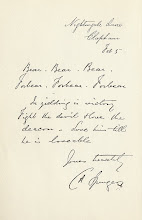
A selection from a letter by Augustus Toplady to John Ryland, Jr. Toplady addressed the conflict he had with those of "Wesley's party," that is, the Arminians. He was greatly despised for his defense of Calvinism but sought to love those who differed with him, though he himself could be very sharp in disputation. The letter was written April 30, 1773.
The envy, malice, and fury of Wesley's party, are inconceivable. But, as violently as they hate me, I dare not, I cannot hate them in return. I have not so learned Christ.—They have my prayers and my best wishes, for their present and eternal salvation, But their errors have my opposition also: and this is the irremissible sin, which those red-hot bigots know not how to forgive.
The Works of Augustus Toplady, volume 6, London, reprint, p. 173.
Showing posts with label opposition. Show all posts
Thursday, September 15, 2011
Friday, April 1, 2011
Opposition
A selection from a letter by John Broadus to his good friend and co-laborer in teaching, J. P. Boyce. Boyce was president of the Baptist seminary in Greenville, SC. He was responsible for raising funds for the relocation of the school to Louisville, KY. His task was difficult. He faced, in the words of Tom Nettles, "post-Civil War distress, Landmark contrariness, and institutional suspicion." These things made it difficult to secure sufficient financial interest in the school. At a particularly low point, Broadus wrote a letter to boost his low spirits. Eventually Boyce met with success but his endurance through the difficult days was helped by the encouragement of friends like Broadus. The letter was written March 4, 1873.
I do not wonder that you sometimes feel discouraged, painfully. The task is difficult, and the kind of opposition encountered is very depressing. But life is always a battle. My dear Fellow, nobody but you can do this thing. I believe you can do it, and it will be, all things considered, one of the great achievements of our time. To have carried it through will be a comfort and a pleasure to you through life, a matter of joy and pride to many who love and honor you, an occasion of thanksgiving through eternity. Opposition—every good thing encounters opposition. Think of Paul, of Jesus! Nay, Nay, no such words as fail. Somehow, somehow, you are bound to succeed.
James Petigru Boyce: A Southern Baptist Statesman, by Thomas J. Nettles, P & R Publishing, 2009, p. 255.
Labels:
depression,
discouragement,
J. P. Boyce,
John A. Broadus,
opposition,
pride,
seminary,
success
Friday, July 30, 2010
Let Us Not Fear
A letter from George Whitefield to the Welsh evangelist, Howell Harris. Whitefield was soon to be in Wales. Whitefield spoke of the opposition they both faced in preaching the gospel but rejoiced in the care extended to him by Christ. The letter was written from London, June 6, 1741.
Outward enemies are now more quiet. Enemies within the church, carnal professors, and self-righteous Pharisees, most try us. Let us not fear, JESUS CHRIST will give us the victory over all. God mightily strengthens me. Our congregations are very large and solemn. I never had greater freedom in preaching. God enables me to cast all my care upon him, with a full assurance that he careth for me.
Letters of George Whitefield: For the Period 1734-1742, The Banner of Truth Trust, 1976, reprinted from The Works of George Whitefield, 1771, p. 268.
Friday, August 28, 2009
Looking to the Lord for Help

A selection from a letter by James Petigru Boyce to his good friend and fellow laborer in the gospel, John A. Broadus. The Seminary in Greenville, South Carolina, of which Boyce was president, was moving to Louisville, Kentucky. Boyce faced much opposition in heading up this move and was attempting to raise funds for the school. The cause of the school was in doubt but due to the laborers of J. P. Boyce and the power of God, the school, now known as The Southern Baptist Theological Seminary, was firmly established. This letter was written December 10, 1872.
I have had some blessed experience in this work of mine. I fear I came in too great self-confidence and conviction that so good a cause must commend itself. The Lord has taught me that all hope in man is vain and as I have been able to look to Him alone I have some wonderful evidences of His aid. Do you wonder then that in the moment of real disdain, and when all felt that nothing could be done, I was enabled to rise and say all is right? I shall succeed. I have no fears. And I feel confident, thought human flesh sometimes fails and I fear. My experience was like that of David in the cave (Ps. 142). Even the temptation was put before me to destroy my enemies, and I was graciously enabled by my publications of minutes to show what I could have done. And I believe God had blessed by peaceful intentions and answered my prayers and accepted my trust. Or shall I not rather say others’ prayers, for all of you have been praying for me—or rather none of ours but only those of Christ whose Spirit has taught us what to ask for and who has himself asked that the prayers be granted. All the glory be to God. The work is succeeding I am sure. Yet I have no more subscriptions yet to report, but my plans are working.
James Petigru Boyce: A Southern Baptist Statesman, by Thomas J. Nettles, P & R Publishing, 2009, pp. 252-53.
Labels:
confidence,
J. P. Boyce,
John A. Broadus,
opposition,
seminary
Subscribe to:
Posts (Atom)