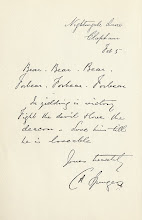
A selection from a letter by Augustus Toplady to John Ryland, Jr. Toplady addressed the conflict he had with those of "Wesley's party," that is, the Arminians. He was greatly despised for his defense of Calvinism but sought to love those who differed with him, though he himself could be very sharp in disputation. The letter was written April 30, 1773.
The envy, malice, and fury of Wesley's party, are inconceivable. But, as violently as they hate me, I dare not, I cannot hate them in return. I have not so learned Christ.—They have my prayers and my best wishes, for their present and eternal salvation, But their errors have my opposition also: and this is the irremissible sin, which those red-hot bigots know not how to forgive.
The Works of Augustus Toplady, volume 6, London, reprint, p. 173.
Showing posts with label Augustus Toplady. Show all posts
Thursday, September 15, 2011
Friday, February 25, 2011
To Be Happy
A selection from a letter to a friend by the well-known hymn writer and preacher of the gospel, Augustus Toplady. Toplady wrote simply of what one must be in order to be happy and the means by which one finds it. The letter was written November 9, 1772.
To be happy we must be virtuous; and in order to our becoming truly virtuous, we must experience the grace of God, which bringeth salvation.
The Works of Augustus Toplady, Bookshelf Publications, reprint from the 1794 edition, p. 834.
To be happy we must be virtuous; and in order to our becoming truly virtuous, we must experience the grace of God, which bringeth salvation.
The Works of Augustus Toplady, Bookshelf Publications, reprint from the 1794 edition, p. 834.
Labels:
Augustus Toplady,
grace of God,
happiness,
salvation,
virtue
Thursday, July 22, 2010
The Good Old Wine of Distinguishing Grace
A selection from a letter by the well-known hymn writer and preacher of the gospel, Augustus Toplady, to a Mr. Bottomley, who had sent him a paper that he had written expressing his acceptance of Calvinistic doctrine. Toplady encouraged him to continue to search the Scriptures and with the light given to him, to throw off the errors of Arminianism. The letter was written December 3, 1768.
I verily hope and believe that that most gracious Being who has led you thus far, will go on to translate you farther and farther into the light and liberty of his children. As I once took occasion to tell you, it is much the same with mistakes in matters of judgment, as it was with the two disciples in the dungeon of Philippi [Acts 16:26]: first the prison shakes and next the doors fly open. I am heartily glad that you are shaken as to the system you have long embraced and trust that it is preclusive to your deliverance from it…
Chiefly keep your eye fixed on the Scriptures and derive by humble, earnest, waiting prayer, all your light and knowledge thence. One thing I am very clear in, that if you reduce your ideas to the standard of Scripture, and make this the model of those, suffering the unerring word of revelation to have the casting vote, and turning your mind into the gospel mould, you must and will eventually throw the idol of Arminianism, in all its branches, to the moles and to the bats. You will no longer dwell with Mesech, nor have your habitation among the tents of Kedar. Having tasted the good old wine of distinguishing grace, you will no longer have any relish for the new scheme of grace without a plan, and of a random salvation; for you will both know and acknowledge that the old is better.
The Works of Augustus Toplady, Bookshelf Publications, reprint from the 1794 edition, pp. 832-33.
Tuesday, March 16, 2010
A Must Be, A Necessity
A selection from a letter by Augusta Toplady to someone who had asked him some important theological questions. One question was whether God might have saved sinners in some other way than by the sacrifice of His Son. Toplady answered that question clearly and accurately in this letter written December 4, 1772.
As to the second question, “Whether sinners might not have been saved in some other way, than by the incarnation, righteousness, and death of Christ?” I make no scruple to give it as my judgment that there was no other possible way of salvation for the lost sons of Adam. If there had, Infinite Wisdom and Goodness would certainly have fixed upon it, in preference to the sorrows and agonies, the wounds and death of him who had done no sin, neither was guile found in his mouth. His own prayer, If it be possible, let this cup (the cup of pain and death) pass from me, would most infallibly have been granted (for the Father heareth him always), and Christ could no more pray than he could bleed in vain, if any thing short of the oblation of himself could have obtained eternal redemption for the people of his love.
Ought not Christ to have suffered these things…? Was there not a must be, a necessity for it? Yes, there was. And, upon any other hypothesis, I see not how it could please the Father to bruise the sinless Messiah and put him to grief, without forfeiting every claim to justice, wisdom, and goodness.
The Works of Augustus Toplady, Bookshelf Publications, reprint from the 1794 edition, p. 835.
Thursday, September 24, 2009
How Is It With Your Soul?

A selection from a letter by Augusta Toplady to a friend, inquiring about the state of her soul. The preacher who has brought encouragement to us all with his wonderful hymns also encouraged many with his letters. He once said, “Letters are but conversation committed to paper.” Here he has, as it were, a conversation with a friend about her relationship with the Lord. The letter was written November 20, 1772.
Above all, Madam, how is it with your soul? What are your views of God and Christ and heaven? Lively, I trust, and full of glory. Yet if our views are dim and languid, still He abideth faithful, and cannot deny himself. Not upon our frames, but upon the adorable Giver of them, is all our safety built. If we cannot follow him in the light, God help us to follow him in the dark; and if we cannot follow him so, to fall down at his feet, and sink into nothing, under the feelings of our own vileness. They who are enabled thus to fall, shall be raised in due time. I know not why, but I could not forbear writing to you. May the Spirit of the living God write his consolations on your heart, and cause your triumphs in Christ to abound more and more.
The Works of Augustus Toplady, Bookshelf Publications, reprint from the 1794 edition, pp. 834-35.
Above all, Madam, how is it with your soul? What are your views of God and Christ and heaven? Lively, I trust, and full of glory. Yet if our views are dim and languid, still He abideth faithful, and cannot deny himself. Not upon our frames, but upon the adorable Giver of them, is all our safety built. If we cannot follow him in the light, God help us to follow him in the dark; and if we cannot follow him so, to fall down at his feet, and sink into nothing, under the feelings of our own vileness. They who are enabled thus to fall, shall be raised in due time. I know not why, but I could not forbear writing to you. May the Spirit of the living God write his consolations on your heart, and cause your triumphs in Christ to abound more and more.
The Works of Augustus Toplady, Bookshelf Publications, reprint from the 1794 edition, pp. 834-35.
Monday, August 3, 2009
The Use of Means

A selection from a letter by Augusta Toplady to Ambrose Serle, a “dear and ever respected friend.” Toplady once said, “Letters are but conversation committed to paper.” This “conversation” was written July 8, 1774.
Sure I am, that God will incline the scale (and not this only, but every other, to the end of time) so as shall conduce to his own glory, and to the accomplishment of his own purpose. It is ours to use the means, in a dependence on his absolute providence; to bless the means used, is his. With him, all events must be ultimately rested; and I trust I can say, ex animo [from the heart], with him I ever wish and desire to rest them; nor would I ever have a single incident removed out of his hand, were I possessed of all power both in heaven and earth.
The Works of Augustus Toplady, Bookshelf Publications, reprint from the 1794 edition, p. 859.
Sure I am, that God will incline the scale (and not this only, but every other, to the end of time) so as shall conduce to his own glory, and to the accomplishment of his own purpose. It is ours to use the means, in a dependence on his absolute providence; to bless the means used, is his. With him, all events must be ultimately rested; and I trust I can say, ex animo [from the heart], with him I ever wish and desire to rest them; nor would I ever have a single incident removed out of his hand, were I possessed of all power both in heaven and earth.
The Works of Augustus Toplady, Bookshelf Publications, reprint from the 1794 edition, p. 859.
Monday, July 6, 2009
Sowing on Ploughed Ground

A selection from a letter by Augusta Toplady to William Romaine, a winsome and effective preacher of the gospel, upon hearing that he had accepted his invitation to come to Broad Hembury in Devonshire, England, to preach. The letter was written September 11, 1773.
God’s Holy Spirit come with you, and speak by you, and bless you to this people. You will sow on ploughed ground, and cannot offend the generality of my hearers; preach free and finished salvation as strongly as you will. May you be enabled to reach their hearts.
The Works of Augustus Toplady, Bookshelf Publications, reprint from the 1794 edition, p. 848.
God’s Holy Spirit come with you, and speak by you, and bless you to this people. You will sow on ploughed ground, and cannot offend the generality of my hearers; preach free and finished salvation as strongly as you will. May you be enabled to reach their hearts.
The Works of Augustus Toplady, Bookshelf Publications, reprint from the 1794 edition, p. 848.
Friday, January 30, 2009
Less Than Nothing and Vanity
A selection from a letter by Augusta Toplady to someone who had written him with words of admiration. He responded with a personal assessment of himself. The letter was written November 2, 1777.
Madam,
Your letter quite distresses me, because it places excellencies to my account which I feel myself to be totally unpossessed of. Among all the weak and unworthy servants of Christ, I am the unworthiest and the weakest. If you know me as well as I know myself, you would be entirely of my mind.
For the Lord’s sake let us look to Jesus only, and learn to cease from man. Christ is all in all. Every other person and thing are vile, and wretched, and hateful, but so far as he deigns to smile and bless. “Less than nothing and vanity” is the only motto that belongs to me. If he vouchsafe to wash me in his blood, and to save me by his infinitely free and glorious redemption; a more worthless and helpless sinner will never sing his praises in the land of glory.
Instead of commending me, pray for me; that I may be kept from evil, and devote my few days (in humble and earnest attempt at least) to the honour of his name…
The Works of Augustus Toplady, Bookshelf Publications, reprint from the 1794 edition, p. 878.
Madam,
Your letter quite distresses me, because it places excellencies to my account which I feel myself to be totally unpossessed of. Among all the weak and unworthy servants of Christ, I am the unworthiest and the weakest. If you know me as well as I know myself, you would be entirely of my mind.
For the Lord’s sake let us look to Jesus only, and learn to cease from man. Christ is all in all. Every other person and thing are vile, and wretched, and hateful, but so far as he deigns to smile and bless. “Less than nothing and vanity” is the only motto that belongs to me. If he vouchsafe to wash me in his blood, and to save me by his infinitely free and glorious redemption; a more worthless and helpless sinner will never sing his praises in the land of glory.
Instead of commending me, pray for me; that I may be kept from evil, and devote my few days (in humble and earnest attempt at least) to the honour of his name…
The Works of Augustus Toplady, Bookshelf Publications, reprint from the 1794 edition, p. 878.
Friday, December 19, 2008
I Desire to Follow His Guidance
A selection from a letter by Augustus Toplady to the Countess of Huntingdon, about his role as a “regular” preacher, a sentinel who keeps to his post, rather than a cavalry officer that is ready for duty wherever he is sent. The letter was written December 9, 1774.
I remember that, in one of my last conversations with dear Mr. Whitefield, antecedently to his last voyage to America, that great and precious man of God said as follows: ‘My good sir, why do not you come out? Why do not you come out? You might be abundantly more useful, were you to widen your sphere, and preach at large, instead of restraining your ministry to a few parish churches.’ My answer was to this effect: that ‘The same Providence which bids others roll at large seems to have confined me to a particular orbit.’
And, I honestly own, I am still of the same mind. If there be, for me, a yet more excellent way, God, I trust, will reveal even this to me. I hope I can truly say, that I desire to follow his guidance with a single eye.
The Works of Augustus Toplady, Bookshelf Publications, reprint from the 1794 edition, p. 862.
I remember that, in one of my last conversations with dear Mr. Whitefield, antecedently to his last voyage to America, that great and precious man of God said as follows: ‘My good sir, why do not you come out? Why do not you come out? You might be abundantly more useful, were you to widen your sphere, and preach at large, instead of restraining your ministry to a few parish churches.’ My answer was to this effect: that ‘The same Providence which bids others roll at large seems to have confined me to a particular orbit.’
And, I honestly own, I am still of the same mind. If there be, for me, a yet more excellent way, God, I trust, will reveal even this to me. I hope I can truly say, that I desire to follow his guidance with a single eye.
The Works of Augustus Toplady, Bookshelf Publications, reprint from the 1794 edition, p. 862.
Monday, November 10, 2008
Standing Up For Christ
A selection from a letter by Augusta Toplady to a pastor in New York. He was encouraged to know that there were faithful Church of England men ministering in America. Mr. Toplady, an opponent of Pelagianism and Arminianism, commented on defending the gospel in his letter. It was written on September 6, 1773.
I can never sufficiently bless God for giving me to see the day when I can truly affirm that I care not whom I displease when the inestimable truths of his gospel are at stake. His providence has rendered me independent on any but himself; and his grace enables me to act accordingly. I must likewise add, as a still further motive to my gratitude, that the bolder I am in his cause, the more he gives me the affections of those to whom I minister, and with whom I am connected. Where I have lost one friend by standing up for Christ, I have gained a multitude.
The Works of Augustus Toplady, Bookshelf Publications, reprint from the 1794 edition, p. 847.
I can never sufficiently bless God for giving me to see the day when I can truly affirm that I care not whom I displease when the inestimable truths of his gospel are at stake. His providence has rendered me independent on any but himself; and his grace enables me to act accordingly. I must likewise add, as a still further motive to my gratitude, that the bolder I am in his cause, the more he gives me the affections of those to whom I minister, and with whom I am connected. Where I have lost one friend by standing up for Christ, I have gained a multitude.
The Works of Augustus Toplady, Bookshelf Publications, reprint from the 1794 edition, p. 847.
Labels:
Augustus Toplady,
controvery,
defense of the faith
Monday, June 2, 2008
If He Was Ever Of Us
A selection from a letter by Augusta Toplady to a friend, about a mutual acquaintance who had departed from the faith, written on September 6, 1768:
If he was ever of us in reality, God will, in due time, bring him to us again. A truly gracious man, like a thorough good watch, may deviate, and point wrong, for a season; but, like the machine just mentioned, will after a time come round, and point right as before. In the mean while, let such instances teach us to be jealous over our own corrupt hearts; make us dependent on the power and faithfulness of the Holy Ghost; stir us up to prayer, that we may be kept from being carried away with the error of the wicked; and put a song of thanksgiving into our mouths, to that God whose free, invincible grace hath enabled us to stand, when others (in appearance stronger than we) have fallen, and become as water that runneth apace.
The Works of Augustus Toplady, Bookshelf Publications, reprint from the 1794 edition, p. 832.
If he was ever of us in reality, God will, in due time, bring him to us again. A truly gracious man, like a thorough good watch, may deviate, and point wrong, for a season; but, like the machine just mentioned, will after a time come round, and point right as before. In the mean while, let such instances teach us to be jealous over our own corrupt hearts; make us dependent on the power and faithfulness of the Holy Ghost; stir us up to prayer, that we may be kept from being carried away with the error of the wicked; and put a song of thanksgiving into our mouths, to that God whose free, invincible grace hath enabled us to stand, when others (in appearance stronger than we) have fallen, and become as water that runneth apace.
The Works of Augustus Toplady, Bookshelf Publications, reprint from the 1794 edition, p. 832.
Monday, March 3, 2008
Our Justifying Merit
Extract from a letter by Augusta Toplady to a friend, March 6, 1767:
Every sigh, if directed to him [God], is a prayer; every tear shed for sin is a sort of oblation, acceptable to him in Christ, and shall be noted in his book. Yet not the sighs we breathe, nor the tears we pour, are our justifying merit; but the sigh, the tears, the obedience , the death, of his co-eternal Son; his are the propitiations, ours are the memorial, and the proof of the work of grace which his Spirit begins in the soul.
The Works of Augustus Toplady, Bookshelf Publications, reprint from the 1794 edition, p. 830.
Every sigh, if directed to him [God], is a prayer; every tear shed for sin is a sort of oblation, acceptable to him in Christ, and shall be noted in his book. Yet not the sighs we breathe, nor the tears we pour, are our justifying merit; but the sigh, the tears, the obedience , the death, of his co-eternal Son; his are the propitiations, ours are the memorial, and the proof of the work of grace which his Spirit begins in the soul.
The Works of Augustus Toplady, Bookshelf Publications, reprint from the 1794 edition, p. 830.
Thursday, December 27, 2007
To Him Let Us Look
Extract from a letter by Augusta Toplady to Mr. Rutter, October 3, 1768:
May the light of his gracious countenance, the comforts of his Spirit, and the cheering intimations of his favour, be your strength, and your portion, when heart and flesh fail! You have, I trust, a merciful and faithful High-Priest above, who bears you on his heart, and is touched with the feeling of your infirmities. To him let us look; on him let the anchor of our reliance be cast.
The Works of Augustus Toplady, Bookshelf Publications, reprint from the 1794 edition, p. 832.
May the light of his gracious countenance, the comforts of his Spirit, and the cheering intimations of his favour, be your strength, and your portion, when heart and flesh fail! You have, I trust, a merciful and faithful High-Priest above, who bears you on his heart, and is touched with the feeling of your infirmities. To him let us look; on him let the anchor of our reliance be cast.
The Works of Augustus Toplady, Bookshelf Publications, reprint from the 1794 edition, p. 832.
Monday, October 29, 2007
The Subjects of My Ministry
A selection from a letter by Augusta Toplady to Mr. Morris, September 2, 1768:
Electing, justifying, regenerating, sanctifying, and persevering grace, have been, and are, the subjects of my ministry; and, I hope, will be, to my latest breath.
The Works of Augustus Toplady, Bookshelf Publications, reprint from the 1794 edition, p. 831.
Electing, justifying, regenerating, sanctifying, and persevering grace, have been, and are, the subjects of my ministry; and, I hope, will be, to my latest breath.
The Works of Augustus Toplady, Bookshelf Publications, reprint from the 1794 edition, p. 831.
Wednesday, September 12, 2007
Predestined to Take Advice
Extract from a letter by Augustus Toplady to Mrs. Macaulay, June 11, 1773, who after exhorting her to watch after her health, said:
Say not, ‘How does this advice comport with your doctrine of predestination?’ For I hope you are predestinated to take the advice; and that a predestinated old age will be the result. Our friend, Mr. Northcote, sometimes says, ‘Mr. Toplady believes absolute predestination; and yet he is loth to ride on horseback, for fear of breaking his neck.’ I answer, ‘True.’ And, perhaps, that very fear may be an appointed means of preserving my neck unbroken.
The Works of Augustus Toplady, Bookshelf Publications, reprint from the 1794 edition, pp. 844-45.
Say not, ‘How does this advice comport with your doctrine of predestination?’ For I hope you are predestinated to take the advice; and that a predestinated old age will be the result. Our friend, Mr. Northcote, sometimes says, ‘Mr. Toplady believes absolute predestination; and yet he is loth to ride on horseback, for fear of breaking his neck.’ I answer, ‘True.’ And, perhaps, that very fear may be an appointed means of preserving my neck unbroken.
The Works of Augustus Toplady, Bookshelf Publications, reprint from the 1794 edition, pp. 844-45.
Subscribe to:
Posts (Atom)