Showing posts with label conversion. Show all posts

Tuesday, July 19, 2011

He Exhorts His Fellow Sinners

A portion of a letter by James Haldane to his ten year-old daughter, Elizabeth. He and his friend, John Campbell, were away preaching in the northern part of Scotland. He told her about a man that had been converted on a previous trip they had made to the north, who had lost both his hands "by the going off of a gun." This convert was most thankful for the goodness of God in sparing his life that he might come to know Christ. The letter was written June 22, 1805.

He was brought to a knowledge of the truth, by a sermon of Mr. Campbell's, the last time we were north. We did not find him at home, but just as we were setting off, after dinner, he came running to see us, and appears to be very happy in waiting for the coming of Jesus. He occasionally exhorts his fellow-sinners, and sometimes holds out his arms, and calls their attention to the goodness of God, in not allowing him to die when he was ignorant of Christ.

The Lives of Robert and James Haldane, by Alexander Haldane, first published in 1852, reprinted by The Banner of Truth, 1990, p. 349.

Friday, September 17, 2010

Born Again!

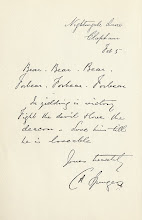
A letter from C. H. Spurgeon to T. W. Medhurst written after Medhurst had become a believer. The last two letters that I have posted were from Medhurst to Spurgeon asking if there was any hope for him, to which Spurgeon responded with the glorious affirmation of hope in Christ. It wasn't long afterwards when salvation came and a dead sinner was raised to life. Medhurst wrote Spurgeon, telling him that he had been converted upon hearing his sermon on John 6:37. He also told him of his desire to be baptized and join the church. Spurgeon replied to Medhurst in this letter written August 7, 1854.

My Dear Sir,

Your letters have given me great joy. I trust I see in you the marks of a son of God, and I earnestly pray that you may have the evidence within that you are born of God.

There is no reason why you should not be baptized. "If thou believest with all thine heart, thou mayest" [Acts 8:37]. Think very seriously of it, for it is a solemn matter. Count the cost. You are now about to be buried to the world, and you may well say, "What manner of persons ought we to be in all holy conversation and godliness" [2 Peter 3:11]. The friends who were with you in the days of your carnal pleasure will strive to entice you from Christ; but I pray that the grace of God may be mightily manifest in you, keeping you steadfast, unmovable, always abounding in the work of the Lord.

I should like to see you on Thursday evening, after six o’clock, in the vestry.

I am,
Yours faithfully,
C. H. SPURGEON

C. H. Spurgeon's Autobiography, Compiled from his diary, letters, and records, by his wife and his private secretary, Volume 2, 1854-1860, p. 141f, from the electronic edition by Logos Research Systems, Inc., 2009. The Banner of Truth Trust have these excellent volumes in print form.

Tuesday, September 14, 2010

There Is Hope

A letter from C. H. Spurgeon to T. W. Medhurst. Medhurst had been attending the services at the New Park Street Church where Spurgeon was preaching and soon to officially be the pastor. He had come under conviction of sin and had sent Spurgeon a letter asking if there was hope for him (see previous post). Spurgeon replied most graciously to his letter. The young man was later converted, entered the ministry, was trained at the Pastor's College later established by Spurgeon, and pastored for over 40 years in churches all across Britain. The letter was written July 14, 1854.

Dear Sir,

I am glad that you have been able to write to me and state your feelings. Though my hands are always full, it will ever give me joy to receive such notes as yours.

You ask me a very important question, “Are you one of God’s elect?” Now, this is a question neither you nor I can answer at present, and therefore let it drop. I will ask you an easier one, “Are you a sinner?” Can you say “YES”? All say, “Yes”; but then they do not know what the word “sinner” means.

A sinner is a creature who has broken all his Maker’s commands, despised His Name, and run into rebellion against the Most High. A sinner deserves hell, yea, the hottest place in hell; and if he be saved, it must be entirely by unmerited mercy. Now, if you are such a sinner, I am glad to be able to tell you the only way of salvation, “Believe on the Lord Jesus.”

I think you have not yet really understood what believing means. You are, I trust, really awakened, but you do not see the door yet. I advise you seriously to be much alone, I mean as much as you can; let your groans go up if you cannot pray, attend as many services as possible; and if you go with an earnest desire for a blessing, it will come very soon. But why not believe now? You have only to believe that Jesus is able and willing to save, and then trust yourself to Him.

Harbour not that dark suggestion to forsake the house of God; remember you turn your back on Heaven, and your face to hell, the moment you do that. I pray God that He will keep you. If the Lord had meant to destroy you, He would not have showed you such things as these. If you are but as smoking flax, there is hope. Touch the hem of His garment; look to the brazen serpent.

My dear fellow-sinner, slight not this season of awakening. Up, and be in earnest. It is your soul, your OWN soul, your eternal welfare, your Heaven or your hell, that is at stake.

There is the cross, and a bleeding God-man upon it; look to Him, and be saved! There is the Holy Spirit able to give you every grace. Look, in prayer, to the Sacred Three-one-God, and then you will be delivered.

I am,
Your anxious friend,
C. H. SPURGEON
Write Again

C. H. Spurgeon's Autobiography, Compiled from his diary, letters, and records, by his wife and his private secretary, Volume 2, 1854-1860, p. 141f, from the electronic edition by Logos Research Systems, Inc., 2009.

Wednesday, May 5, 2010

Soundly Converted Under My Preaching


A selection from a letter by Rev. Daniel Baker to his wife. He had recently arrived in Galveston, Texas, on a survey trip about the possibility of doing mission work there. The city was new and growing. His church in Tuscaloosa, Alabama, did not wish him to leave them but granted him permission to take the trip, along with the blessing of his local Presbytery. His letter home gave some indication of the open door for gospel work and church planting. He ended up spending the rest of his life preaching the gospel in Texas. The letter was written February 21, 1840.

I have preached some fifteen or twenty sermons already, to houses generally crowded, and we should probably have twice as many out, if we could accommodate them. Two or three persons, have, I trust, been this week soundly converted under my preaching. They are, I believe, the very first cases of conversion that ever took place on the island. Thank the Lord for this great honour conferred upon me, a poor, unworthy instrument!

One of the persons spoken of, is a lady of high respectability, who had been on the island about three years, and had never heard a single sermon before she heard me, except one from a Catholic priest some time ago. And strange to tell, this first sermon she heard me preach was blessed to her awakening. She has since obtained a hope, and is one of the most interesting and satisfactory cases of conversion I ever knew in all my life.

Making Many Glad: The Life and Labours of Daniel Baker, by William M. Baker, first published in 1858, reprinted by the Banner of Truth, 2000, pp. 234-35.

Tuesday, May 4, 2010

Every Returning Birthday


A portion of a letter by Rev. Henry Venn, Church of England minister, to his son John on his 20th birthday. He recounted his son's birth in a depraved state, his upbringing and education, and then his conversion. He was a thankful father, happy to know that his son was a follower of Jesus Christ but also that he had given himself to the work of the ministry. His joy is expressed in this natal letter and wise counsel, peppered with hope, characterizes the last paragraph, a letter written March 9, 1779.

… With every requisite qualification as a scholar, and with a character unsullied by conformity to the world, you may, if life is spared, be admitted amongst the witnesses who testify against the evil doctrine and evil practice everywhere prevailing, and come forth engrossed by one grand purpose, from which nothing shall ever divert you—a purpose, through the grace of the Lord Jesus Christ, to spend and be spent in His service—to follow, though with very unequal steps, yet still with all your might to follow, the example of the Apostles, in the doctrine you preach, in the self-denied life you will lead, in the longing desire of our heart to see the lost saved, and the slaves of sin and Satan returning to Zion with everlasting joy upon their heads, transformed into the Divine image, and, with all gratitude, confessing they heard from your lips what they found the means of their salvation. In this most blessed employment (if it please our adorable Saviour) may you work for many years! And every returning birthday solemnly present yourself before Him, to be endued with more wisdom, knowledge, and grace; till, in the appointed hour, you are called to give account of your ministry, and find the day of your death infinitely better than the day of your birth! This is the wish, the ardent, constant prayer, of your affectionate father…

Letters of Henry Venn, by John Venn, first published in 1835, republished by the Banner of Truth, 1993, pp. 273-74.

Wednesday, April 7, 2010

Thinking Too Lightly of the Conversion of Sinners


A selection from a letter by Mary Winslow (1774-1854). No name or date is given but what a convicting letter regarding the lack of general concern believers have for the lost. She points to her own carelessness and then exhorts her correspondent, as well as herself, to be a faithful witness for Christ.


I think the best of God's saints think too lightly of the conversion of sinners; and I take shame to myself that it has not had the influence upon my own mind that it ought to have had. Oh, how much and how deeply have I had cause to mourn over my lack of faithfulness to an immortal soul I knew was traveling the downward road that leads to eternal death; and yet, from fear of offending, have withheld the truth, or have merely satisfied myself with some general hints, unsatisfactory and unconvincing! Did we really believe that ever unconverted person we met with dying so, would be lost forever, should we not be in earnest to warn that soul to flee from the wrath to come? Should we not avail ourselves of every favourable opportunity of praying for them, expostulating with them, and beseeching them to consider their latter end and turn to the Lord that they might be saved? I know there is much wisdom to be exercised to know how and when to speak, all of which the Lord will give to those who are earnest in asking for it. May the Lord make us faithful, myself in particular.

Heaven Opened: A Selection from the Correspondence of Mrs. Mary Winslow, edited by her son, Octavius Winslow, 1864, reprinted by Reformation Heritage Books, 2001, pp. 175-76.

Wednesday, January 27, 2010

Do I Need a New Name?


A selection from a letter by missionary William Carey to Andrew Fuller, one of the leading pastors in England that supported his work in India. Carey explained to Fuller how they looked for preaching gifts among those whom the Lord had saved. Mention was made of Krishna Pal who became a leading worker in the mission. He also wrote about their policy not to change the names of the converts to “Christian” names, thus Krishna, whose name came from a Hindu deity, was not given a new name. The letter was written August 4, 1801.

It has been the custom with the Moravians to give new Names to those who were converted from the Heathens. We had some consultations about it. I opposed it because I thought there was no connection between baptism and giving names but principally because it does [not] appear to have been the primitive practice to change the names of those who believed, for among the primitive Christians we have Sylvanus, Olympus, Hermes, Nereus, Fortunatus and others which are evidently Heathen names. Our Brethren [are] convinced in the opinion that it is unnecessary and, therefore, we have not proposed it. This we should recommend to them not to name any more children with Heathenistic names.

The Journal and Selected Letters of William Carey, collected and edited by Terry G. Carter, Smyth & Helwys, 2000, p. 173.

Thursday, September 17, 2009

Wounded and Healed


A letter from George Whitefield to an acquaintance in Philadelphia who was an overseer of a Society of “negro women and children.” Whitefield had a great interest in the slaves and often preached the gospel to them. Arnold Dallimore shows in a chapter of his two-volume work on the life of Whitefield entitled, “Whitefield and the American Negro,” how he loved the slaves and how they loved him. Many of them responded to the gospel message as preached by Whitefield. Dallimore even argues that Negro Spirituals originated from the slaves that found Christ as Savior and Lord through Whitefield’s preaching.

May 2, 1740

Dear R______,

Let nothing said to you in my absence affect you. God has lately delivered you out of one snare; take heed how you fall into another. If you watch unto prayer, who knows but God may bless your endeavours amongst the poor negro women and children? I could not wish you more happily situated.—My love to all the society.—Exhort them not to rest in good desires. Shew them, O shew them the necessity of being deeply wounded, before they can be capable of healing by Jesus Christ. Bid them to beware of a light behaviour, and light company. Both do grieve the blessed Spirit of God. Take heed, take heed of those accursed snares. I could say more, but time will not permit. My love to the Negro Peggy, and all her black sisters. Bid them to pray for me. May the blood of Jesus wash away all the pollutions of their sin-sick souls! What if they were put into a society by themselves, and you, or some white woman, met with them? The good Lord direct and bless you in all things.—This is the hearty prayer of

Your sincere friend and servant in Christ,
G.W.

Letters of George Whitefield: For the Period 1734-1742, The Banner of Truth Trust, 1976, reprinted from The Works of George Whitefield, 1771, pp. 476-77.

Wednesday, September 2, 2009

The Design of the Gospel


A selection from a letter by John Newton to Thomas Scott. Mr. Scott was a neighbor to Newton. He was an Anglican minister in a nearby parish but he didn’t know the Lord. It was through his friendship with Newton that he came to understand the gospel and was converted. After his conversion Scott wrote A Commentary on the Whole Bible that went through many editions, being popular both in England and America. He wrote his spiritual biography in a book first published in 1779, published now by The Banner of Truth Trust, The Force of Truth. This letter was written August 11, 1775, during Newton’s witnessing stage to Scott.

The gospel, my dear sir, is a salvation appointed for those who are ready to perish, and is not designed to put them in a way to save themselves by their own works. It speaks to us as condemned already, and calls upon us to believe in a crucified Saviour, that we may receive redemption through his blood, even the forgiveness of our sins. And the Spirit of God, by the gospel, first convinces us of unbelief, sin, and misery; and then by revealing the things of Jesus to our minds, enables us, as helpless sinners, to come to Christ, to receive him, to behold him, or in other words, to believe in him; and expect pardon, life, and grace from him; renouncing every hope and aim in which we once rested, ‘and accounting all things loss and dung for the excellency of the knowledge of Christ.’

Letters of John Newton: with Biographical Sketches and Notes, by Josiah Bull, reprinted by the Banner of Truth, p. 256.

Friday, May 22, 2009

O William! Consider Your Dangerous Situation


A selection from a letter by Rev. Edmund Botsford, Baptist pastor in South Carolina and member of the Charleston Association of Churches, to William B. Johnson, an unconverted young man. This is the conclusion to a letter that was hard-hitting about the young man’s sin. Johnson was later converted and became most useful in the kingdom of Christ. The letter was written August 15, 1803.

If you do not turn to him [Christ] with your whole heart, his justice will light on you, he will execute eternal punishment upon you. When I tell you these things, you can evade the force of them, and your natural politeness prevents you from unbecoming behavior; but you go away, and sin again, and do not the things you are required. I tell you, if you continue this practice, the eternal God will be aroused to anger, and swear you shall not enter his rest. When you are summoned to his bar, you must obey; then no evasion will do; you must answer to all that is alleged against you. And how will you answer? In the name of God, how will you answer? O William! If ever grace reaches your poor, blind, hard, unbelieving heart, you will have a worse opinion of it than any other person can. I sincerely wish you may make the discovery in time, but believe me, I greatly fear for you. I consider you in a dangerous situation. I shall not think it strange to see you at the left hand of the Judge, when we shall all make our appearance at his bar. God grant it may be otherwise. If it should be, a great change must take place.

The Memoirs of Elder Edmund Botsford, originally printed by W. Riley Charleston, South Carolonia, 1832, published by Particular Baptist Press, compiled and edited by Charles D. Mallary, with additional footnotes, illustrations and an index, 2004, pp. 124-125.

Wednesday, April 29, 2009

To See and Feel Your Need of a Precious Saviour


A selection from a letter by Mary Jones, wife of the Rev. Charles Colcock Jones. She wrote her son Charles about the death of a young man, George Helm. She used the opportunity to press on him his need for Christ. The letter was written on February 16, 1858.

Would that I could know how he died. I have often thought of his spiritual state. Did he return to the Ark of Safety? Had he an opportunity to seek his Saviour’s face? We may never know. Your father and myself gave him at parting a little token of our interest in his spiritual welfare. Why was he taken and you are left? God’s sovereignty has so ordained it, but for some wise design. My dear son, I pray the Lord to open your eyes and open your heart by this stroke to see and feel your need of a precious Saviour. Oh, to live without Christ and to die without Christ is to be lost forever! Poor, lost, and guilty as we are, we must have an Advocate with the Father—divine and all-sufficient Jesus Christ the Righteous!

The Children of Pride: A True Story of Georgia and the Civil War, edited by Robert Manson Myers, Yale University Press, 1972, p. 394. Iain Murray makes reference to this book of letters in a chapter on the Jones’s in his recent book, Heroes (published by The Banner of Truth Trust).

Wednesday, November 12, 2008

Self-Determination Cannot Lead to Conversion

A portion of a letter from Jonathan Edwards to Rev. John Erskine in Scotland about the fatal doctrine of self-determination. He was sounding a warning against the pernicious errors of Henry Home (Lord Kames) who had distorted the truth of evangelical conversion. The letter was written on August 3, 1757.

And this notion of self-dependence and self-determination tends to prevent or enervate all prayer to God for converting grace; for why should men earnestly cry to God for his grace, to determine their hearts to that, which they must be determined to of themselves? And indeed it destroys the very notion of conversion itself. There can properly be no such thing, or anything akin to what the Scripture speaks of as conversion, renovation of the heart, regeneration, etc. if growing good by a number of successive self-determined acts, be all that is required, or to be expected.

Jonathan Edwards: Letters and Personal Writings, edited by George S. Claghorn, vol. 16 in The Works of Jonathan Edwards, Yale University Press, 1998, p. 723.