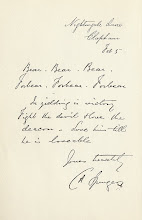
A portion of a letter from George Whitefield to a friend (perhaps George Stonehouse) in England. Whitefield was in Savannah, Georgia, on one of his many trips to America. Whatever trial this brother was facing, Whitefield wrote an edifying letter. The letter was written June 26, 1740.
Go on, dear Sir, go on, and follow your glorious Master without the camp, bearing his sacred reproach. Never fear the scourge of the tongue, or the threatenings that are daily breathed out against the Lord and against his Christ. Suffer we must, I believe, and that great things. Our Lord, by his providence, begins to shew it. Ere long, perhaps, we may sing in a prison, and have our feet set fast in the stocks. But faith in Jesus turns a prison into a palace, and makes a bed of flames become a bed of down. Let us be faithful today and our Lord will support us tomorrow.
Letters of George Whitefield: For the Period 1734-1742, The Banner of Truth Trust, 1976, reprinted from The Works of George Whitefield, 1771, p. 193.
Showing posts with label suffering. Show all posts
Friday, February 18, 2011
Wednesday, July 28, 2010
These Perplexing Dispensations
A selection from a letter by Rev. Thomas Boston to a friend whose wife was ill. Boston's wife was also ailing. The explanation that he gave his friend for God's design in sending hardships was as much intended for his own soul as for his acquaintance. The letter was written January 27, 1728.
When the storm is hard where two seas meet, great is the hazard of fainting; but patience must have her perfect work. These things are designed, I believe, by a holy wise God, not against you, but against the unrenewed part in you, called in scripture the flesh, which is not to be amended, but to be mortified gradually till it die out in the close of the spiritual warfare; at which time the new creature will be perfected, and the image of God, that is never on the whole soul, will wholly occupy every part of the soul, through full and perfecting supplies of grace from Christ the Head, not communicate during the course of this life. Then will be fully seen the beauty of these perplexing dispensations, the necessity of them, and every one of them, which is now to be believed, but not to be clearly seen, by reason of the remains of darkness that is to be found together with the light of grace in the mind.
Be we so happy as to take part with the spirit against the flesh in this war; and though this last complaint under great hardships put upon it, let us secretly rejoice, that the Lord is at such pains to advance mortification in us, that we may be still aiming to be as weaned children, and look upon your afflictions as what the Lord is laying on, to conform you to the image of His Son, whereof suffering and holiness are joint parts.
Memoirs of Thomas Boston, first published in 1899, reprinted by the Banner of Truth, 1988, pp. 504-05.
Thursday, February 25, 2010
Walking Worthy

A letter from George Whitefield to a friend in South Carolina who had written him. He rejoiced in the common salvation they shared. Whitefield was in America at the time and was soon to take a ship bound for Scotland. The letter was written July 24, 1741.
Blessed be God, even the Father of our Lord Jesus Christ, who I trust hath begotten you, called you out of darkness into his marvelous light. What an honour is it, that we should be counted worthy to suffer the least degree of reproach for his great name sake? I am ashamed to think how little I do, or suffer for him. O free grace! Sovereign and electing love! How sweet to the soul, who really feels the power of it! May we walk worthy of that holy vocation wherewith we are called!
Letters of George Whitefield: For the Period 1734-1742, The Banner of Truth Trust, 1976, reprinted from The Works of George Whitefield, 1771, p. 281.
Labels:
common faith,
George Whitefield,
grace,
love,
sovereignty,
suffering
Wednesday, October 21, 2009
The Pop-Gun Threats of a Frowning World

A selection from a letter by the Puritan preacher, Joseph Alleine, to his congregation from prison. He was ejected from the Church of England for nonconformity in 1662 and was arrested and imprisoned because he continued to preach the gospel. Alleine wrote letters to his church while in prison. John Wesley once referred to him as “the English Rutherford.” Alleine touches on the theme of persecution and its blessedness in this letter. It was written July 28, 1665.
…Hath not God said, that if we suffer with him we shall also reign with him; and that these light afflictions work for us a weight of glory? And if this be true, I pray you tell me whether God hath not dealt well with us in counting us worthy of this little tribulation for his name? Indeed, the sufferings are but little; but verily the reward will not be little. I know whom I have trusted; I am well assured the glass is turned up, and every hour reckoned of our imprisonments, and every scorn and reproach of our enemies is kept in black and white.
I believe, therefore do I speak; God is infinitely tender of us, my brethren, though a poor and despicable generation. I value not the pop-gun threats of a frowning world; it is well with us, we are God’s favourites. Come, my beloved, let us sit down under his shadow; here is safety and rest; if God be for us, who can be against us? Verily He bottles all our tears, and tells all our wanderings; He numbers all our hairs; whosoever toucheth us shall not be innocent. Know you not that we are the apple of his eye? Hath not he reproved the greatest for his people’s sakes, saying, ‘Reproach not mine anointed.’ And so we forget how he loved us. Are not we his jewels? Doth He not own us for his members, for his children?
Life and Letters of Joseph Alleine, by Rev. Richard Baxter, Theodosia Alleine, and others, with a new introduction by Joel R. Beeke and Herb Samworth, Reformation Heritage Books, reprinted in 2003, pp. 197-99.
Labels:
affliction,
Joseph Alleine,
persecution,
prison,
suffering
Friday, February 6, 2009
The Lord's Laying Aside His Instruments
A selection from a letter by C. H. Spurgeon to the members of the Metropolitan Tabernacle, London, England. He had been once again laid aside with sickness and was unable to preach. He had gone to Mentone, France, to recuperate. The letter was written December 6, 1890.
I have no question that there is great wisdom in the Lord’s laying aside his instruments. It is for his own glory, for thereby he shows that he is not in need of them, and it is for their humbling, for hereby they learn how deep is their need of him. The uninterrupted reception of blessing through one channel might breed in our foolish hearts an idolatrous confidence in the means; therefore there comes a break in the use of the means that the Lord may be the more tenderly remembered. We may be sure that, if the Lord dries up a cistern, it is because he would have us fly to the fountain of inexhaustible strength.
The Suffering Letters of C. H. Spurgeon, annotations by Hannah Wyncoll, The Wakeman Trust, 2007, p. 71.
Subscribe to:
Posts (Atom)