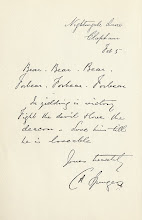
A portion of a letter from George Whitefield to a friend (perhaps George Stonehouse) in England. Whitefield was in Savannah, Georgia, on one of his many trips to America. Whatever trial this brother was facing, Whitefield wrote an edifying letter. The letter was written June 26, 1740.
Go on, dear Sir, go on, and follow your glorious Master without the camp, bearing his sacred reproach. Never fear the scourge of the tongue, or the threatenings that are daily breathed out against the Lord and against his Christ. Suffer we must, I believe, and that great things. Our Lord, by his providence, begins to shew it. Ere long, perhaps, we may sing in a prison, and have our feet set fast in the stocks. But faith in Jesus turns a prison into a palace, and makes a bed of flames become a bed of down. Let us be faithful today and our Lord will support us tomorrow.
Letters of George Whitefield: For the Period 1734-1742, The Banner of Truth Trust, 1976, reprinted from The Works of George Whitefield, 1771, p. 193.
Showing posts with label providence. Show all posts
Friday, February 18, 2011
Wednesday, February 2, 2011
Everything Ordered and Directed by Divine Goodness
A selection from a letter by the Welsh preacher, Thomas Charles, to Sally Jones, whom he would later marry. Charles was a spiritual counselor to Miss Jones throughout their courtship. She grew by leaps and bounds in the grace and knowledge of the Lord through her acquaintance with him. In this letter he directed her to gain comfort in knowing that all events are under God's directions. It was written March 1, 1782.
Never was a truer saying than this… "the good God makes all things good, for good to his people." Everything, the smallest as well as the greatest event, is ordered and directed by divine goodness and wisdom for their good. He is as much present with, and takes as much care of, everyone of his children, as if he had no other creature to watch over, and take care of, in the whole universe.
Thomas Charles' Spiritual Counsels, Selected from his Letters and Papers, by Edward Morgan, first published in 1836, reprinted by the Banner of Truth Trust, 1993, p. 251.
Never was a truer saying than this… "the good God makes all things good, for good to his people." Everything, the smallest as well as the greatest event, is ordered and directed by divine goodness and wisdom for their good. He is as much present with, and takes as much care of, everyone of his children, as if he had no other creature to watch over, and take care of, in the whole universe.
Thomas Charles' Spiritual Counsels, Selected from his Letters and Papers, by Edward Morgan, first published in 1836, reprinted by the Banner of Truth Trust, 1993, p. 251.
Labels:
providence,
Rom 8:28,
Sally Jones,
Thomas Charles,
wisdom
Wednesday, June 30, 2010
Far Be It From Us To Repine
A portion of a letter from John Newton to his beloved wife, Mary. She was away carrying for her father. They were to be together again but the weather became a hindrance. He was disappointed that he would not see her when planned but bemoaned his lack of trust in the Lord more so. The letter was written from his home in Olney, England, January 7, 1776.
I suppose, if Self had his will, he would think his journey to you, of such importance, that no snow should have fallen to retard it, or make it inconvenient. Poor proud creature! What a presumptuous worm, to admit one thought against the appointment of the most High; instead of being duly thankful, that you and I, are safely sheltered, and well provided for, in this severe weather! What hardships are some person suffering this morning, while you, I hope, are sleeping peacefully in your bed, and I am sitting by a good fire. Far be it from us to repine, if in some things our inclinations are a little crossed. It is often, yea always, in mercy when they are. We have seen it so in many instances already, and shall hereafter see that it was so in all.
Letters to a Wife: Written in England from 1755 to 1785, by the author of Cardiphonia (a pen name for John Newton), vol. 2, London, 1793, pp. 192-93.
I suppose, if Self had his will, he would think his journey to you, of such importance, that no snow should have fallen to retard it, or make it inconvenient. Poor proud creature! What a presumptuous worm, to admit one thought against the appointment of the most High; instead of being duly thankful, that you and I, are safely sheltered, and well provided for, in this severe weather! What hardships are some person suffering this morning, while you, I hope, are sleeping peacefully in your bed, and I am sitting by a good fire. Far be it from us to repine, if in some things our inclinations are a little crossed. It is often, yea always, in mercy when they are. We have seen it so in many instances already, and shall hereafter see that it was so in all.
Letters to a Wife: Written in England from 1755 to 1785, by the author of Cardiphonia (a pen name for John Newton), vol. 2, London, 1793, pp. 192-93.
Labels:
contentment,
gratitude,
John Newton,
Mary Newton,
pride,
providence,
repining,
Self,
separation,
weather
Monday, May 10, 2010
Seeing the Hand of God
A selection from a letter by David Kinghorn to his friend, Henry Dawson, who had recently moved to another village and therefore another church. He wrote words of encouragement regarding providence and prayer. In the years following, Mr. Kinghorn wrote his son, Joseph, when a student at the Baptist college in Bristol and then the pastor of St. Mary's Baptist Church, Norwich, many valuable and instructive letters. This letter to the former member of his church was written December 3, 1781.
…As the Lord's way is in the deep waters, and his footsteps are not known until his purposes break forth in his providence, and manifest his design to us, by their accomplishment, it is no wonder, that we should often think, that he writeth bitter things against us, even when he is bringing about the greatest good; and is no proof, that because judgment is not speedily executed against an evil work, that it will not be executed at all; so neither is it a proof, that because prayer is not immediately answered, therefore it is not accepted. The time when, the place where, and the means by which, God accomplishes his purposes, fulfills his promises, and grants our requests, are often quite out of our sight. This indeed makes the hand of God more manifest, for if we had our desires fulfilled in our own way, and agreeable to our own mind, in many respects, we should be at a loss to see the hand of God. To prevent which, and that we may not lose the comfort, nor himself the glory of his own works, he crosses his hands in his providence, and withholds from us, in our way, what he gives in his own.
The Life and Works of Joseph Kinghorn, vol. 3, compiled and edited by Terry Wolever, Particular Baptist Press, 2010, pp. 294-95.
Labels:
David Kinghorn,
God's purposes,
Henry Dawson,
prayer,
promises,
providence
Tuesday, March 30, 2010
Your Saviour is Leading You
A portion of a letter written to Paul Wolfe by a friend. Paul learned that he had cancer when he was a senior at Westminster Seminary. Paul had surgery and went through several rounds of chemotherapy and radiation treatment. God spared his life and taught him many lessons along the way. Those lessons are the subject of a book he has written, published by the Banner of Truth, which is a great encouragement to believers who face cancer, or for that matter, who face any life-threatening ailment. The following was written to him by a friend four days after he was diagnosed with cancer. It was written April 27, 1999.
Dear Paul, surely your Saviour is leading you and Christy through the deepest waters, and is asking you both to trust him with your lives. What else can you do, dear friend? This dark providence has consternated us all, and we cry out for you both. But it is only our dear Elder Brother who understands your sufferings, and through them is changing you from one degree of glory to another. We ever look to his mercy.
My God is True: Lessons Learned Along Cancer's Dark Road, Paul D. Wolfe, The Banner of Truth Trust, 2009, p. 110.
Labels:
cancer,
encouragement,
Paul D. Wolfe,
providence
Wednesday, February 17, 2010
Be Devoted to God
A selection from a letter by Daniel and Hannah Sutcliff, to their son John, who was studying at the Bristol Baptist Academy. Smallpox had killed a number of their friends and relatives. They were grateful that God had spared their son and wrote to exhort him to live his life to the glory of God. John Sutcliff later became the pastor of the Baptist church in Olney, a town made famous by the ministry of John Newton and William Cowper. John received this letter on March 7, 1773.
Dear Son, thy life has been spared through that and other disorders which calls for thankfulness and gratitude. O that it may be devoted to God, spent to His glory and the good of them where His providence may call thee to which end I would suggest a few things…
First, be humble, seek not great things for thyself… If thou have [John] Gillies’ history near thee read the life of [Richard] Blackerby and the extract from the life of David Brainerd.
2nd. Indulge yourself in the happiness of frequent contemplations upon and addresses to the Lord Jesus for light and assistance in all thy studies: consider that this Divine Redeemer’s presence is the life and light of thy soul.
The British Particular Baptists: 1638-1910, volume 3, edited by Michael A. G. Haykin, Particular Baptist Press, 2003, “John Sutcliff: 1752-1814,” by Michael A. G. Haykin, p. 22.
Dear Son, thy life has been spared through that and other disorders which calls for thankfulness and gratitude. O that it may be devoted to God, spent to His glory and the good of them where His providence may call thee to which end I would suggest a few things…
First, be humble, seek not great things for thyself… If thou have [John] Gillies’ history near thee read the life of [Richard] Blackerby and the extract from the life of David Brainerd.
2nd. Indulge yourself in the happiness of frequent contemplations upon and addresses to the Lord Jesus for light and assistance in all thy studies: consider that this Divine Redeemer’s presence is the life and light of thy soul.
The British Particular Baptists: 1638-1910, volume 3, edited by Michael A. G. Haykin, Particular Baptist Press, 2003, “John Sutcliff: 1752-1814,” by Michael A. G. Haykin, p. 22.
Labels:
devotion,
gratitude,
happiness,
humility,
John Sutcliff,
parents,
providence
Thursday, December 17, 2009
Sad Errors

A letter from George Whitefield to the Welsh evangelist, Howell Harris. Whitefield was in Boston but expecting to return to England soon. He wrote of concerns with the theology of John Wesley and his influence on friends at Fetters Lane Society. The letter was written September 24, 1740.
And is dear Brother H[owell] H[arris] yet alive in body and soul? Blessed be God, who causes those that wait on him to renew their strength. I rejoice in your success; may you mount with wings like eagles, walk and not be weary, run and not be faint! You shall not be taken or hurt, till the appointed hour is come.
I hope your conversation was blessed to dear Mr. W[esley]. O that the LORD may batter down his freewill, and compel him to own his sovereignty and everlasting love! Some of F[etters] Lane society, I fear, are running into sad errors; but this happens for our trial, especially mine. Those that before, I suppose, would have plucked out their eyes for me, now I suspect, I shall see very shy, and avoiding me. This is my comfort, the LORD is a never-failing friend; his truth will make its way in spite of all carnal reasoning. O pray for me that I may have the spirit of judgment and a sound mind…
Letters of George Whitefield: For the Period 1734-1742, The Banner of Truth Trust, 1976, reprinted from The Works of George Whitefield, 1771, p. 210.
And is dear Brother H[owell] H[arris] yet alive in body and soul? Blessed be God, who causes those that wait on him to renew their strength. I rejoice in your success; may you mount with wings like eagles, walk and not be weary, run and not be faint! You shall not be taken or hurt, till the appointed hour is come.
I hope your conversation was blessed to dear Mr. W[esley]. O that the LORD may batter down his freewill, and compel him to own his sovereignty and everlasting love! Some of F[etters] Lane society, I fear, are running into sad errors; but this happens for our trial, especially mine. Those that before, I suppose, would have plucked out their eyes for me, now I suspect, I shall see very shy, and avoiding me. This is my comfort, the LORD is a never-failing friend; his truth will make its way in spite of all carnal reasoning. O pray for me that I may have the spirit of judgment and a sound mind…
Letters of George Whitefield: For the Period 1734-1742, The Banner of Truth Trust, 1976, reprinted from The Works of George Whitefield, 1771, p. 210.
Monday, August 3, 2009
The Use of Means

A selection from a letter by Augusta Toplady to Ambrose Serle, a “dear and ever respected friend.” Toplady once said, “Letters are but conversation committed to paper.” This “conversation” was written July 8, 1774.
Sure I am, that God will incline the scale (and not this only, but every other, to the end of time) so as shall conduce to his own glory, and to the accomplishment of his own purpose. It is ours to use the means, in a dependence on his absolute providence; to bless the means used, is his. With him, all events must be ultimately rested; and I trust I can say, ex animo [from the heart], with him I ever wish and desire to rest them; nor would I ever have a single incident removed out of his hand, were I possessed of all power both in heaven and earth.
The Works of Augustus Toplady, Bookshelf Publications, reprint from the 1794 edition, p. 859.
Sure I am, that God will incline the scale (and not this only, but every other, to the end of time) so as shall conduce to his own glory, and to the accomplishment of his own purpose. It is ours to use the means, in a dependence on his absolute providence; to bless the means used, is his. With him, all events must be ultimately rested; and I trust I can say, ex animo [from the heart], with him I ever wish and desire to rest them; nor would I ever have a single incident removed out of his hand, were I possessed of all power both in heaven and earth.
The Works of Augustus Toplady, Bookshelf Publications, reprint from the 1794 edition, p. 859.
Subscribe to:
Posts (Atom)