Showing posts with label common faith. Show all posts

Wednesday, October 27, 2010

The Life of Faith is a Wonderful Life

A letter by Mary Winslow (1774-1854). The date the letter was written is not given nor the name of the person to whom she wrote. Her letter is about faith, in particular, the trial of faith. If anyone knew by experience how to walk by faith during difficult times, it was Mary Winslow. At forty years of age, she was widowed and left to raise nine children in her newly adopted country, America. She truly learned to walk by faith in times of suffering. Her counsel is wise and tried.

But you must look above and beyond these earthly disappointments, to Jesus as our only Friend. We only want more faith to ask at His hands what we will, and to be satisfied with what He gives, believing that if more were for our good, our dearest and best Friend would give more.

The life of faith is a wonderful life. Honoured is the Christian who is called to live it. He is trained in this life to know more of himself, and more of the unchanging character, love, and tender, watchful care of his heavenly Father. Has God so loved us as to give His only and well-beloved Son to die for us, and is it probably that He will withhold anything that is absolutely needful for us? The trial of faith is the sure way of increasing it. We ask for more faith, and God tries what we have, and that is His way of answering our prayer for its increase. He brings us into trials, so that we are compelled to look only to Him for help. He knocks from beneath us every human and earthly prop; for (to our shame be it spoken) we are for ever hewing out creature cisterns, and constructing earthly supports, instead of going without ceasing to our sure and faithful Friend for all we need.

I sometimes think it were a greater trial to be rich than to be poor. Of this I am quite sure, that riches to the Christian are a great snare, as well as a great trouble, and entails more anxiety and sorrow than real pleasure and enjoyment. If ever I have wished for affluence, it has been to help others. Yet in so doing, what losers might the objects of my charity be in this experimental acquaintance with the Saviour's love! Why did our all-wise God lead the children of Israel through the wilderness, and feed them day by day with manna from heaven and water from the rock, but to shew them what was in them, and what was in Him?

And so He feeds and cares for His sheep now. He is unchanged and unchangeable. He took care of Elisha, and He takes care of us; so let us be of good courage, and trust fully in the Lord our God.

Heaven Opened: A Selection from the Correspondence of Mrs. Mary Winslow, edited by her son, Octavius Winslow, 1864, reprinted by Reformation Heritage Books, 2001, pp. 222-223 (the letter has been broken up into paragraphs in order to make it more readable).

Friday, October 22, 2010

Make the Grip Stronger

A portion of a letter from Samuel Rutherford to Lady Boyd, a frequent correspondent. His letter directs her to be strong in the midst of trials and exercise faith in "a smiting Redeemer." A time of trial for a believer is an occasion to cleave to the Lord. The letter was written October 15, 1640.

What is wrath to others is mercy to you and your house. It is faith’s work to claim and challenge loving–kindness out of all the roughest strokes of God…

And, since you will not alter upon Him who will not change upon you, I do in my weakness, think myself no spiritual seer if I should not prophesy that daylight is near, when such a morning darkness is upon you; and that this trial of your Christian mind towards Him (whom you dare not leave, nevertheless He should slay you) shall close with a doubled mercy. It is time for faith to hold fast as much of Christ as ever you had, and to make the grip stronger, and to cleave closer to Him, seeing Christ loveth to be believed in and trusted to. The glory of laying strength upon one that is mighty to save is more than we can think.

That piece of service, believing in a smiting Redeemer, is a precious part of obedience. Oh what glory to Him to lay over the burden of our heaven upon Him that purchased for us an eternal kingdom! O blessed soul, who can adore and kiss His lovely free grace!

Letters of Spiritual Counsel: Taken from Samuel Rutherford's Letters (electronic edition), Simpsonville SC: Christian Classics Foundation.

Tuesday, September 14, 2010

There Is Hope

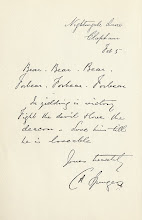
A letter from C. H. Spurgeon to T. W. Medhurst. Medhurst had been attending the services at the New Park Street Church where Spurgeon was preaching and soon to officially be the pastor. He had come under conviction of sin and had sent Spurgeon a letter asking if there was hope for him (see previous post). Spurgeon replied most graciously to his letter. The young man was later converted, entered the ministry, was trained at the Pastor's College later established by Spurgeon, and pastored for over 40 years in churches all across Britain. The letter was written July 14, 1854.

Dear Sir,

I am glad that you have been able to write to me and state your feelings. Though my hands are always full, it will ever give me joy to receive such notes as yours.

You ask me a very important question, “Are you one of God’s elect?” Now, this is a question neither you nor I can answer at present, and therefore let it drop. I will ask you an easier one, “Are you a sinner?” Can you say “YES”? All say, “Yes”; but then they do not know what the word “sinner” means.

A sinner is a creature who has broken all his Maker’s commands, despised His Name, and run into rebellion against the Most High. A sinner deserves hell, yea, the hottest place in hell; and if he be saved, it must be entirely by unmerited mercy. Now, if you are such a sinner, I am glad to be able to tell you the only way of salvation, “Believe on the Lord Jesus.”

I think you have not yet really understood what believing means. You are, I trust, really awakened, but you do not see the door yet. I advise you seriously to be much alone, I mean as much as you can; let your groans go up if you cannot pray, attend as many services as possible; and if you go with an earnest desire for a blessing, it will come very soon. But why not believe now? You have only to believe that Jesus is able and willing to save, and then trust yourself to Him.

Harbour not that dark suggestion to forsake the house of God; remember you turn your back on Heaven, and your face to hell, the moment you do that. I pray God that He will keep you. If the Lord had meant to destroy you, He would not have showed you such things as these. If you are but as smoking flax, there is hope. Touch the hem of His garment; look to the brazen serpent.

My dear fellow-sinner, slight not this season of awakening. Up, and be in earnest. It is your soul, your OWN soul, your eternal welfare, your Heaven or your hell, that is at stake.

There is the cross, and a bleeding God-man upon it; look to Him, and be saved! There is the Holy Spirit able to give you every grace. Look, in prayer, to the Sacred Three-one-God, and then you will be delivered.

I am,
Your anxious friend,
C. H. SPURGEON
Write Again

C. H. Spurgeon's Autobiography, Compiled from his diary, letters, and records, by his wife and his private secretary, Volume 2, 1854-1860, p. 141f, from the electronic edition by Logos Research Systems, Inc., 2009.

Friday, June 11, 2010

Mistake Not the Means for the End


A selection from a letter by Rev. John Newton to Rev. Thomas Scott. Mr. Scott was an unconverted Anglican minister in a nearby parish. His conversion came about through a friendship with Mr. Newton, who through correspondence answered many of his questions. In a letter written December 8, 1775, Newton answered several questions that had been posed by Scott. Newton told him, "I have embraced the occasion to lay before you simply, and rather in a way of testimony than argumentation, what (in the main) I am sure is truth." One question was whether man had the power to do anything good apart from "an extraordinary impulse from on high."

You ask if man can do nothing without an extraordinary impulse from on high, is he to sit still and careless? By no means. I am far from saying man can do nothing, though I believe, he cannot open his own eyes, or give himself faith. I wish every man to abstain carefully from sinful company, and sinful actions, to read the Bible, to pray to God for his heavenly teaching. And if he persevere thus seeking, the promise is sure, that he shall not seek in vain. But I would not have him mistake the means for the end; think himself good because he is preserved from gross vices and follies, or trust to his religious course of duties for acceptance, nor be satisfied till Christ be revealed in him, formed within him, and dwell in his heart by faith.

Letters of John Newton: with Biographical Sketches and Notes, by Josiah Bull, reprinted by the Banner of Truth, p. 270.

Monday, March 8, 2010

Sovereign Disposal


A selection from a letter by Rev. Thomas Boston, to his friend, James Hog. Hog's wife was ill as was Boston's wife. He wrote to remind his friend that the Lord was not absent in the hour of trial and that the hope of glory was sure. The letter was written April 25, 1726.


I understood by yours, that your wife continues in her ordinary tender condition; may it be sanctified by grace to her and to you. The different states of persons, in respect of health and infirmity, is a piece of sovereign disposal, which the afflicted are to reverence and adore. Our Lord Himself was a man of sorrows, and acquainted with griefs; and if we suffer with Him, we shall also reign with Him. The heaviest burden of affliction is but light in respect of the weight of glory we have in hope; and the affliction that is of such continuance as the party has forgot prosperity, is but for a moment, being compared with the eternity of that weight which faith has the view of.


Memoirs of Thomas Boston, first published in 1899, reprinted by the Banner of Truth Trust, 1988, p. 501.

Thursday, February 25, 2010

Walking Worthy


A letter from George Whitefield to a friend in South Carolina who had written him. He rejoiced in the common salvation they shared. Whitefield was in America at the time and was soon to take a ship bound for Scotland. The letter was written July 24, 1741.

Blessed be God, even the Father of our Lord Jesus Christ, who I trust hath begotten you, called you out of darkness into his marvelous light. What an honour is it, that we should be counted worthy to suffer the least degree of reproach for his great name sake? I am ashamed to think how little I do, or suffer for him. O free grace! Sovereign and electing love! How sweet to the soul, who really feels the power of it! May we walk worthy of that holy vocation wherewith we are called!

Letters of George Whitefield: For the Period 1734-1742, The Banner of Truth Trust, 1976, reprinted from The Works of George Whitefield, 1771, p. 281.