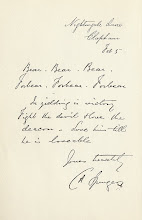
A portion of a letter by Martin Luther to his friend, Philip Melanchthon, December, 1535. He wrote to tell him that he should not be deterred from returning to Wittenberg by rumors concerning the plague.
We expect your return, and should a rumor reach you, then endure and overcome it. We hope that, even if there should be any future cases of contagious disease [around here], we will nevertheless have clean air (instead of this Scythian sky). Were it the plague, it would need other symptoms. Everywhere on earth people are mortal; they are born and they die. We cannot all remain alive here on earth, otherwise we will not get yonder.
Luther's Works, Letters III, Vol. 50, #266, edited by J. J. Pelikan, H. C. Oswald and H. T. Lehmann, Fortress Press.
Friday, November 28, 2008


Wednesday, November 26, 2008
The Proofs of Our Having Been Christians
A selection from a letter by James A. Haldane to his aunt, upon hearing of the sudden death of her husband. In writing to comfort her, he commented on the necessity of godly living so as to be prepared for that day when we shall all stand before the Lord. The letter was written August 14, 1804:
I should wish constantly to connect every word I speak and every action I perform with the judgment-seat of Jesus, for according to our words and actions we shall stand or fall. The holiness of our lives, our deadness to the world, and all that is in it, our constant pressing forward to win Christ, and to be found in Him; esteeming everything else but loss and dung; sacrificing to this great object every inclination of our corrupt nature, and every consideration which would for a moment divert our attention from Christ, these and these alone will in the great day of God be the proofs of our having been Christians. If we be risen with Christ, let us seek the things that are above. Yes, we shall infallibly do so, for in that case we must have the spirit of Christ, and where the spirit of Christ dwells there will be conformity to him, whose whole heart and affections were constantly fixed on his heavenly Father.
The Lives of Robert and James Haldane, by Alexander Haldane, first published in 1852, reprinted by The Banner of Truth, 1990, p. 345.
Monday, November 24, 2008
Building Up and Fortifying the Church
A selection from a letter by Rev. William Still to his congregation, Gilcomston South Church of Scotland, Aberdeen, November, 1960:
The Church’s first task, it seems to me, is to keep being herself in a changing world, and thus to build herself up and fortify herself against the growing onslaughts of evil, as prophesied in history and in each successive generation. This she can only do by being, not evangelically minded, devotionally or convention minded, socially minded, ecumenically minded, or politically minded; but by taking the whole Word of God as her diet, and feeding and building herself up on that. Thus she preserves her strength for every heroic task, including all these, and makes impact, often painful impact, upon all the life of her day.
The Letters of William Still, The Banner of Truth, 1984, pp. 75-76.
Friday, November 21, 2008
More Prayer
A selection from a letter by Elizabeth Prentiss, author of Stepping Heavenward, a book which has touched the hearts of many, to her husband, George Lewis Prentiss, written in October of 1869.
I am not skilled in argument, but my heart sides with God in everything, and my conception of His character is such a beautiful one that I feel that He can not err… The more time we spend upon our knees, in real communion with God, the better we shall comprehend His wonderful nature, and how impossible it is to submit that nature to the rules by which we judge human beings. Every turn in life brings me back to this—more prayer.
More Love to Thee: The Life and Letters of Elizabeth Prentiss, George Lewis Prentiss, reprinted by Solid Ground Christian Books, p. 279.
Wednesday, November 19, 2008
Family Worship
A portion of a letter from Rev. Joseph Kinghorn, pastor of St. Mary’s Baptist Church, Norwich, England, written to Rev. William Newman, who had just become the president of Stepney Academy on March 25, 1811. The letter was filled with spiritual counsel on many practical subjects, including the importance of maintaining family worship.
You will do well, also, to pay a particular attention to your family worship; not so much that it be long as that it be regular, and conducted in a manner likely to support a devotional feeling, and a sense of its importance. Let it not be broken upon, or treated as a matter of mere conveniency.
The Life and Works of Joseph Kinghorn, by Martin Hood Wilkin, reprinted by Particular Baptist Press, 1995, p. 338.
Friday, November 14, 2008
Dressed Gloriously in the Robes of Gospel Righteousness
A selection from a letter by Thomas Charles to a female acquaintance that had made remarks in a letter to him about modest dress. He agreed with her but made a spiritual application in his return letter, written August 14, 1795.
What a glorious change – the garments of salvation instead of our own filthy rags! “Take away the filthy rags from him” – gracious words! Instead of driving him and his filthy garments into destruction, he is saved, as a brand plucked out of the burning; and he is clothed with a change of raiment. What a dispensation of abounding grace is here! The sin destroyed and not the sinner! – not saved in his filthy raiment, but saved and washed and dressed gloriously in the robes of gospel righteousness. How shall we adore, wonder and praise, when we appear above, thus completely arrayed!
Thomas Charles’ Spiritual Counsels: Selected from his Letters and Papers, by Edward Morgan, first published in 1836, reprinted by the Banner of Truth, 1993, pp. 379-80.
Wednesday, November 12, 2008
Self-Determination Cannot Lead to Conversion
A portion of a letter from Jonathan Edwards to Rev. John Erskine in Scotland about the fatal doctrine of self-determination. He was sounding a warning against the pernicious errors of Henry Home (Lord Kames) who had distorted the truth of evangelical conversion. The letter was written on August 3, 1757.
And this notion of self-dependence and self-determination tends to prevent or enervate all prayer to God for converting grace; for why should men earnestly cry to God for his grace, to determine their hearts to that, which they must be determined to of themselves? And indeed it destroys the very notion of conversion itself. There can properly be no such thing, or anything akin to what the Scripture speaks of as conversion, renovation of the heart, regeneration, etc. if growing good by a number of successive self-determined acts, be all that is required, or to be expected.
Jonathan Edwards: Letters and Personal Writings, edited by George S. Claghorn, vol. 16 in The Works of Jonathan Edwards, Yale University Press, 1998, p. 723.
Subscribe to:
Posts (Atom)