Showing posts with label forgiveness. Show all posts

Wednesday, August 31, 2011

I Really Don't Like This Guy

A portion of a letter written by a forty-three-year old black man from Tennessee, to John MacArthur. This gentleman had been influenced by the Black Power movement and had turned away from Christianity. In listening to MacArthur preaching on the Grace to You radio broadcast, he was converted and began to live for Christ.

I bought into the teaching against a "white" Jesus, and the pro-Black teachings became my religion… When I first heard you on radio about nine years ago, I thought to myself, "I really don't like this guy and what he is saying." I was pretty sure you were white. Then one day I heard you preach on forgiveness of sins and love, and the veil was lifted from my eyes. Up until then, I had never truly heard the gospel preached, never truly understood the holiness of God. The Word of God began to have an incredible impact on me as I listened to your preaching daily. By God's grace, I've been living for Him, studying His Word, and listening to your broadcast for the last nine years.

John MacArthur: Servant of the Word and Flock, Iain H. Murray, The Banner of Truth Trust, 2011, p. 180.

Thursday, July 14, 2011

A Firmer Grip Than Ever

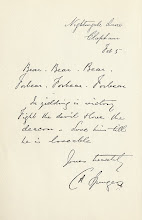
A portion of a letter from Charles Haddon Spurgeon, written to his congregation, four weeks prior to his death. His church was the Metropolitan Tabernacle, London, England. He was writing from Menton, France, where he had gone to recover from illness. But recovery was not meant to be. He had gone through the valley of the shadow of death just a short while before, but his health was now worse. He wanted his flock to know that the gospel he had preached for over 40 years was still his hope and joy, and should be theirs too. The letter was written January 6, 1892.

I feel my mind grasping with firmer grip than ever that everlasting gospel which for so many years I have preached to you. We have not been deceived. Jesus does give rest to those who come to him, he does save those who trust him, he does photograph his image on those who learn of him. I hate the Christianised infidelity of the modern school more than ever, as I see how it rends away from sinful man his last and only hope. Cling to the gospel of forgiveness through the substitutionary sacrifice, and spread it with all your might, each one of you, for it is the only cure for bleeding hearts.

The Suffering Letters of C. H. Spurgeon, annotations by Hannah Wyncoll, Wakeman Trust, 2007, pp. 118-19.

Friday, June 3, 2011

A Beautiful World Ravaged by War

A portion of a letter written by Robert E. Lee, commander of the Confederate army, to his wife, Mary. He comments on the beautiful countryside of Culpeper, Virginia, which had been ravaged by war. He laments the degradation that man had brought to God's creation. The letter was written June 9, 1863. The Battle of Gettysburg would commence in four weeks time.

The country here looks very green and pretty notwithstanding the ravages of war. What a beautiful world God in His loving kindness to His creatures has given us. What a shame that man endowed with reason and a knowledge of right should mar His gifts. May He soon change the hearts of men, shew them their sins and enable them to repent and be forgiven.

The Wartime Papers of Robert E. Lee, edited by Clifford Dowdey, The Da Capo Press, 1961, document #466, p. 507.

Wednesday, March 9, 2011

It Is Best to Fall Into His Hands

A selection from a letter by J. C. Philpot to his friend, Mr. Tanner. Philpot was a Strict Baptist pastor and editor of the Gospel Standard magazine. His letters are filled with spiritual counsel of a high quality. He began this letter by reminding his friend that it is better "to suffer from the Lord than to sin against the Lord." The letter was written November 22, 1861.

Our coward flesh shrinks from every affliction and trial, and even though we may have proved in times past that there has been a blessing couched in them, yet our heart murmurs and frets under the weight of the cross. But the Lord, like a wise parent, does not consult us as to where, when, or how He may lay on the chastising stroke. It is best, therefore, to fall into His hands, and to lie at His feet begging that He will sanctify to us every afflicting stroke, not lay upon us more than we can bear, and remove the trial when it has done its appointed work. Of one thing I am very sure, that it is far better to suffer from the Lord than to sin against the Lord. There is no evil which we need really fear except sin; and, though the Lord, in tender mercy, forgives His erring, wandering children, yet He makes them all deeply feel that indeed it is an evil and a bitter thing to sin against Him.

Letters by the Late Joseph Charles Philpot with a Brief Memoir of His Life and Labours, London, 1871, p. 338.

Monday, January 3, 2011

Love Has Replaced Hate

A letter by a surviving World War II Prisoner of War of the Japanese, Louis Zamperini, to Mutsuhiro Watanabe, one of the worst guards in any POW Camp, who had a particular vendetta against him. Zamperini was an Olympic runner before the war, so was well-known and famous. He was bombardier of a B-24 in the Pacific during the war. After his plane went down, he and the pilot survived over 40 days in a raft only to be picked up by the Japanese and was thus interred as prisoner. 37% of POW's in Japan did not survive and many of the men that did were scarred physically and emotionally for the rest of their lives. Such was the case of Zamperini until he found Christ. Conversion took away his nightmares, cured him of alcoholism, and enabled him to love his former enemies, even the guard that mistreated him so badly. Zamperini returned to Japan in 1998 to carry the Olympic torch. He hoped to visit Watanabe, "the Bird," so he could tell him about Christ, but his overture was refused. This letter was sent instead.

To Mutsuhiro Watanabe,

As a result of my prisoner war experience under your unwarranted and unreasonable punishment, my post-war life became a nightmare. It was not so much due to the pain and suffering as it was the tension of stress and humiliation that caused me to hate with a vengeance.

Under your discipline, my rights, not only as a prisoner of war but also as a human being, were stripped from me. It was a struggle to maintain enough dignity and hope to live until the war's end.

The post-war nightmares caused my life to crumble, but thanks to a confrontation with God through the evangelist Billy Graham, I committed my life to Christ. Love has replaced the hate I had for you. Christ said, "Forgive your enemies and pray for them."

As you probably know, I returned to Japan in 1952 and was graciously allowed to address all the Japanese war criminals at Sugamo Prison… I asked then about you, and was told that you probably had committed Hara Kiri, which I was sad to hear. At that moment, like the others, I also forgave you and now would hope that you would also become a Christian.

Louis Zamperini

Unbroken: A World War II Story of Survival, Resilience, and Redemption, by Laura Hillenbrand, Random House, 2010, pp. 396-97.

Monday, December 28, 2009

Preaching Grace


A portion of a letter by Martin Luther to Philip Melanchthon. The bulk of the letter contains Luther’s views on celibacy and communion but he concludes with a word about sin and forgiveness. Luther appears to encourage licentiousness but his intentions lay elsewhere. The great reformer meant to highlight the greatness of Christ’s atonement. However, it is easy to see why others misunderstood his meaning. The letter was written August 1, 1521.

If you are a preacher of grace, then preach a true and not a fictitious grace; if grace is true, you must bear a true and not a fictitious sin. God does not save people who are only fictitious sinners. Be a sinner and sin boldly, but believe and rejoice in Christ even more boldly, for he is victorious over sin, death, and the world. As long as we are here [in this world] we have to sin. This life is not the dwelling place of righteousness, but, as Peter says, we look for new heavens and a new earth in which righteousness dwells. It is enough that by the riches of God’s glory we have come to know the Lamb that takes away the sin of the world. No sin will separate us from the Lamb, even though we commit fornication and murder a thousand times a day. Do you think that the purchase price that was paid for the redemption of our sins by so great a Lamb is too small? Pray boldly—you too are a mighty sinner.

Luther's Works, Vol. 48, Letters I, edited by J. J. Pelikan, H. C. Oswald and H. T. Lehmann, Fortress Press, letter # 91, p. 283.

Tuesday, October 27, 2009

Life Is Too Short For Prolonged Contention

A letter seeking reconciliation by Robert Haldane to Greville Ewing, a pastor friend who had separated himself from Haldane due to differences in doctrine and other matters. Their disagreements had an adverse consequence on the growing Baptist and Congregational movement then taking place in Scotland. Haldane didn’t want to enter heaven without their being reconciled. Haldane’s efforts for a public reconciliation were in vain but it appears that Mr. Ewing laid aside all personal animosity and bitterness. The letter was written in 1819 in Montauban, France, but was not delivered until Haldane returned to Scotland in 1821.

My Dear Sir:

Having had the other night a pleasing dream respecting an interview which I thought I enjoyed with you, and which recalled all that tenderness of affection I once had for you, I cannot let the feeling it excited pass without sending you these lines. Life is too short for such a prolonged contention. A great portion of yours and mine has passed since the unseemly strife began. Peace be with you!

I would not, however, desire to place so important a matter merely on the foundation of feeling, but it appears to me, considering the complication of circumstances which were, and perhaps still are, viewed by us in different lights, and the long period that has elapsed since we met, that while to each of us there are strong ground of searching of heart, all real or supposed offences may now be mutually set aside and give place to peace and cordial goodwill. May He who, I trust I may say, has loved us both, and washed us in his blood, subdue all our iniquities and cast our sins behind him into the depths of the sea! Being at such a distance, it is uncertain if we shall ever meet on earth. May we enjoy a blessed eternity in his presence!

I am, my dear Sir, yours,
Robert Haldane

The Lives of Robert and James Haldane, by Alexander Haldane, first published in 1852, reprinted by The Banner of Truth, 1990, p. 374.

Wednesday, May 27, 2009

My Only Daily Remedy


A selection from a letter by the Welsh preacher, Thomas Charles, to a friend. The letter focuses on the necessity of forgiveness, bestowed and received. There had been a misunderstanding between them and he sought her forgiveness. The letter was written April 9, 1802.

If I have trespassed, you must freely forgive me, and then we are friends again. The doctrine of forgiveness, whether received or bestowed, is very suitable to us in the world, full of failings; and continual infirmities as we all are. It is my only daily remedy. Were it not for pardon, dearly bought, but freely bestowed upon me, a guilty wretch, daily, I should sink in a moment into all the gloom of eternal despair. But “there is forgiveness,” and we “have redemption through his blood, the forgiveness of sin,” and that “according to the riches of His grace.” Charming words! Though utterly ruined, we are thus made up for ever.

Thomas Charles’ Spiritual Counsels: Selected from his Letters and Papers, by Edward Morgan, first published in 1836, reprinted by the Banner of Truth, 1993, p. 303.