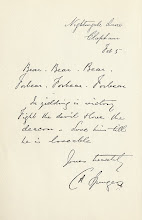
A selection from a letter written by William B. Sprague (1795-1876), pastor for 40 years of the Second Presbyterian Church in Albany, New York. He wrote a series of letters to his daughter after his wife and her mother died. The letters contain counsel from a loving father who desired for his daughter to become a godly woman. No date is given for this letter.
… let me counsel you to cherish a deep sense of the constant presence of God, and of your accountableness to him for every part of your conduct. An habitual impression of this kind will make you comparatively indifferent, both to the censures and applauses of mortals, and will lead you to regard every other question as unimportant, in comparison with the simple question of duty. And the consequence of this cannot fail to be, that you will judge carefully and honestly of what is right, and will act with unyielding decision. No matter what temptations may spread themselves before you to divert you from the path of duty, the reflection, "Thou, God, seest me" [Gen. 16:13], brought home to your understanding and conscience, will insure you the victory over them. This is something distinct from natural inflexibility of character: it is independence of mind, based on religious principle; and it is this especially which I urge you to cultivate.
Letters on Practical Subjects to a Daughter, by William B. Sprague, New York, 1831, pp. 90-91.
Showing posts with label daughter-in-law. Show all posts
Monday, November 15, 2010
Wednesday, January 20, 2010
Under God All Depends on the Mother

A selection from a letter by Rev. Benjamin Morgan Palmer to his daughter Anna, who recently had given birth to a son. He wrote to comfort her for she has lost her first child, a daughter, at birth. He also wrote to challenge her to be a dedicated mother. The letter was written January 4, 1869.
This time it is a son! What a solemn responsibilities cluster around that word! This boy-babe is after a while to be a man. Can you tell what a vast intellect may be slumbering within that little head? Who knows but that the fate of an empire may be wrapped in the folds of his career? Those little hands may wield the destiny of this great Republic—and that tiny voice may sway the councils of a nation; who knows! That little heart, it may be a volcano of passions, to be belched forth in smoke and fire upon a devastated earth—or it may be the well-spring of a mighty stream of beneficence to refresh and fertilize the world. Which shall it be? Do not stagger, nor be affrighted, when I answer that under God all depends upon the mother.
A fearful trust is reposed in you, my daughter, in this boy’s birth; for of a truth, in time and in the great hereafter, he will be just what you shall make him. It is too late to shrink back in terror. He is yours; and the great God, who gave him to you, says, ‘Take this child and nurse it for me, and I will give thee thy wages’ [Exodus 2:9]. Mark the terms of the contract, for therein lies the trust, and the comfort too. ‘Nurse it for me’—that is the trust; ‘and I will give thee thy wages’—this is the assurance. Both are bound together. If you nurse it for God, you shave have ample recompense…
The Life and Letters of Benjamin Morgan Palmer, by Thomas Cary Johnson, Banner of Truth, p. 383.
This time it is a son! What a solemn responsibilities cluster around that word! This boy-babe is after a while to be a man. Can you tell what a vast intellect may be slumbering within that little head? Who knows but that the fate of an empire may be wrapped in the folds of his career? Those little hands may wield the destiny of this great Republic—and that tiny voice may sway the councils of a nation; who knows! That little heart, it may be a volcano of passions, to be belched forth in smoke and fire upon a devastated earth—or it may be the well-spring of a mighty stream of beneficence to refresh and fertilize the world. Which shall it be? Do not stagger, nor be affrighted, when I answer that under God all depends upon the mother.
A fearful trust is reposed in you, my daughter, in this boy’s birth; for of a truth, in time and in the great hereafter, he will be just what you shall make him. It is too late to shrink back in terror. He is yours; and the great God, who gave him to you, says, ‘Take this child and nurse it for me, and I will give thee thy wages’ [Exodus 2:9]. Mark the terms of the contract, for therein lies the trust, and the comfort too. ‘Nurse it for me’—that is the trust; ‘and I will give thee thy wages’—this is the assurance. Both are bound together. If you nurse it for God, you shave have ample recompense…
The Life and Letters of Benjamin Morgan Palmer, by Thomas Cary Johnson, Banner of Truth, p. 383.
Labels:
Benjamin Morgan Palmer,
birthday,
daughter-in-law,
duty,
grandson,
J. P. Boyce,
motherhood,
parents,
son
Tuesday, November 10, 2009
My Deep and Affectionate Sympathy

A portion of a letter from Robert E. Lee, commanding general of the Confederate army, to his daughter-in-law, Charlotte Wickham Lee. Dorie McCullough Lawson writes, “He had [recently] suffered the loss of his beloved twenty-three-year-old daughter to typhoid fever. Lee wrote the following letter to his daughter-in-law upon learning of the death of his only living grandchild, a baby girl.” The letter was written December 10, 1862, three days prior to the Battle of Fredericksburg.
I heard yesterday, my dear daughter, with the deepest sorrow, of the death of your infant. I was so grateful at her birth. I felt that she would be such a comfort to you, such a pleasure to my dear Fitzhugh, and would fill so full the void still aching in your hearts. But you have now two sweet angels in heaven. What joy there is in the thought! I can say nothing to soften the anguish you must feel, and I know you are assured of my deep and affectionate sympathy. May God give you strength to bear the affliction He has imposed, and produce future joy out of your present misery, is my earnest prayer.
Posterity: Letters of Great Americans to Their Children, Dorie McCullough Lawson, Doubleday, 2004, p. 230.
I heard yesterday, my dear daughter, with the deepest sorrow, of the death of your infant. I was so grateful at her birth. I felt that she would be such a comfort to you, such a pleasure to my dear Fitzhugh, and would fill so full the void still aching in your hearts. But you have now two sweet angels in heaven. What joy there is in the thought! I can say nothing to soften the anguish you must feel, and I know you are assured of my deep and affectionate sympathy. May God give you strength to bear the affliction He has imposed, and produce future joy out of your present misery, is my earnest prayer.
Posterity: Letters of Great Americans to Their Children, Dorie McCullough Lawson, Doubleday, 2004, p. 230.
Labels:
daughter-in-law,
death,
hope,
joy,
Robert E. Lee,
sorrow
Subscribe to:
Posts (Atom)