Showing posts with label hope. Show all posts

Thursday, July 14, 2011

A Firmer Grip Than Ever

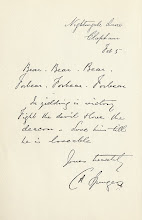
A portion of a letter from Charles Haddon Spurgeon, written to his congregation, four weeks prior to his death. His church was the Metropolitan Tabernacle, London, England. He was writing from Menton, France, where he had gone to recover from illness. But recovery was not meant to be. He had gone through the valley of the shadow of death just a short while before, but his health was now worse. He wanted his flock to know that the gospel he had preached for over 40 years was still his hope and joy, and should be theirs too. The letter was written January 6, 1892.

I feel my mind grasping with firmer grip than ever that everlasting gospel which for so many years I have preached to you. We have not been deceived. Jesus does give rest to those who come to him, he does save those who trust him, he does photograph his image on those who learn of him. I hate the Christianised infidelity of the modern school more than ever, as I see how it rends away from sinful man his last and only hope. Cling to the gospel of forgiveness through the substitutionary sacrifice, and spread it with all your might, each one of you, for it is the only cure for bleeding hearts.

The Suffering Letters of C. H. Spurgeon, annotations by Hannah Wyncoll, Wakeman Trust, 2007, pp. 118-19.

Friday, June 24, 2011

In My Old Age

A selection from a letter by Rev. Henry Venn, a minister in the Church of England, to an acquaintance, Mrs. Braiser, who had lost an infant in death. He gave reasons why "our dear children, taken away almost as soon as we see them, are safe in the hands of their merciful Creator and Redeemer." He also spoke of his trials in old age but of the nearness to God in meditation and prayer. The letter was written March 27, 1781.

My health is very much restored; yet I am forced, I think, to pay dearly for it. I am obliged to be on horseback every day, and cannot study and apply as my heart delights to do. I began to make trial of preaching four times one week; but I smarted for it for more than a fortnight; so that I must be content with doing very little indeed in my old age. Oh that I may enjoy more meditation and prayer, and communion with God, till I am with Him, whose Name is most glorious in my eyes, and His service the highest honor… Oh for an overcoming faith, to possess the inheritance of the saints in light, by hope, before we are translated to it!

Letters of Henry Venn, by John Venn, first published in 1835, republished by the Banner of Truth, 1993, pp. 323-34.

Tuesday, April 26, 2011

Hope the Best

A selection from a letter by John Newton to John Ryland, Jr. Newton made reference to Ryland's son, John Tyler Ryland, who was about one year old at the time, who was gravely ill. Mr. Newton expressed his hope that all might be well with the lad and exhorted his father to do the same. The letter was written October 26, 1787.

I hope your little boy will live to be a comfort to you; perhaps he may preach the gospel, when you can no longer speak. However this may be, devote and entrust him to the Lord, and he will take care of him. Sufficient to the present day is the evil thereof [Matthew 6:34]. Why should you burden yourself by looking a great while forward to peradventures and possibilities? Hope the best; and when you meet with a dark cloud, wait and expect to see, in due time, a rainbow painted upon it, or a light and glory springing out of it.

Wise Counsel: John Newton’s Letter to John Ryland, Jr., edited by Grant Gordon, The Banner of Truth Trust, 2009, letter #40, pp. 194-95.

Thursday, November 4, 2010

Sustaining Hope

A selection from a letter by Thomas Chalmers to a close friend, Jane Morton. Having already written a letter of sympathy to her upon the death of her daughter, he writes again to help steady her soul with the comfort of the Lord, but he cautions her not to sorrow as those who have no hope. The letter was written October 19, 1845.

I observe from your letter of the 1st, that you still dwell on the thoughts of your dear Catherine, and I would not forbid this; mellowed and mixed up as these thoughts are with the sustaining hope that you will meet her again. The Gospel does not lay an interdict upon your sorrow, though it would dissuade you against being swallowed up of too much grief. But you have fled to the best refuge; and He who is touched with the fellow-feeling of our infirmities, knows how to adapt His succor to the necessities of all who trust in Him.

Letters of Thomas Chalmers, edited by William Hanna, first published 1853, reprinted by The Banner of Truth, 2007, pp. 248-49.

Tuesday, September 14, 2010

There Is Hope

A letter from C. H. Spurgeon to T. W. Medhurst. Medhurst had been attending the services at the New Park Street Church where Spurgeon was preaching and soon to officially be the pastor. He had come under conviction of sin and had sent Spurgeon a letter asking if there was hope for him (see previous post). Spurgeon replied most graciously to his letter. The young man was later converted, entered the ministry, was trained at the Pastor's College later established by Spurgeon, and pastored for over 40 years in churches all across Britain. The letter was written July 14, 1854.

Dear Sir,

I am glad that you have been able to write to me and state your feelings. Though my hands are always full, it will ever give me joy to receive such notes as yours.

You ask me a very important question, “Are you one of God’s elect?” Now, this is a question neither you nor I can answer at present, and therefore let it drop. I will ask you an easier one, “Are you a sinner?” Can you say “YES”? All say, “Yes”; but then they do not know what the word “sinner” means.

A sinner is a creature who has broken all his Maker’s commands, despised His Name, and run into rebellion against the Most High. A sinner deserves hell, yea, the hottest place in hell; and if he be saved, it must be entirely by unmerited mercy. Now, if you are such a sinner, I am glad to be able to tell you the only way of salvation, “Believe on the Lord Jesus.”

I think you have not yet really understood what believing means. You are, I trust, really awakened, but you do not see the door yet. I advise you seriously to be much alone, I mean as much as you can; let your groans go up if you cannot pray, attend as many services as possible; and if you go with an earnest desire for a blessing, it will come very soon. But why not believe now? You have only to believe that Jesus is able and willing to save, and then trust yourself to Him.

Harbour not that dark suggestion to forsake the house of God; remember you turn your back on Heaven, and your face to hell, the moment you do that. I pray God that He will keep you. If the Lord had meant to destroy you, He would not have showed you such things as these. If you are but as smoking flax, there is hope. Touch the hem of His garment; look to the brazen serpent.

My dear fellow-sinner, slight not this season of awakening. Up, and be in earnest. It is your soul, your OWN soul, your eternal welfare, your Heaven or your hell, that is at stake.

There is the cross, and a bleeding God-man upon it; look to Him, and be saved! There is the Holy Spirit able to give you every grace. Look, in prayer, to the Sacred Three-one-God, and then you will be delivered.

I am,
Your anxious friend,
C. H. SPURGEON
Write Again

C. H. Spurgeon's Autobiography, Compiled from his diary, letters, and records, by his wife and his private secretary, Volume 2, 1854-1860, p. 141f, from the electronic edition by Logos Research Systems, Inc., 2009.

Monday, September 13, 2010

Have I Any Room for Hope?


A letter from T. W. Medhurst to C. H. Spurgeon. The young Medhurst had attended a few services at the New Park Street Church to hear the new pastor, who was quite young himself. Spurgeon preached from Hosea 6:3 on a particular Lord's Day evening. Medhurst came under conviction of sin. In trouble of soul, he wrote the pastor a letter, inquiring if there was any hope for him. It was written July 2, 1854 (I will post Spurgeon's reply in the next post).

Dear Sir,

Will you be kind enough candidly to inform me whether I have any room for hope that I belong to the elect family of God, whether Jesus Christ His Son has died for me, while my affections are in the world? I try to pray, but cannot. I make resolutions only to break them. I from time to time listen to you when you speak of the glory set apart for the saints, when you describe their joys and their feelings, but I feel myself as having nothing to do with them. O sir, that Sunday morning when you spoke of the hypocrite, I felt that you described me!

I go to chapel to hear the Word preached, I return home, and make resolutions; I go to work, then out into the world, and forget all until the time for preaching comes again. I read the Bible, but do not feel interested; it seems no more to me than a book I have before read,—dry and insipid. Christ has said that, of all who come to Him, He will not send any away. How am I to come? I feel that I cannot come. I would if I could, but I cannot. At times, I think that I will give it all up, that I will not go to chapel any more; yet when the time comes, I cannot stay away, but feel compelled to go again once more. Do, dear sir, tell me, how am I to find Jesus? How am I to know that He died for me, and that I belong to His family? Dear sir, tell me, am I a hypocrite?

I remain,
Dear sir,
Yours to serve in anxiety,
T. W. MEDHURST

C. H. Spurgeon's Autobiography, Compiled from his diary, letters, and records, by his wife and his private secretary, Volume 2, 1854-1860, p. 141f, from the electronic edition by Logos Research Systems, Inc., 2009.

Wednesday, April 28, 2010

In Thee Have the Faithful Trusted


A portion of a letter by John Calvin to his friend, Guillaume Farel, about his wife's death. Calvin was happily married to Idelette de Bure, who was a widow with two children when they were joined together in holy matrimony. After suffering from ill health for a number of years, she died in March 1549. With a heavy heart he wrote to his friend about her death. This letter was written April 11, 1549.

About the sixth hour of the day, on which she yielded up her soul to the Lord, our brother Bourgouin addressed some pious words to her, and while he was doing so, she spoke aloud, so that all saw that her heart was raised far above the world. For these were her words: "O glorious resurrection! O God of Abraham, and of all our fathers, in thee have the faithful trusted during so many past ages, and none of them have trusted in vain. I also will hope." These short sentences were rather ejaculated than distinctly spoken. This did not come from the suggestion of others, but from her own reflections, so that she made it obvious in few words what were her own meditations.

The Christian Lover: The Sweetness of Love and Marriage in the Letters of Believers, by Michael A. G. Haykin with Victoria J. Haykin, Reformation Trust, 2009, p. 11.

Monday, February 15, 2010

How I Love You!


A letter from C. H. Spurgeon to his wife, Suzanna. She was very dear to him. His letters to her are full of great affection and spiritual joy. The date of this letter is not known.

Sweet One,

How I love you! I long to see you; and yet it is but half-an-hour since I left you. Comfort yourself in my absence by the thought that my heart is with you. My own gracious God bless you in all things,—in heart, in feeling, in life, in death, in Heaven! May your virtues be perfected, your prospects realized, your zeal continued, your love to Him increased, and your knowledge of Him rendered deeper, higher, broader—in fact, may more than even my heart can wish, or my hope anticipate, be yours for ever! May we be mutual blessings;—wherein I shall err, you will pardon; and wherein you may mistake, I will more than overlook.

Yours till Heaven, and then,
C. H. S.

The Letters of Charles Haddon Spurgeon, first published in 1923, published in electronic format by Logos Research Systems, Inc., 2009, p. 74.

Tuesday, November 10, 2009

My Deep and Affectionate Sympathy


A portion of a letter from Robert E. Lee, commanding general of the Confederate army, to his daughter-in-law, Charlotte Wickham Lee. Dorie McCullough Lawson writes, “He had [recently] suffered the loss of his beloved twenty-three-year-old daughter to typhoid fever. Lee wrote the following letter to his daughter-in-law upon learning of the death of his only living grandchild, a baby girl.” The letter was written December 10, 1862, three days prior to the Battle of Fredericksburg.

I heard yesterday, my dear daughter, with the deepest sorrow, of the death of your infant. I was so grateful at her birth. I felt that she would be such a comfort to you, such a pleasure to my dear Fitzhugh, and would fill so full the void still aching in your hearts. But you have now two sweet angels in heaven. What joy there is in the thought! I can say nothing to soften the anguish you must feel, and I know you are assured of my deep and affectionate sympathy. May God give you strength to bear the affliction He has imposed, and produce future joy out of your present misery, is my earnest prayer.

Posterity: Letters of Great Americans to Their Children, Dorie McCullough Lawson, Doubleday, 2004, p. 230.

Thursday, March 26, 2009

I Am Satisfied

An extract from a letter by Andrew Fuller to his dear friend in the ministry, John Ryland, Jr. Fuller was less than a month away from death. He wrote about his only basis of assurance and hope of heaven. The letter was written April 28, 1815.

I have very little hope of recovery; but I am satisfied to drink of the cup which my heavenly Father giveth me to drink. Without experience, no one can conceive of the depression of my spirits; yet I have no despondency. ‘I know whom I have believed, and that he is able to keep that which I have committed to him against that day.’ I am a poor guilty creature, but Christ is an almighty Saviour. I have preached and written much against the abuse of the doctrine of grace; but that doctrine is all my salvation and all my desire. I have no other hope than from salvation by mere sovereign, efficacious grace, through the atonement of my Lord and Saviour. With this hope, I can go into eternity with composure. Come Lord Jesus! Come when thou wilt! Here I am; let him do with me as seemeth him good!

The Armies of the Lamb: The Spirituality of Andrew Fuller, edited and introduced by Michael A. G. Haykin, Joshua Press, pp. 269, 271.

Wednesday, December 10, 2008

She Is Gone To Heaven

A selection from a letter by John A. Broadus to his wife, Maria, after the death of his beloved sister, Carry Whitescarver. He was grieved over her passing but thankful that she had lived an exemplary life and had gone to be with the Lord. The letter was written September 1, 1852.

May her holy life, and this her hopeful, happy death be the life and death of her so unworthy, yet so richly-blessed, ‘baby’ brother! Oh, that sister was dear to me, dearer than any knew, dearer than I knew myself, yet she is gone! But then, she is gone to heaven; and I can hope, humbly and trustingly, that by the grace of God I shall see my sister Carry again, and part from her no more. My dear Maria, be a Christian, with all your heart, now.

Life and Letters of John Albert Broadus, by Archibald Thomas Robertson, 1901, reprint by Gano Books, p. 100.