A letter from the Lord Protector of England, Oliver Cromwell, to his wife, written from Edinburgh, May 3, 1651:
My Dearest,
I could not satisfy myself to omit this post, although I have not much to write; yet indeed I love to write to my Dear, who is very much in my heart. It joys me to hear thy soul prospereth: the Lord increase his favours to thee more and more. The great good thy soul can wish is, that the Lord lift upon thee the light of his countenance, which is better than life. The Lord bless all thy good counsel and example to all those about thee, and hear all thy prayers, and accept thee always.
'To Honor God:' The Spiritually of Oliver Cromwell, edited and introduced by Michael A. G. Haykin, Joshua Press, 1999, p. 87.
Wednesday, July 2, 2008


Monday, June 30, 2008
Let God Worry About Me
A portion of a letter from Martin Luther to his wife, Katie, who had been worrying about him. The letter was written on February 7, 1546. He died eleven days later after experiencing a heart attack or stroke.
Grace and peace in the Lord! You, dear Katie, read John and the Small Catechism, about which you once said: Everything in this book has been said about me. For you prefer to worry about me instead of letting God worry, as if he were not almighty and could not create ten Doctor Martins, should the old one drown in the Saale, or burn in the oven, or perish in Wolfgang’s bird trap. Free me from your worries. I have a caretaker who is better than you and all the angels; he lies in the cradle and rests on a virgin’s bosom, and yet, nevertheless, he sits at the right hand of God, the almighty Father. Therefore be at peace.
Luther's Works, Letters III, Vol. 50, edited by J. J. Pelikan, H. C. Oswald and H. T. Lehmann, Fortress Press, letter # 321.
Grace and peace in the Lord! You, dear Katie, read John and the Small Catechism, about which you once said: Everything in this book has been said about me. For you prefer to worry about me instead of letting God worry, as if he were not almighty and could not create ten Doctor Martins, should the old one drown in the Saale, or burn in the oven, or perish in Wolfgang’s bird trap. Free me from your worries. I have a caretaker who is better than you and all the angels; he lies in the cradle and rests on a virgin’s bosom, and yet, nevertheless, he sits at the right hand of God, the almighty Father. Therefore be at peace.
Luther's Works, Letters III, Vol. 50, edited by J. J. Pelikan, H. C. Oswald and H. T. Lehmann, Fortress Press, letter # 321.
Thursday, June 26, 2008
Your Sinfulness Far Exceeds All That You Have Stated
A portion of a letter written by Charles Simeon of Cambridge, to Lord Harrowby, whose son, Granville, had been deeply depressed. Simeon told Lord Harrowby about a conversation he had had with the son. Simeon gave advice quite different than he had been receiving from his friends. The letter was written in February, 1823. Mr. Simeon told the lad:
You see yourself guilty of sins which preclude a hope of forgiveness. Your friends have endeavoured to shew you that you judge yourself too hardly. In this they have erred for, if they have succeeded, they have given you a peace founded on your own worthiness, a peace that would last no longer than till the next temptation arose in your mind… If they have not succeeded, they have only confirmed you in your views. I say to you the very reverse. Your views of yourself (your own sinfulness) though they may be erroneous, are not one atom too strong. Your sinfulness far exceeds all that you have stated, or have any conception of. “Your heart is deceitful above all things and desperately wicked: who can know it?” But I have an effectual remedy for them all – “the blood of Jesus Christ cleanseth from all sin.” I grant that you are lost and utterly undone. So are all mankind – some for gross sins – some for impenitence – some for other sins. You are lost for the very sins you mention, hardness of hear, indifference, etc…
Do this then, take a book as large as any that is in the Bank of England. Put down all the sins of which either conscience or a morbid imagination can accuse you. Fear not to add to their number all that Satan himself can suggest.
And this I will do. I will put on the creditor side “the unsearchable riches of Christ” and will leave you to draw the balance…
Charles Simeon of Cambridge, by Hugh Evan Hopkins, Hodder & Stoughton, 1977, p. 126.
You see yourself guilty of sins which preclude a hope of forgiveness. Your friends have endeavoured to shew you that you judge yourself too hardly. In this they have erred for, if they have succeeded, they have given you a peace founded on your own worthiness, a peace that would last no longer than till the next temptation arose in your mind… If they have not succeeded, they have only confirmed you in your views. I say to you the very reverse. Your views of yourself (your own sinfulness) though they may be erroneous, are not one atom too strong. Your sinfulness far exceeds all that you have stated, or have any conception of. “Your heart is deceitful above all things and desperately wicked: who can know it?” But I have an effectual remedy for them all – “the blood of Jesus Christ cleanseth from all sin.” I grant that you are lost and utterly undone. So are all mankind – some for gross sins – some for impenitence – some for other sins. You are lost for the very sins you mention, hardness of hear, indifference, etc…
Do this then, take a book as large as any that is in the Bank of England. Put down all the sins of which either conscience or a morbid imagination can accuse you. Fear not to add to their number all that Satan himself can suggest.
And this I will do. I will put on the creditor side “the unsearchable riches of Christ” and will leave you to draw the balance…
Charles Simeon of Cambridge, by Hugh Evan Hopkins, Hodder & Stoughton, 1977, p. 126.
Tuesday, June 24, 2008
Meet Me In Heaven
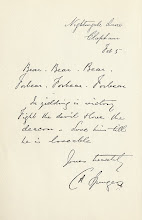
This is a letter written by C. H. Spurgeon to a young boy whom he longed to see saved. A portion of this letter was read by Jonathan Watson at the Banner Youth Conference, March 2008, in an address on the value of reading Spurgeon’s works (see The Banner of Truth Magazine, July 2008). It reveals the evangelistic heart of this great preacher. He was in poor health but he took the time to write this lad about his greatest need. The letter was used of the Lord to savingly bring this young boy to Christ.
Westwood,
Westwood,
Norwood, July 1, 1890
O Lord, bless this letter.
My Dear Arthur Layzell,
I was a little while ago at a meeting for prayer where a large number of ministers were gathered together. The subject of prayer was “our children.” It soon brought the tears to my eyes to hear those good fathers pleading with God for their sons and daughters. As they went on entreating the Lord to save their families my heart seemed ready to burst with strong desire that it might be even so. Then I thought, I will write to those sons and daughters, to remind them of their parents’ prayers.
Dear Arthur, you are highly privileged in having parents who pray for you. Your name is known in the courts of heaven. Your case has been laid before the throne of God.
Do you not pray for yourself? If you do not do so, why not? If other people value your soul, can it be right for you to neglect it? See, the entreaties and wrestlings of your father will not save you if you never seek the Lord yourself. You know this.
You do not intend to cause grief to dear mother and father: but you do. So long as you are not saved, they can never rest. However obedient and sweet and kind you may be, they will never feel happy about you until you believe in the Lord Jesus Christ, and so find everlasting salvation.
Think of this. Remember how much you have already sinned, and none can wash you but Jesus. When you grow up you may become very sinful, and none can change your nature and make you holy but the Lord Jesus, through His Spirit.
You need what father and mother seek for you and you need it NOW. Why not seek it at once? I heard a father pray, “Lord, save our children, and save them young.” It is never too soon to be safe; never too soon to be happy; never too soon to be holy. Jesus loves to receive the very young ones.
You cannot save yourself, but the great Lord Jesus can save you. Ask him to do it. “He that asketh receiveth.” Then trust in Jesus to save you. He can do it, for he died and rose again that whosoever believeth in him might not perish, but have everlasting life.
Come and tell Jesus you have sinned; seek forgiveness; trust in Him for it, and be sure that you are saved.
Then imitate our Lord. Be at home what Jesus was at Nazareth. Yours will be a happy home, and your dear father and mother will feel that the dearest wish of their hearts has been granted them.
I pray you think of heaven and hell, for in one of those places you will live forever. Meet me in heaven. Meet me at once at the mercy-seat. Run upstairs and pray to the great Father, through Jesus Christ.
Yours very lovingly,
C. H. Spurgeon
Spurgeon: A New Biography, by Arnold Dallimore, The Banner of Truth Trust, 1985, pp. 224-25.
My Dear Arthur Layzell,
I was a little while ago at a meeting for prayer where a large number of ministers were gathered together. The subject of prayer was “our children.” It soon brought the tears to my eyes to hear those good fathers pleading with God for their sons and daughters. As they went on entreating the Lord to save their families my heart seemed ready to burst with strong desire that it might be even so. Then I thought, I will write to those sons and daughters, to remind them of their parents’ prayers.
Dear Arthur, you are highly privileged in having parents who pray for you. Your name is known in the courts of heaven. Your case has been laid before the throne of God.
Do you not pray for yourself? If you do not do so, why not? If other people value your soul, can it be right for you to neglect it? See, the entreaties and wrestlings of your father will not save you if you never seek the Lord yourself. You know this.
You do not intend to cause grief to dear mother and father: but you do. So long as you are not saved, they can never rest. However obedient and sweet and kind you may be, they will never feel happy about you until you believe in the Lord Jesus Christ, and so find everlasting salvation.
Think of this. Remember how much you have already sinned, and none can wash you but Jesus. When you grow up you may become very sinful, and none can change your nature and make you holy but the Lord Jesus, through His Spirit.
You need what father and mother seek for you and you need it NOW. Why not seek it at once? I heard a father pray, “Lord, save our children, and save them young.” It is never too soon to be safe; never too soon to be happy; never too soon to be holy. Jesus loves to receive the very young ones.
You cannot save yourself, but the great Lord Jesus can save you. Ask him to do it. “He that asketh receiveth.” Then trust in Jesus to save you. He can do it, for he died and rose again that whosoever believeth in him might not perish, but have everlasting life.
Come and tell Jesus you have sinned; seek forgiveness; trust in Him for it, and be sure that you are saved.
Then imitate our Lord. Be at home what Jesus was at Nazareth. Yours will be a happy home, and your dear father and mother will feel that the dearest wish of their hearts has been granted them.
I pray you think of heaven and hell, for in one of those places you will live forever. Meet me in heaven. Meet me at once at the mercy-seat. Run upstairs and pray to the great Father, through Jesus Christ.
Yours very lovingly,
C. H. Spurgeon
Spurgeon: A New Biography, by Arnold Dallimore, The Banner of Truth Trust, 1985, pp. 224-25.
Sunday, June 22, 2008
A Sweet Farewell
A selection from a letter by John Calvin to Melanchthon, urging him to be strong in his stance on the issue of the Lord’s Supper in face of opposition. Calvin ended the letter with a warm expression of love to his friend. The letter was written March 5, 1555:
Farewell, most renowned and my ever honoured sir. May the Lord govern you by his Spirit, defend you with his protection, sustain you by his power, and may he always keep us in holy union, till at length he gather us into his heavenly kingdom.
Letters from John Calvin: Selected from the Bonnet Edition, the Banner of Truth, 1980, pp. 169-70.
Farewell, most renowned and my ever honoured sir. May the Lord govern you by his Spirit, defend you with his protection, sustain you by his power, and may he always keep us in holy union, till at length he gather us into his heavenly kingdom.
Letters from John Calvin: Selected from the Bonnet Edition, the Banner of Truth, 1980, pp. 169-70.
Thursday, June 19, 2008
Great Likeness to Jesus
A portion of a letter written by Robert Murray McCheyne to Rev. Dan Edwards, who was on his way to Germany as a missionary. The letter was written on October 2, 1840:
I trust you will have a pleasant and profitable time in Germany. I know you will apply hard to German; but do not forget the culture of the inner man—I mean of the heart. How diligently the cavalry officer keeps his saber clean and sharp; every stain he rubs off with the greatest care. Remember you are God’s sword, His instrument—I trust a chosen vessel unto Him to bear His name. In great measure, according to the purity and perfections of the instrument, will be the success. It is not great talents God blesses so much as great likeness to Jesus. A holy minister is an awful weapon in the hand of God.
Robert Murray M’Cheyne: Memoir and Remains, Andrew A. Bonar, first published in 1884, reprinted by the Banner of Truth, 1966, p. 282.
I trust you will have a pleasant and profitable time in Germany. I know you will apply hard to German; but do not forget the culture of the inner man—I mean of the heart. How diligently the cavalry officer keeps his saber clean and sharp; every stain he rubs off with the greatest care. Remember you are God’s sword, His instrument—I trust a chosen vessel unto Him to bear His name. In great measure, according to the purity and perfections of the instrument, will be the success. It is not great talents God blesses so much as great likeness to Jesus. A holy minister is an awful weapon in the hand of God.
Robert Murray M’Cheyne: Memoir and Remains, Andrew A. Bonar, first published in 1884, reprinted by the Banner of Truth, 1966, p. 282.
Wednesday, June 18, 2008
God Has Used You In My Life
An extract from a letter by Ernie Reisinger to Dr. Martyn Lloyd-Jones, expressing appreciation for the influence he had exercised in his life. The letter was written on May 20, 1968:
I felt this morning I wanted to just drop you a few lines telling you how greatly God has used you in my own life and in the lives of many, many men in this country. Time would not permit me to recount the number of testimonies of preachers as to the great help they have received from your writings, and when I meet the men from your country, such as Jim Packer, Iain Murray and others, they have personally acknowledged to me their deep love and gratitude to God for your life and ministry. They have both called you ‘father’ in the proper sense of that expression.
Ernest C. Reisinger: A Biography, by Geoffrey Thomas, The Banner of Truth Trust, 2002, pp. 137-38.
I felt this morning I wanted to just drop you a few lines telling you how greatly God has used you in my own life and in the lives of many, many men in this country. Time would not permit me to recount the number of testimonies of preachers as to the great help they have received from your writings, and when I meet the men from your country, such as Jim Packer, Iain Murray and others, they have personally acknowledged to me their deep love and gratitude to God for your life and ministry. They have both called you ‘father’ in the proper sense of that expression.
Ernest C. Reisinger: A Biography, by Geoffrey Thomas, The Banner of Truth Trust, 2002, pp. 137-38.
Subscribe to:
Posts (Atom)