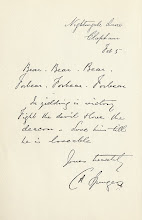
A portion of a letter from Rev. Joseph Kinghorn, pastor of St. Mary’s Baptist Church, Norwich, England, written to Rev. William Newman, who had just become the president of Stepney Academy on March 25, 1811. The letter was filled with spiritual counsel on many practical subjects, including the importance of maintaining family worship.
You will do well, also, to pay a particular attention to your family worship; not so much that it be long as that it be regular, and conducted in a manner likely to support a devotional feeling, and a sense of its importance. Let it not be broken upon, or treated as a matter of mere conveniency.
The Life and Works of Joseph Kinghorn, by Martin Hood Wilkin, reprinted by Particular Baptist Press, 1995, p. 338.
Wednesday, November 19, 2008


Friday, November 14, 2008
Dressed Gloriously in the Robes of Gospel Righteousness
A selection from a letter by Thomas Charles to a female acquaintance that had made remarks in a letter to him about modest dress. He agreed with her but made a spiritual application in his return letter, written August 14, 1795.
What a glorious change – the garments of salvation instead of our own filthy rags! “Take away the filthy rags from him” – gracious words! Instead of driving him and his filthy garments into destruction, he is saved, as a brand plucked out of the burning; and he is clothed with a change of raiment. What a dispensation of abounding grace is here! The sin destroyed and not the sinner! – not saved in his filthy raiment, but saved and washed and dressed gloriously in the robes of gospel righteousness. How shall we adore, wonder and praise, when we appear above, thus completely arrayed!
Thomas Charles’ Spiritual Counsels: Selected from his Letters and Papers, by Edward Morgan, first published in 1836, reprinted by the Banner of Truth, 1993, pp. 379-80.
What a glorious change – the garments of salvation instead of our own filthy rags! “Take away the filthy rags from him” – gracious words! Instead of driving him and his filthy garments into destruction, he is saved, as a brand plucked out of the burning; and he is clothed with a change of raiment. What a dispensation of abounding grace is here! The sin destroyed and not the sinner! – not saved in his filthy raiment, but saved and washed and dressed gloriously in the robes of gospel righteousness. How shall we adore, wonder and praise, when we appear above, thus completely arrayed!
Thomas Charles’ Spiritual Counsels: Selected from his Letters and Papers, by Edward Morgan, first published in 1836, reprinted by the Banner of Truth, 1993, pp. 379-80.
Wednesday, November 12, 2008
Self-Determination Cannot Lead to Conversion
A portion of a letter from Jonathan Edwards to Rev. John Erskine in Scotland about the fatal doctrine of self-determination. He was sounding a warning against the pernicious errors of Henry Home (Lord Kames) who had distorted the truth of evangelical conversion. The letter was written on August 3, 1757.
And this notion of self-dependence and self-determination tends to prevent or enervate all prayer to God for converting grace; for why should men earnestly cry to God for his grace, to determine their hearts to that, which they must be determined to of themselves? And indeed it destroys the very notion of conversion itself. There can properly be no such thing, or anything akin to what the Scripture speaks of as conversion, renovation of the heart, regeneration, etc. if growing good by a number of successive self-determined acts, be all that is required, or to be expected.
Jonathan Edwards: Letters and Personal Writings, edited by George S. Claghorn, vol. 16 in The Works of Jonathan Edwards, Yale University Press, 1998, p. 723.
And this notion of self-dependence and self-determination tends to prevent or enervate all prayer to God for converting grace; for why should men earnestly cry to God for his grace, to determine their hearts to that, which they must be determined to of themselves? And indeed it destroys the very notion of conversion itself. There can properly be no such thing, or anything akin to what the Scripture speaks of as conversion, renovation of the heart, regeneration, etc. if growing good by a number of successive self-determined acts, be all that is required, or to be expected.
Jonathan Edwards: Letters and Personal Writings, edited by George S. Claghorn, vol. 16 in The Works of Jonathan Edwards, Yale University Press, 1998, p. 723.
Monday, November 10, 2008
Standing Up For Christ
A selection from a letter by Augusta Toplady to a pastor in New York. He was encouraged to know that there were faithful Church of England men ministering in America. Mr. Toplady, an opponent of Pelagianism and Arminianism, commented on defending the gospel in his letter. It was written on September 6, 1773.
I can never sufficiently bless God for giving me to see the day when I can truly affirm that I care not whom I displease when the inestimable truths of his gospel are at stake. His providence has rendered me independent on any but himself; and his grace enables me to act accordingly. I must likewise add, as a still further motive to my gratitude, that the bolder I am in his cause, the more he gives me the affections of those to whom I minister, and with whom I am connected. Where I have lost one friend by standing up for Christ, I have gained a multitude.
The Works of Augustus Toplady, Bookshelf Publications, reprint from the 1794 edition, p. 847.
I can never sufficiently bless God for giving me to see the day when I can truly affirm that I care not whom I displease when the inestimable truths of his gospel are at stake. His providence has rendered me independent on any but himself; and his grace enables me to act accordingly. I must likewise add, as a still further motive to my gratitude, that the bolder I am in his cause, the more he gives me the affections of those to whom I minister, and with whom I am connected. Where I have lost one friend by standing up for Christ, I have gained a multitude.
The Works of Augustus Toplady, Bookshelf Publications, reprint from the 1794 edition, p. 847.
Friday, November 7, 2008
The Valuable Experiences of Brainerd and Elliot
A selection from a letter by Thomas Chalmers to “a young Clergyman,” giving him advice for the work of the ministry. Chalmers advised the young minister to model his ministry after the lives of two great missionaries to the American Indians – David Brainerd and John Elliot. The letter was written November 12, 1838.
It is a most valuable experience of Brainerd—that the regular distribution of time is essential to one’s religious prosperity; and of Elliot—that through faith in Christ Jesus, it is in the power of prayer and of pains to do everything.
Letters of Thomas Chalmers, edited by William Hanna, first published 1853, reprinted by The Banner of Truth, 2007, pp. 311-12.
It is a most valuable experience of Brainerd—that the regular distribution of time is essential to one’s religious prosperity; and of Elliot—that through faith in Christ Jesus, it is in the power of prayer and of pains to do everything.
Letters of Thomas Chalmers, edited by William Hanna, first published 1853, reprinted by The Banner of Truth, 2007, pp. 311-12.
Wednesday, November 5, 2008
On Ill Terms with Myself
A selection from a letter by John Newton to his close friend, Rev. William Bull, who was pastor of a dissenting congregation about five miles from Olney. This letter was written in the cold of winter (January 27, 1778), when Newton said “cold predominates in my frostbound spirit.”
I have reason to be upon ill terms with myself. It is strange that pride should ever find any thing in my experience to feed upon; but this completes my character for folly, vileness, and inconsistence, that I am not only poor but proud; and, though I am convinced I am a very wretch, as nothing before the Lord, I am prone to go forth among my fellow-creatures as though I were wise and good.
Letters of John Newton: with Biographical Sketches and Notes, by Josiah Bull, reprinted by the Banner of Truth, p. 301.
I have reason to be upon ill terms with myself. It is strange that pride should ever find any thing in my experience to feed upon; but this completes my character for folly, vileness, and inconsistence, that I am not only poor but proud; and, though I am convinced I am a very wretch, as nothing before the Lord, I am prone to go forth among my fellow-creatures as though I were wise and good.
Letters of John Newton: with Biographical Sketches and Notes, by Josiah Bull, reprinted by the Banner of Truth, p. 301.
Monday, November 3, 2008
An Instrument in Saving Some
A selection from a letter by Robert L. Dabney to his mother. The year was 1868. The South was undergoing great hardships due to Reconstruction. He told his mother that he was filled with “melancholy” because of the “present oppressions.” Yet he rejoiced that there were some things that could not be taken away. The letter was written on February 15, 1868.
The labors of my life seem to be like marks made on a sand beach for the rising tide to wash away, save as I may have been instrumental in saving some souls. That work, thank God, cannot be undone by the malice of men or devils.
The Life and Letters of Robert Lewis Dabney, by Thomas Cary Johnson, first published in 1903, reprinted by the Banner of Truth Trust, 1977, p. 303.
The labors of my life seem to be like marks made on a sand beach for the rising tide to wash away, save as I may have been instrumental in saving some souls. That work, thank God, cannot be undone by the malice of men or devils.
The Life and Letters of Robert Lewis Dabney, by Thomas Cary Johnson, first published in 1903, reprinted by the Banner of Truth Trust, 1977, p. 303.
Subscribe to:
Posts (Atom)