Monday, October 5, 2009

Forget Not the Truth


A portion of the letter that John A. Broadus wrote to his church, the Charlottesville Baptist Church, Charlottesville, Virginia, when he resigned the pastorate in order to take up a teaching position in the newly established Baptist Seminary in Greenville, South Carolina. J. P. Boyce had prayed to God and pleaded with Broadus that he might help begin what was soon to become The Southern Baptist Theological Seminary, which eventually moved to Louisville, Kentucky. The letter was written August 28, 1859.

I am unable to express my feelings of gratitude for all your kindness and of affectionate interest in your welfare, as a church, as families, and as individuals. I trust you will always look with charitable indulgence upon my faults of character, and failures in duty. I have little fear of being personally forgotten here, but I especially ask that you will not forget the truth I have preached among you, but will seek to profit hereafter by the labors which are now ended; so ‘that I may rejoice in the day of Christ, that I have not run in vain, neither labored in vain.’

Life and Letters of John Albert Broadus, by Archibald Thomas Robertson, 1901, reprint by Gano Books, p. 166.

Thursday, October 1, 2009

How Greatly I Have Been Blessed!


A portion of a letter from Rev. Daniel Baker to his friend in the ministry, Rev. John S. Galloway. He told him of the blessings they had experienced in a protracted meeting in his church in Holly Springs, Mississippi, and of his sons call to the ministry. The letter was written December 21, 1842.

I have some very pleasing intelligence to communicate. We have had a blessed and powerful work of grace in my church. We had a protracted meeting in September last, and about seventy precious souls were made, as I hope, to bow at the feet of our blessed Redeemer! Protracted meetings were held nearly about the same time in all the other churches; and the result of the whole is, the hopeful conversion of more than two hundred souls in our town! To God be all the glory!

Among the converts in my church, I am peculiarly happy to say is my youngest son, who has already turned his attention to the sacred office. Once he was deeply tinctured with the principles of infidelity, and was a great admirer of Byron; but, after his conversion, when asked whether he was willing to be a preacher, he replied, with much emotion, ‘Pa, I would be willing to be a ditcher, for Christ’s sake.’ I have sent him to Princeton to prepare, if it be the Divine will, to preach the glorious gospel of the blessed God. I have another son, who was last week taken under the care of our Presbytery as a candidate for the gospel ministry. How greatly have I been blessed! Bless the Lord, O my soul!

Making Many Glad: The Life and Labours of Daniel Baker, prepared by his son, Rev. William M. Baker, first published in 1858, reprinted by the Banner of Truth Trust, 2000, pp. 294-95.

Tuesday, September 29, 2009

A Happy State


A selection from a letter by Henry Venn, Church of England minister, to his son, Rev. John Venn. He stated his satisfaction with Christ as Lord and Saviour and his contentment with a life of preaching the whole counsel of God. The letter was written January 1, 1796.

I have to tell you—and would, if it were with my last breath—that I can wish for nothing more than I now find Christ is to me. And though I discover, more than ever, most lamentable defects in my preaching, and cannot place the smallest confidence in the multitudes to whom God has been pleased to make His Word a blessing by my mouth and pen, yet I am absolutely certain that I have preached the very doctrine that Christ and His Apostles did. The whole Word of God is equally acceptable to me—not less those parts which are the fortress of Arminians, Perfectionists, and Antinomians, than the others; so that I am, and have been for thirty-five years, in the happy state of not being tempted to wrest any Scripture, or pervert it, in order to make it favour my own tenets.

Letters of Henry Venn, by John Venn, first published in 1835, republished by the Banner of Truth, 1993, pp. 531-32.

Saturday, September 26, 2009

A Country Beyond the Grave


A selection from a letter by Thomas Chalmers to a close friend, Jane Morton. Mrs. Morton’s daughter, Catherine, had recently died and Chalmers wrote to extend his sympathy and offer a word of comfort. He contemplated the day of his own death and charged Jane to join him in proper preparation for meeting the Lord. The letter was written May 4, 1845.

I am now more than half way from sixty to seventy; and certain it is, that though free of any specific complaint, there has been a general decay of strength during the last year, which tells me that I should forthwith set my house in order, and be in readiness for the coming of the Lord.

But this readiness is a duty which lies upon all of every age and condition; and may the death over which we have been called to mourn bring the lesson forcibly home to us. May the event be sanctified and blessed to all your family. Though in itself not joyous but grievous, may it yield to you and yours the peaceable fruits of righteousness. Let us stand, my dear Jane, more disengaged than ever from a world that will soon pass away; and with the feeling that we are strangers and pilgrims here, let our doings plainly declare that we seek a country beyond the grave—that we are looking forward to a city which hath foundations, whose builder and maker is God.

Letters of Thomas Chalmers, edited by William Hanna, first published 1853, reprinted by The Banner of Truth, 2007, p. 248.

Thursday, September 24, 2009

How Is It With Your Soul?


A selection from a letter by Augusta Toplady to a friend, inquiring about the state of her soul. The preacher who has brought encouragement to us all with his wonderful hymns also encouraged many with his letters. He once said, “Letters are but conversation committed to paper.” Here he has, as it were, a conversation with a friend about her relationship with the Lord. The letter was written November 20, 1772.

Above all, Madam, how is it with your soul? What are your views of God and Christ and heaven? Lively, I trust, and full of glory. Yet if our views are dim and languid, still He abideth faithful, and cannot deny himself. Not upon our frames, but upon the adorable Giver of them, is all our safety built. If we cannot follow him in the light, God help us to follow him in the dark; and if we cannot follow him so, to fall down at his feet, and sink into nothing, under the feelings of our own vileness. They who are enabled thus to fall, shall be raised in due time. I know not why, but I could not forbear writing to you. May the Spirit of the living God write his consolations on your heart, and cause your triumphs in Christ to abound more and more.

The Works of Augustus Toplady, Bookshelf Publications, reprint from the 1794 edition, pp. 834-35.

Tuesday, September 22, 2009

Public Prayer a Holy Work


A selection from a letter by John Elias to his son about praying in public. The younger Elias requested spiritual counsel from his father for he had been asked to lead in public prayer. His father cautioned him to be watchful and exemplary. He believed that leading in prayer in the assembly of the Lord’s people a task not to be entered into lightly. The letter was written October 18, 1821.

Moreover, consider well carefully what is your own motive in such a great undertaking, especially when you feel some desires and propensity for it. Be very careful that you have no end in view for such a holy work, but to glorify the Lord. Besides, be assured that if you engage in such a public part of the service of God, it will be necessary for you to be more watchful and circumspect in all your conduct and conversation, such as becometh the Gospel of Christ; the more public we may be engaged in his service, the greater will be the dishonor we shall bring upon his cause if we should be inconsistent. If any one takes the place and work of an elder, he should have the spirit and conduct of such a person.

John Elias: Life, Letters and Essays, by Edward Morgan, first published in 1844, published by the Banner of Truth in 1973, pp. 208-09.

Saturday, September 19, 2009

I Tremble Yet Rejoice


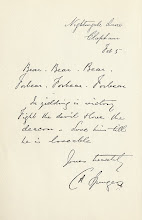
A portion of a letter by Charles Haddon Spurgeon, written to his parents after getting settled in school at Newmarket. He hadn’t been long converted and was joyous of knowing Christ but struggled spiritually because he didn’t want to bring disgrace on his Saviour. He was not yet 16 years old when he wrote this letter, January 30, 1850.

How sweet is prayer! I would be always engaged in it. How beautiful is the Bible! I never loved it so before; it seems to me as necessary food. I feel that I have not one particle of spiritual life in me but what the Spirit placed there. I feel that I cannot live if He depart; I tremble and fear lest I should grieve Him. I dread lest sloth or pride should overcome me, and I should dishonour the gospel by neglect of prayer, or the Scriptures, or by sinning against God. Truly, that will be a happy place where we shall get rid of sin and this depraved corrupt nature. When I look at the horrible pit and the hole from which I have been digged, I tremble lest I should fall into it, and yet rejoice that I am on the King’s highway.

The Letters of Charles Haddon Spurgeon, collected and collated by his son, Charles Spurgeon, first published in 1923, p. 13, now available electronically by Logos Research Systems, Inc.