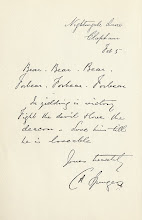
A selection from a letter by the Welsh Protestant preacher, Christopher Love, to his wife, on the day before his execution by the English government. He was found guilty of treason because he was of Presbyterian persuasion. Other Puritans would be ejected from the Church of England but Love was tried and put to death. He left four children behind with another soon to be born. In writing he revealed great love and care for his wife and demonstrated confidence and faith in Christ. The letter was written from the Tower of London, August 22, 1651.
I am now going from a prison to a palace. I have finished my work, I am now to receive my wages. I am now going to heaven where are two of my children, and leaving thee on the earth where are three of my babes. Those two above need not my care, but the three below need thine. It comforts me to think two of my children are in the bosom of Abraham and three of them will be in the arms and care of so tender a godly mother.
I know thou art a woman of a sorrowful spirit, yet be comforted; though thy sorrow be great for thy husband's going out of the world, yet the pains shall be the less in bringing thy child into the world. Thou shalt be a joyful mother, though thou beest a sad widow. God hath many mercies in store for thee; the prayers of a dying husband for thee will not be lost. To my shame I speak it: I never prayed so much for thee at liberty as I have done in prison…
Dear wife, farewell. I will call thee wife no more. I shall see thy face no more, yet I am not much troubled for now I am going to meet the Bridegroom, the Lord Jesus Christ, to whom I shall be eternally married.
A Spectacle Unto God: The life and death of Christopher Love, by Don Kistler, Soli Deo Gloria Publications, 1994.
Showing posts with label heaven. Show all posts
Tuesday, December 28, 2010
From a Prison to a Palace
Labels:
children,
Christ,
Christopher Love,
death,
heaven,
martyr,
persecution,
prison,
wife
Wednesday, November 24, 2010
Pray to God to Give You a New Heart
A selection from a letter by Rev. Daniel Baker to some Sunday School children in Frankfort, Kentucky, where Baker used to pastor, who had sent him money to aid in his mission work in Texas. He told them how God had been saving people through his ministry in Texas, and as he was want to do, exhorted them to be sure that they were Christians and ready to go to heaven when they died. The letter was written from Galveston, July 20, 1849.
And remember, dear children, if you wish to try to get some of the people in Texas to go to heaven, you must be sure to try to get to heaven yourselves. O, it is a sweet place, a blessed place; and if you get there you will be as angels, with your crowns so bright, and your robes so white. I do believe that there are a great many children there already, and many others are on their way to that happy world now. A little girl, only thirteen years of age, joined my church last Sabbath; she was permitted by the Session to sit down at the table of the Lord, and take the sacrament. She seemed very happy, and I do believe she is a real Christian.
Would you not like to be real Christians too, and go to heaven when you die? Then you must pray to God to give you a new heart, and make you good children. I used to live in Frankfort; I used to preach in your church, and talk to your school; but I don't know that I shall ever be in Frankfort again. Many of you, I suppose, never saw me. No matter; if we get to heaven, we will see and love each other there; and there we will see our blessed Saviour, and the holy angels, and all our pious friends, and be so happy for ever and ever!
Making Many Glad: The Life and Labours of Daniel Baker, by William M. Baker, first published in 1858, reprinted by the Banner of Truth, 2000, p. 387.
And remember, dear children, if you wish to try to get some of the people in Texas to go to heaven, you must be sure to try to get to heaven yourselves. O, it is a sweet place, a blessed place; and if you get there you will be as angels, with your crowns so bright, and your robes so white. I do believe that there are a great many children there already, and many others are on their way to that happy world now. A little girl, only thirteen years of age, joined my church last Sabbath; she was permitted by the Session to sit down at the table of the Lord, and take the sacrament. She seemed very happy, and I do believe she is a real Christian.
Would you not like to be real Christians too, and go to heaven when you die? Then you must pray to God to give you a new heart, and make you good children. I used to live in Frankfort; I used to preach in your church, and talk to your school; but I don't know that I shall ever be in Frankfort again. Many of you, I suppose, never saw me. No matter; if we get to heaven, we will see and love each other there; and there we will see our blessed Saviour, and the holy angels, and all our pious friends, and be so happy for ever and ever!
Making Many Glad: The Life and Labours of Daniel Baker, by William M. Baker, first published in 1858, reprinted by the Banner of Truth, 2000, p. 387.
Labels:
children,
Christ,
Daniel Baker,
happiness,
heaven,
missions,
offering,
salvation,
Sunday School
Friday, October 15, 2010
It Is Enough That I Live And Die With Christ
This is the last letter written by John Calvin. It was written to his longtime friend, William Farel. Calvin died May 27, 1564, age 55. Farel died the next year, September 13, 1565, age 76. After Calvin's death, Farel wrote a friend, "Oh why was I not taken away in his stead, and he preserved to the church which he has so well served, and in combats harder than death? He has done more and with greater promptitude than any one, surpassing not only the others but himself. Oh, how happily he has run a noble race! May the Lord grant that we run like him, and according to the measure of grace that has been dealt out to us." Calvin's letter is a moving testimony of his gratitude to God for his friend and a deep expression of his own personal devotion to Christ. It was written from Geneva, May 2, 1564.
Farewell, my most excellent and upright brother; and since it is the will of God that you should survive me in the world, live mindful of our intimacy, which, as it was useful to the church of God, so the fruits of it await us in heaven. I am unwilling that you should fatigue yourself for my sake. I draw my breath with difficulty, and every moment I am in expectation of breathing my last. It is enough that I live and die for Christ, who is to all his followers a gain both in life and death. Again I bid you and your brethren Farewell.
John Calvin: Tracts and Letters, edited by Jules Bonnet and translated by David Constable, first published by the Presbyterian Board of Publication, 1858, republished by The Banner of Truth Trust, 2009, vol. 7, p. 364.
Farewell, my most excellent and upright brother; and since it is the will of God that you should survive me in the world, live mindful of our intimacy, which, as it was useful to the church of God, so the fruits of it await us in heaven. I am unwilling that you should fatigue yourself for my sake. I draw my breath with difficulty, and every moment I am in expectation of breathing my last. It is enough that I live and die for Christ, who is to all his followers a gain both in life and death. Again I bid you and your brethren Farewell.
John Calvin: Tracts and Letters, edited by Jules Bonnet and translated by David Constable, first published by the Presbyterian Board of Publication, 1858, republished by The Banner of Truth Trust, 2009, vol. 7, p. 364.
Labels:
death,
farewell,
friendship,
heaven,
John Calvin,
ministry,
permissive will of God,
William Farel
Monday, August 16, 2010
Your Little Child Was Born for Eternity
A letter from John Elias to a relative, the Rev. W. Roberts, who had lost an infant girl in death. The parents were naturally grieving and Rev. Elias offered sympathy and encouragement to them under such distressing circumstances. I can well imagine how this letter must have been read many times over in their days of sorrow. The letter was written July 12, 1838.
I hope you both shall have much strength from above to bear under the trial that is so painful to flesh and blood. To be enabled to view the secret movements of the good and wise providence of God towards us, would afford great calmness and ease of mind. He does all things right, they cannot be better; and he can bring us to see that, and to reconcile us to his proceedings, though so disagreeable to our natural feelings.
To lose dear infants, and to commit them to the dust, is most poignant bitterness. But some meet with more distressing circumstances in the conduct of those that are spared! Your little child was born for eternity; it is her dwelling, her home. The Lord has been pleased to remove her there, according to his eternal counsel, sooner than you expected. Who can say how great was his goodness in this act? She was taken out of the reach of many temptations, and out of many evils and sorrow.
You have no need to be uncomfortable as to the state of the child; your heavenly Father took her to himself. It was very distressing to you and her mother to behold her affliction; it was becoming to mourn and to sympathize; but now, she being dead, arise and wash away your tears, and worship God (2 Samuel 12:20). May the Lord give you help in the time of need, may he support and comfort you!
John Elias: Life, Letters and Essays, by Edward Morgan, first published in 1844, published by the Banner of Truth in 1973, pp. 219-220.
Labels:
comfort,
death,
eternal counsels,
heaven,
infant daughter,
John Elias,
wise providence
Saturday, September 26, 2009
A Country Beyond the Grave

A selection from a letter by Thomas Chalmers to a close friend, Jane Morton. Mrs. Morton’s daughter, Catherine, had recently died and Chalmers wrote to extend his sympathy and offer a word of comfort. He contemplated the day of his own death and charged Jane to join him in proper preparation for meeting the Lord. The letter was written May 4, 1845.
I am now more than half way from sixty to seventy; and certain it is, that though free of any specific complaint, there has been a general decay of strength during the last year, which tells me that I should forthwith set my house in order, and be in readiness for the coming of the Lord.
But this readiness is a duty which lies upon all of every age and condition; and may the death over which we have been called to mourn bring the lesson forcibly home to us. May the event be sanctified and blessed to all your family. Though in itself not joyous but grievous, may it yield to you and yours the peaceable fruits of righteousness. Let us stand, my dear Jane, more disengaged than ever from a world that will soon pass away; and with the feeling that we are strangers and pilgrims here, let our doings plainly declare that we seek a country beyond the grave—that we are looking forward to a city which hath foundations, whose builder and maker is God.
Letters of Thomas Chalmers, edited by William Hanna, first published 1853, reprinted by The Banner of Truth, 2007, p. 248.
I am now more than half way from sixty to seventy; and certain it is, that though free of any specific complaint, there has been a general decay of strength during the last year, which tells me that I should forthwith set my house in order, and be in readiness for the coming of the Lord.
But this readiness is a duty which lies upon all of every age and condition; and may the death over which we have been called to mourn bring the lesson forcibly home to us. May the event be sanctified and blessed to all your family. Though in itself not joyous but grievous, may it yield to you and yours the peaceable fruits of righteousness. Let us stand, my dear Jane, more disengaged than ever from a world that will soon pass away; and with the feeling that we are strangers and pilgrims here, let our doings plainly declare that we seek a country beyond the grave—that we are looking forward to a city which hath foundations, whose builder and maker is God.
Letters of Thomas Chalmers, edited by William Hanna, first published 1853, reprinted by The Banner of Truth, 2007, p. 248.
Labels:
comfort,
death,
heaven,
Jane Morton,
readiness,
Thomas Chalmers
Monday, June 1, 2009
Bereavement

A selection from a letter by Elizabeth Prentiss, hymn writer and author. She also encouraged many with her letters. Her brother once told her, “You excel anyone I know in the kind and gentle art of letter-writing.” This letter was written to a friend at a time when death had invaded her family. Her sister, Anna, had been taken in death and a niece was soon to be removed. The letter was written January 9, 1869.
One of the hard things about bereavement is the physical prostration and listlessness which make it next to impossible to pray, and quite impossible to feel the least interest in anything. We must bear this as a part of the pain, believing that it will not last forever, for nothing but God’s goodness does. How I wish you were near us, and that we could meet and talk and pray together over all that has saddened our lives, and made heaven such a blessed reality!
More Love to Thee: The Life and Letters of Elizabeth Prentiss, George Lewis Prentiss, reprinted by Solid Ground Christian Books, p. 263.
One of the hard things about bereavement is the physical prostration and listlessness which make it next to impossible to pray, and quite impossible to feel the least interest in anything. We must bear this as a part of the pain, believing that it will not last forever, for nothing but God’s goodness does. How I wish you were near us, and that we could meet and talk and pray together over all that has saddened our lives, and made heaven such a blessed reality!
More Love to Thee: The Life and Letters of Elizabeth Prentiss, George Lewis Prentiss, reprinted by Solid Ground Christian Books, p. 263.
Monday, February 9, 2009
Ready To Go At Any Moment
A selection from a letter by Rev. Daniel Baker to his wife. He was on a preaching tour raising money for Austin College in Huntsville, Texas. And epidemic of cholera had broken out, taking several lives. He assured his wife that he was ready to go and meet the Lord if it was the Lord’s will. This letter was written from Memphis, May 13, 1851.
I have visited Vicksburg, Jackson, Yazoo City, and Memphis. Last Sabbath morning I preached for brother Coons. I am just waiting for a boat for St. Louis. Cholera has broken out in this place; I believe three or four persons died yesterday, and two last night—one a young man who eat his supper in good health—this morning a corpse! The sexton of the _____ church rang the bell last night, and about three hours after the services closed, was in the arms of death. What poor creatures we all are!—how important to be ready to go at any moment. You need not be uneasy, my dear E. [Eliza], on my account; I am in the hands of a Being who is infinitely wise and good, and, as the saying is, ‘I am immortal till my work is done’… O what a blessed thing it is to be a Christian, and to have heaven in full view! My dear E., let us try to be more engaged—‘O for a closer walk with God!’
Making Many Glad: The Life and Labours of Daniel Baker, by William M. Baker, first published in 1858, reprinted by the Banner of Truth, 2000, pp. 428-29.
I have visited Vicksburg, Jackson, Yazoo City, and Memphis. Last Sabbath morning I preached for brother Coons. I am just waiting for a boat for St. Louis. Cholera has broken out in this place; I believe three or four persons died yesterday, and two last night—one a young man who eat his supper in good health—this morning a corpse! The sexton of the _____ church rang the bell last night, and about three hours after the services closed, was in the arms of death. What poor creatures we all are!—how important to be ready to go at any moment. You need not be uneasy, my dear E. [Eliza], on my account; I am in the hands of a Being who is infinitely wise and good, and, as the saying is, ‘I am immortal till my work is done’… O what a blessed thing it is to be a Christian, and to have heaven in full view! My dear E., let us try to be more engaged—‘O for a closer walk with God!’
Making Many Glad: The Life and Labours of Daniel Baker, by William M. Baker, first published in 1858, reprinted by the Banner of Truth, 2000, pp. 428-29.
Wednesday, December 10, 2008
She Is Gone To Heaven
A selection from a letter by John A. Broadus to his wife, Maria, after the death of his beloved sister, Carry Whitescarver. He was grieved over her passing but thankful that she had lived an exemplary life and had gone to be with the Lord. The letter was written September 1, 1852.
May her holy life, and this her hopeful, happy death be the life and death of her so unworthy, yet so richly-blessed, ‘baby’ brother! Oh, that sister was dear to me, dearer than any knew, dearer than I knew myself, yet she is gone! But then, she is gone to heaven; and I can hope, humbly and trustingly, that by the grace of God I shall see my sister Carry again, and part from her no more. My dear Maria, be a Christian, with all your heart, now.
Life and Letters of John Albert Broadus, by Archibald Thomas Robertson, 1901, reprint by Gano Books, p. 100.
May her holy life, and this her hopeful, happy death be the life and death of her so unworthy, yet so richly-blessed, ‘baby’ brother! Oh, that sister was dear to me, dearer than any knew, dearer than I knew myself, yet she is gone! But then, she is gone to heaven; and I can hope, humbly and trustingly, that by the grace of God I shall see my sister Carry again, and part from her no more. My dear Maria, be a Christian, with all your heart, now.
Life and Letters of John Albert Broadus, by Archibald Thomas Robertson, 1901, reprint by Gano Books, p. 100.
Subscribe to:
Posts (Atom)