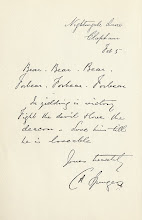
A selection from a letter by John Broadus to his good friend and co-laborer in teaching, J. P. Boyce. Boyce was president of the Baptist seminary in Greenville, SC. He was responsible for raising funds for the relocation of the school to Louisville, KY. His task was difficult. He faced, in the words of Tom Nettles, "post-Civil War distress, Landmark contrariness, and institutional suspicion." These things made it difficult to secure sufficient financial interest in the school. At a particularly low point, Broadus wrote a letter to boost his low spirits. Eventually Boyce met with success but his endurance through the difficult days was helped by the encouragement of friends like Broadus. The letter was written March 4, 1873.
I do not wonder that you sometimes feel discouraged, painfully. The task is difficult, and the kind of opposition encountered is very depressing. But life is always a battle. My dear Fellow, nobody but you can do this thing. I believe you can do it, and it will be, all things considered, one of the great achievements of our time. To have carried it through will be a comfort and a pleasure to you through life, a matter of joy and pride to many who love and honor you, an occasion of thanksgiving through eternity. Opposition—every good thing encounters opposition. Think of Paul, of Jesus! Nay, Nay, no such words as fail. Somehow, somehow, you are bound to succeed.
James Petigru Boyce: A Southern Baptist Statesman, by Thomas J. Nettles, P & R Publishing, 2009, p. 255.
Showing posts with label John A. Broadus. Show all posts
Friday, April 1, 2011
Opposition
Labels:
depression,
discouragement,
J. P. Boyce,
John A. Broadus,
opposition,
pride,
seminary,
success
Wednesday, September 8, 2010
Our Life Work
A selection from a letter by James Petigru Boyce to his good friend and fellow laborer in the gospel, John A. Broadus. They had labored together in establishing The Southern Baptist Theological Seminary in Louisville, Kentucky. As president of the seminary, Boyce had the immense pressure of raising funds for the school. While on a visit to France, he received a letter from Broadus telling about a gift of $50,000 for the building of a library. Broadus said this "would doubtless encourage you, with reference to your life-work." It was a great encouragement to him and he expressed his gratitude to God in a return letter to Broadus, written October 31, 1888.
Please express to your friend my hearty thanks for this contemplated gift, both personally and officially. I know not what words to use. None could express too strongly my gratitude and thanks. May God reward her, for he alone can do so worthily of her generosity and noble purposes.
God be with you and bless you, my dear friend. No one knows how much I owe you for your help and your influence in the matter of the establishment of what you call my life-work, but which ought to be 'our life work.'
Life and Letters of John Albert Broadus, by A. T. Robertson, first published in 1901, reprinted by Gano Books, 1987, p. 374.
Labels:
gifts,
gratitude,
J. P. Boyce,
John A. Broadus,
life-work,
Princeton Seminary
Monday, October 5, 2009
Forget Not the Truth

A portion of the letter that John A. Broadus wrote to his church, the Charlottesville Baptist Church, Charlottesville, Virginia, when he resigned the pastorate in order to take up a teaching position in the newly established Baptist Seminary in Greenville, South Carolina. J. P. Boyce had prayed to God and pleaded with Broadus that he might help begin what was soon to become The Southern Baptist Theological Seminary, which eventually moved to Louisville, Kentucky. The letter was written August 28, 1859.
I am unable to express my feelings of gratitude for all your kindness and of affectionate interest in your welfare, as a church, as families, and as individuals. I trust you will always look with charitable indulgence upon my faults of character, and failures in duty. I have little fear of being personally forgotten here, but I especially ask that you will not forget the truth I have preached among you, but will seek to profit hereafter by the labors which are now ended; so ‘that I may rejoice in the day of Christ, that I have not run in vain, neither labored in vain.’
Life and Letters of John Albert Broadus, by Archibald Thomas Robertson, 1901, reprint by Gano Books, p. 166.
Friday, August 28, 2009
Looking to the Lord for Help

A selection from a letter by James Petigru Boyce to his good friend and fellow laborer in the gospel, John A. Broadus. The Seminary in Greenville, South Carolina, of which Boyce was president, was moving to Louisville, Kentucky. Boyce faced much opposition in heading up this move and was attempting to raise funds for the school. The cause of the school was in doubt but due to the laborers of J. P. Boyce and the power of God, the school, now known as The Southern Baptist Theological Seminary, was firmly established. This letter was written December 10, 1872.
I have had some blessed experience in this work of mine. I fear I came in too great self-confidence and conviction that so good a cause must commend itself. The Lord has taught me that all hope in man is vain and as I have been able to look to Him alone I have some wonderful evidences of His aid. Do you wonder then that in the moment of real disdain, and when all felt that nothing could be done, I was enabled to rise and say all is right? I shall succeed. I have no fears. And I feel confident, thought human flesh sometimes fails and I fear. My experience was like that of David in the cave (Ps. 142). Even the temptation was put before me to destroy my enemies, and I was graciously enabled by my publications of minutes to show what I could have done. And I believe God had blessed by peaceful intentions and answered my prayers and accepted my trust. Or shall I not rather say others’ prayers, for all of you have been praying for me—or rather none of ours but only those of Christ whose Spirit has taught us what to ask for and who has himself asked that the prayers be granted. All the glory be to God. The work is succeeding I am sure. Yet I have no more subscriptions yet to report, but my plans are working.
James Petigru Boyce: A Southern Baptist Statesman, by Thomas J. Nettles, P & R Publishing, 2009, pp. 252-53.
I have had some blessed experience in this work of mine. I fear I came in too great self-confidence and conviction that so good a cause must commend itself. The Lord has taught me that all hope in man is vain and as I have been able to look to Him alone I have some wonderful evidences of His aid. Do you wonder then that in the moment of real disdain, and when all felt that nothing could be done, I was enabled to rise and say all is right? I shall succeed. I have no fears. And I feel confident, thought human flesh sometimes fails and I fear. My experience was like that of David in the cave (Ps. 142). Even the temptation was put before me to destroy my enemies, and I was graciously enabled by my publications of minutes to show what I could have done. And I believe God had blessed by peaceful intentions and answered my prayers and accepted my trust. Or shall I not rather say others’ prayers, for all of you have been praying for me—or rather none of ours but only those of Christ whose Spirit has taught us what to ask for and who has himself asked that the prayers be granted. All the glory be to God. The work is succeeding I am sure. Yet I have no more subscriptions yet to report, but my plans are working.
James Petigru Boyce: A Southern Baptist Statesman, by Thomas J. Nettles, P & R Publishing, 2009, pp. 252-53.
Labels:
confidence,
J. P. Boyce,
John A. Broadus,
opposition,
seminary
Wednesday, June 3, 2009
Influence


A selection from a letter to John A. Broadus by his friend, E. C. Dargan. Dargan edited Broadus’s classic Preparation and Delivery of Sermons, and was author of a two-volume work on The History of Preaching. His letter expressed appreciation for the influence Broadus had on many young scholars, himself included. The letter was written November 19, 1878.
Amid your difficulties and troubles, as I know you have many, it must ever be a source of comfort to you to know that you have helped many a man to be a Christian and a scholar. Your influence is deeply felt by all who ever came near enough to you to realize it’s worth—I see it in others, and I feel it in myself. May God bless you and spare you a long time to us yet.
Life and Letters of John Albert Broadus, by Archibald Thomas Robertson, 1901, reprint by Gano Books, p. 311.
Monday, March 16, 2009
Let Us Be Thankful, Trustful, and Hopeful
A selection from a letter by John A. Broadus to his dear friend and co-laborer in teaching, J. P. Boyce. The letter was written from Greenville, South Carolina, on January 24, 1876. It was his 49th birthday.
This is my birthday. We have entered, you and I, on our fiftieth year of life. Each of us could look back with sore lamenting and might be tempted to repining, but let us try to be thankful instead, to be trustful too, and hopeful. For one thing I give thanks at this moment, as often before, that God has given me such a bosom friend as you.
Life and Letters of John Albert Broadus, by Archibald Thomas Robertson, 1901, reprint by Gano Books, p. 299.
This is my birthday. We have entered, you and I, on our fiftieth year of life. Each of us could look back with sore lamenting and might be tempted to repining, but let us try to be thankful instead, to be trustful too, and hopeful. For one thing I give thanks at this moment, as often before, that God has given me such a bosom friend as you.
Life and Letters of John Albert Broadus, by Archibald Thomas Robertson, 1901, reprint by Gano Books, p. 299.
Labels:
birthday,
friendship,
J. P. Boyce,
John A. Broadus
Wednesday, December 10, 2008
She Is Gone To Heaven
A selection from a letter by John A. Broadus to his wife, Maria, after the death of his beloved sister, Carry Whitescarver. He was grieved over her passing but thankful that she had lived an exemplary life and had gone to be with the Lord. The letter was written September 1, 1852.
May her holy life, and this her hopeful, happy death be the life and death of her so unworthy, yet so richly-blessed, ‘baby’ brother! Oh, that sister was dear to me, dearer than any knew, dearer than I knew myself, yet she is gone! But then, she is gone to heaven; and I can hope, humbly and trustingly, that by the grace of God I shall see my sister Carry again, and part from her no more. My dear Maria, be a Christian, with all your heart, now.
Life and Letters of John Albert Broadus, by Archibald Thomas Robertson, 1901, reprint by Gano Books, p. 100.
May her holy life, and this her hopeful, happy death be the life and death of her so unworthy, yet so richly-blessed, ‘baby’ brother! Oh, that sister was dear to me, dearer than any knew, dearer than I knew myself, yet she is gone! But then, she is gone to heaven; and I can hope, humbly and trustingly, that by the grace of God I shall see my sister Carry again, and part from her no more. My dear Maria, be a Christian, with all your heart, now.
Life and Letters of John Albert Broadus, by Archibald Thomas Robertson, 1901, reprint by Gano Books, p. 100.
Wednesday, October 22, 2008
Promote His Glory in the Conversion of Sinners
A portion of a letter written by John A. Broadus to Miss Cornelia Taliaferro, September 5, 1853. He told her about the blessing of God he had experienced in seeing sinners converted when preaching in various meetings.
Our kind Father will not fail to bless to our own growth in grace and comfort of love, any sincere effort, however feeble, which we make to promote his glory in the conversion of sinners; and this blessing may be realized, not only by the preacher in the pulpit, but by every Christian in private efforts to do good to individuals.
Life and Letters of John Albert Broadus, by Archibald Thomas Robertson, 1901, reprint by Gano Books, p. 113.
Our kind Father will not fail to bless to our own growth in grace and comfort of love, any sincere effort, however feeble, which we make to promote his glory in the conversion of sinners; and this blessing may be realized, not only by the preacher in the pulpit, but by every Christian in private efforts to do good to individuals.
Life and Letters of John Albert Broadus, by Archibald Thomas Robertson, 1901, reprint by Gano Books, p. 113.
Thursday, August 21, 2008
A Little But Great Incident
A portion of a letter written to John A. Broadus from T. M. Matthews of Edom, Texas, expressing his appreciation for something he wrote in an “autograph book.” What Broadus wrote was instrumental in Matthew’s salvation. The letter was written May 22, 1883.
I’ve never seen you since 1853 in the pulpit of the church in Charlottesville [VA] when I heard you preach. But, John, you have been preaching to me through all these years. I’ll tell you how. You remember our “autograph books?” Well, of all the students I took mine to you first, that you might write in it the first. Do you remember? I reckon not, however, you wrote: en se hustereo [one thing you lack] (Mark 10:21), John Albert Broadus, University of Virginia.
That rang in my ears till I found “the pearl of great price,” the thing you knew I lacked. I’ve often thought of you since and never without recalling this little, but to me great, incident.
Life and Letters of John Albert Broadus, by Archibald Thomas Robertson, 1901, reprint by Gano Books, pp. 339-40.
I’ve never seen you since 1853 in the pulpit of the church in Charlottesville [VA] when I heard you preach. But, John, you have been preaching to me through all these years. I’ll tell you how. You remember our “autograph books?” Well, of all the students I took mine to you first, that you might write in it the first. Do you remember? I reckon not, however, you wrote: en se hustereo [one thing you lack] (Mark 10:21), John Albert Broadus, University of Virginia.
That rang in my ears till I found “the pearl of great price,” the thing you knew I lacked. I’ve often thought of you since and never without recalling this little, but to me great, incident.
Life and Letters of John Albert Broadus, by Archibald Thomas Robertson, 1901, reprint by Gano Books, pp. 339-40.
Wednesday, March 5, 2008
Hearing Spurgeon Preach
Extract from a letter by John A Broadus while in London, to Mrs. Broadus, Sept. 26, 1870:
I was greatly delighted with Spurgeon, especially with his conduct of public worship. The congregational singing has often been described, and is as good as can well be conceived. Spurgeon is an excellent reader of Scripture, and remarkably impressive in reading hymns, and the prayers were quite what they ought to have been. The sermon was hardly up to his average in freshness, but was exceedingly well delivered, without affectation or apparent effort, but with singular earnestness, and directness. The whole thing – house, congregation, order, worship, preaching, was as nearly up to my ideal as I ever expect to see in this life. Of course Spurgeon has his faults and deficiencies, but he is a wonderful man. Then he preaches the real gospel, and God blesses him.
Life and Letters of John Albert Broadus, by Archibald Thomas Robertson, 1901, reprint by Gano Books, p. 243.
I was greatly delighted with Spurgeon, especially with his conduct of public worship. The congregational singing has often been described, and is as good as can well be conceived. Spurgeon is an excellent reader of Scripture, and remarkably impressive in reading hymns, and the prayers were quite what they ought to have been. The sermon was hardly up to his average in freshness, but was exceedingly well delivered, without affectation or apparent effort, but with singular earnestness, and directness. The whole thing – house, congregation, order, worship, preaching, was as nearly up to my ideal as I ever expect to see in this life. Of course Spurgeon has his faults and deficiencies, but he is a wonderful man. Then he preaches the real gospel, and God blesses him.
Life and Letters of John Albert Broadus, by Archibald Thomas Robertson, 1901, reprint by Gano Books, p. 243.
Friday, December 28, 2007
Think of Jesus
A selection from a letter by John A Broadus, while in Goshen Depot, Virginia, to Mrs. Broadus, June 16, 1867, about a sermon he preached at the Presbyterian Church in Lexington, Virginia:
Sunday morning it rained considerably, which prevented my going to Sunday-school, and prevented the huge Presbyterian church from running over. It was full, including some four hundred college students and cadets [Washington and Lee College]. I did greatly long to make them think of Jesus. Oh, that I could once speak of him somewhat as a man ought to speak [he preached on ‘One Jesus,’ from Acts 25:19].
Life and Letters of John Albert Broadus, by Archibald Thomas Robertson, 1901, reprint by Gano Books, p. 226.
Sunday morning it rained considerably, which prevented my going to Sunday-school, and prevented the huge Presbyterian church from running over. It was full, including some four hundred college students and cadets [Washington and Lee College]. I did greatly long to make them think of Jesus. Oh, that I could once speak of him somewhat as a man ought to speak [he preached on ‘One Jesus,’ from Acts 25:19].
Life and Letters of John Albert Broadus, by Archibald Thomas Robertson, 1901, reprint by Gano Books, p. 226.
Wednesday, October 31, 2007
It Is Good
Extract from a letter by John A Broadus to Maria Harrison, his wife-to-be, October 18, 1850:
It is good for us sometimes to be troubled, since it drives us to the Great Comforter; for it is good to feel our weakness and insufficiency, and then go to the Source of Strength.
Life and Letters of John Albert Broadus, by Archibald Thomas Robertson, 1901, reprint by Gano Books, p. 82.
It is good for us sometimes to be troubled, since it drives us to the Great Comforter; for it is good to feel our weakness and insufficiency, and then go to the Source of Strength.
Life and Letters of John Albert Broadus, by Archibald Thomas Robertson, 1901, reprint by Gano Books, p. 82.
Thursday, September 13, 2007
The Divine Blessing
From a letter by John A Broadus to his wife, Maria Broadus, June 4, 1853:
I know that I am grievously prone to overestimate men’s opinion of me and lamentably inclined to be vain when I ought to be humble. Pray for me, Maria, that a little applause may not be permitted to turn my weak head and bewitch my silly heart in that I may remember my nothingness and my entire dependence for all true success on the Divine blessing, and that more than anything else I may carry back an increased desire to labor for the conversion of men to Christ.
Life and Letters of John Albert Broadus, by Archibald Thomas Robertson, 1901, reprinted by Gano Books, 1987, p. 109.
I know that I am grievously prone to overestimate men’s opinion of me and lamentably inclined to be vain when I ought to be humble. Pray for me, Maria, that a little applause may not be permitted to turn my weak head and bewitch my silly heart in that I may remember my nothingness and my entire dependence for all true success on the Divine blessing, and that more than anything else I may carry back an increased desire to labor for the conversion of men to Christ.
Life and Letters of John Albert Broadus, by Archibald Thomas Robertson, 1901, reprinted by Gano Books, 1987, p. 109.
Subscribe to:
Posts (Atom)