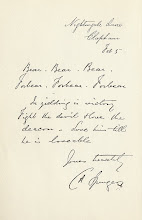
Jonathan Watson gave a few samples of letters written by Alexis baron von Roenne in the March, 2011 edition of The Banner of Truth magazine (pp. 21-27). Alexis baron bon Roenne was born in Prussia in 1902 [03?] and was a career officer in the German army. He opposed Nazism and was later implicated in an assassination attempt of Hitler, of which he was not guilty, yet he was executed. He had strong Christian convictions and died with great faith in Christ on October 12, 1944. This letter was written to his wife on the day of his death.
My dearest beloved:
In a moment now I shall be going home to our Lord in complete calm and in the certainty of salvation. My thoughts are with you, with all of you, with the very greatest love and gratitude.
As my last wish, I entreat you only to cling to Him and to have full confidence in Him; He loves you.
Any decision you may take for all of you, after prayer, has my complete sanction and my blessing. If only you knew with what inconceivable loyalty He is standing by my side at this moment, you would be armoured, and calm, for all your difficult life. He will give you strength for everything.
I bless both of our beloved children, and include them in my last ardent prayer. May the Lord let His countenance shine upon them and lead them home.
Heartfelt greetings and thanks to my beloved Mama, to your parents and my brothers and sisters. May they, safeguarded by Him, survive even difficult times in our ardently beloved fatherland.
To you, my very dearest of all, belong my ardent love and thanks to the last moment and until our blessed reunion.
God keep you.
Dying We Live: The Final Messages and Records of Some Germans Who Defied Hitler, edited by Helmut Gollwitzer, Kathe Kuhn, Reinhold Schneider, translated by R. C. Kuhn, Harvill Press, London, 1956.
Wednesday, March 2, 2011
Cling Only to Him
Labels:
Alexis baron von Roenne,
assurance,
conviction,
courage,
death,
faith,
family,
love
Saturday, February 26, 2011
Living by the Gospel
A portion of a letter from Leonard Ravenhill to one of his closest friends, Al Whittinghill of Woodstock, GA. When Ravenhill wasn't preaching in a meeting somewhere, he was writing letters. And what a ministry of letter writing he had! In one letter to a friend, he spoke of writing 50 letters that week. He preached plainly and powerfully and wrote the same way. Ravenhill made much of Christ in all that he did, including his correspondence, as we see in this letter. This particular letter is undated.
Again we are overloaded, but we must work while it is day. He is a poor butcher who does not eat his own meat. He is a poor preacher who does not live his own gospel. Jesus is the bread of life, bread that is never stale. He is the water of life, water that is never brackish. He is the light of life, light that is never dim.
In Light of Eternity: The Life of Leonard Ravenhill, by Mack M. Tomlinson, Free Grace Press, 2010, p. 441.
Labels:
Al Whittinghill,
Christ,
Leonard Ravenhill,
living on the gospel,
work
Friday, February 25, 2011
To Be Happy
A selection from a letter to a friend by the well-known hymn writer and preacher of the gospel, Augustus Toplady. Toplady wrote simply of what one must be in order to be happy and the means by which one finds it. The letter was written November 9, 1772.
To be happy we must be virtuous; and in order to our becoming truly virtuous, we must experience the grace of God, which bringeth salvation.
The Works of Augustus Toplady, Bookshelf Publications, reprint from the 1794 edition, p. 834.
To be happy we must be virtuous; and in order to our becoming truly virtuous, we must experience the grace of God, which bringeth salvation.
The Works of Augustus Toplady, Bookshelf Publications, reprint from the 1794 edition, p. 834.
Labels:
Augustus Toplady,
grace of God,
happiness,
salvation,
virtue
Tuesday, February 22, 2011
A Fair Testimonial of My Lord Jesus
A selection from a letter by Samuel Rutherford to William Gordon. Rutherford was answering his letter, and as he so often did in correspondence, gave testimony to Christ's worth. He said, "It is my aim and hearty desire, that my furnace, which is of the Lord's kindling, may sparkle fire upon standers-by, to the warming of their hearts with God's love." He followed this with a "fair testimonial" of the Lord Jesus. The letter was written in 1637.
I should be a liar and false witness, if I would not give my Lord Jesus a fair testimonial with my whole soul. My word, I know, will not heighten Him; He needeth not such props under His feet to raise His glory high. But, oh that I could raise Him the height of heaven, and the breadth and length of ten heavens, in the estimation of all His young lovers! for we have all shapen Christ but too narrow and too short, and formed conceptions of His love, in our conceit, very unworthy of it. Oh that men were taken and catched with his beauty and fairness! they would give over playing with idols, in which there is not half room for the love of one soul to expatiate itself.
Letters of Samuel Rutherford, With a Sketch of His Life and Biographical Notices of His Correspondents, by the Rev. Andrew A. Bonar, first published in 1664, republished by The Banner of Truth Trust, 1984, pp. 399-400.
Labels:
Christ,
idols,
love,
praise,
Samuel Rutherford,
testimony,
William Gordon
Friday, February 18, 2011
Bearing His Sacred Reproach
A portion of a letter from George Whitefield to a friend (perhaps George Stonehouse) in England. Whitefield was in Savannah, Georgia, on one of his many trips to America. Whatever trial this brother was facing, Whitefield wrote an edifying letter. The letter was written June 26, 1740.
Go on, dear Sir, go on, and follow your glorious Master without the camp, bearing his sacred reproach. Never fear the scourge of the tongue, or the threatenings that are daily breathed out against the Lord and against his Christ. Suffer we must, I believe, and that great things. Our Lord, by his providence, begins to shew it. Ere long, perhaps, we may sing in a prison, and have our feet set fast in the stocks. But faith in Jesus turns a prison into a palace, and makes a bed of flames become a bed of down. Let us be faithful today and our Lord will support us tomorrow.
Letters of George Whitefield: For the Period 1734-1742, The Banner of Truth Trust, 1976, reprinted from The Works of George Whitefield, 1771, p. 193.
Labels:
faithful,
George Whitefield,
providence,
reproach,
singing,
suffering
Tuesday, February 15, 2011
I Much Wish to See this Mission Settle on a Permanent Foundation
A selection from a letter by missionary William Carey, to Andrew Fuller, one of the pastors who held the ropes in England while he mined for souls in India. Carey was concerned that the next generation of Christians in the home churches might not care for the work as Fuller and others had, and that the Mission would fail because of lack of funds. The matter-of-fact statements made by Carey are not reflective of weak faith but were meant to encourage Fuller and others to pass along to the next generation a love for the mission work in Serampore and all of India. The letter was written February 5, 1800.
I fear dear Bro. [Samuel] Pearce is dead [he died Oct. 10, 1799, but Carey did not yet know]. You, Bro. [John] Ryland [Jr.] and a few of the most active to provide funds for the Mission may soon die; and the work may fall through for want of active persons who will feel interested in it as you do.
The Publick mind may tire soon, especially if success is much longer delayed. In that case the Mission must be broken up for want of funds to support it and then all that is done will be lost…
I have written so much about our temporal concerns in all our Letters, because I fear some of them (may) miscarry and also because I much wish to see this Mission settle on a permanent foundation.
The Journal and Selected Letters of William Carey, collected and edited by Terry G. Carter, Smyth & Helwys, 2000, pp. 196-97.
Labels:
Andrew Fuller,
funds,
John Ryland,
missions,
Samuel Pearce,
support,
temporal concerns,
William Carey
Wednesday, February 2, 2011
Everything Ordered and Directed by Divine Goodness
A selection from a letter by the Welsh preacher, Thomas Charles, to Sally Jones, whom he would later marry. Charles was a spiritual counselor to Miss Jones throughout their courtship. She grew by leaps and bounds in the grace and knowledge of the Lord through her acquaintance with him. In this letter he directed her to gain comfort in knowing that all events are under God's directions. It was written March 1, 1782.
Never was a truer saying than this… "the good God makes all things good, for good to his people." Everything, the smallest as well as the greatest event, is ordered and directed by divine goodness and wisdom for their good. He is as much present with, and takes as much care of, everyone of his children, as if he had no other creature to watch over, and take care of, in the whole universe.
Thomas Charles' Spiritual Counsels, Selected from his Letters and Papers, by Edward Morgan, first published in 1836, reprinted by the Banner of Truth Trust, 1993, p. 251.
Labels:
providence,
Rom 8:28,
Sally Jones,
Thomas Charles,
wisdom
Subscribe to:
Posts (Atom)