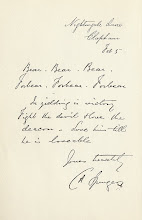
A selection from a letter by missionary William Carey, to Andrew Fuller, one of the pastors who held the ropes in England while he mined for souls in India. Carey was concerned that the next generation of Christians in the home churches might not care for the work as Fuller and others had, and that the Mission would fail because of lack of funds. The matter-of-fact statements made by Carey are not reflective of weak faith but were meant to encourage Fuller and others to pass along to the next generation a love for the mission work in Serampore and all of India. The letter was written February 5, 1800.
I fear dear Bro. [Samuel] Pearce is dead [he died Oct. 10, 1799, but Carey did not yet know]. You, Bro. [John] Ryland [Jr.] and a few of the most active to provide funds for the Mission may soon die; and the work may fall through for want of active persons who will feel interested in it as you do.
The Publick mind may tire soon, especially if success is much longer delayed. In that case the Mission must be broken up for want of funds to support it and then all that is done will be lost…
I have written so much about our temporal concerns in all our Letters, because I fear some of them (may) miscarry and also because I much wish to see this Mission settle on a permanent foundation.
The Journal and Selected Letters of William Carey, collected and edited by Terry G. Carter, Smyth & Helwys, 2000, pp. 196-97.
Showing posts with label missions. Show all posts
Tuesday, February 15, 2011
Wednesday, November 24, 2010
Pray to God to Give You a New Heart
A selection from a letter by Rev. Daniel Baker to some Sunday School children in Frankfort, Kentucky, where Baker used to pastor, who had sent him money to aid in his mission work in Texas. He told them how God had been saving people through his ministry in Texas, and as he was want to do, exhorted them to be sure that they were Christians and ready to go to heaven when they died. The letter was written from Galveston, July 20, 1849.
And remember, dear children, if you wish to try to get some of the people in Texas to go to heaven, you must be sure to try to get to heaven yourselves. O, it is a sweet place, a blessed place; and if you get there you will be as angels, with your crowns so bright, and your robes so white. I do believe that there are a great many children there already, and many others are on their way to that happy world now. A little girl, only thirteen years of age, joined my church last Sabbath; she was permitted by the Session to sit down at the table of the Lord, and take the sacrament. She seemed very happy, and I do believe she is a real Christian.
Would you not like to be real Christians too, and go to heaven when you die? Then you must pray to God to give you a new heart, and make you good children. I used to live in Frankfort; I used to preach in your church, and talk to your school; but I don't know that I shall ever be in Frankfort again. Many of you, I suppose, never saw me. No matter; if we get to heaven, we will see and love each other there; and there we will see our blessed Saviour, and the holy angels, and all our pious friends, and be so happy for ever and ever!
Making Many Glad: The Life and Labours of Daniel Baker, by William M. Baker, first published in 1858, reprinted by the Banner of Truth, 2000, p. 387.
Labels:
children,
Christ,
Daniel Baker,
happiness,
heaven,
missions,
offering,
salvation,
Sunday School
Friday, November 19, 2010
I Cannot But Rejoice
A portion of a letter from missionary William Carey, to his pastor-friend in England, Andrew Fuller. Carey had received letters from Fuller and was thankful. He said, "Few things afford me more pleasure than your letters do." In his reply, Carey gave a report of baptisms for the year 1809. It took seven years before the mission work saw its first baptism but he was able this particular year to report that there had been many. The letter was written December, 1809.
I believe the number baptised within the last year, in all the Churches of Bengal, is sixty seven. Two or three of them have been excluded or suspended, but a greater number of those who had been formally excluded, have given satisfactory proof of repentance, and have been re-admitted to the Lord's table. All the churches are supplied with pastors and have the Word regularly dispensed among them, and some new stations have been attempted, and old ones strengthened. Upon the whole, I cannot but rejoice in what the Lord has done and is now doing among us.
The Journal and Selected Letters of William Carey, collected and edited by Terry G. Carter, Smyth & Helwys, 2000, pp. 202-03.
Labels:
Andrew Fuller,
baptisms,
Bengal,
church discipline,
conversions,
joy,
missions,
preaching,
William Carey
Wednesday, May 5, 2010
Soundly Converted Under My Preaching
A selection from a letter by Rev. Daniel Baker to his wife. He had recently arrived in Galveston, Texas, on a survey trip about the possibility of doing mission work there. The city was new and growing. His church in Tuscaloosa, Alabama, did not wish him to leave them but granted him permission to take the trip, along with the blessing of his local Presbytery. His letter home gave some indication of the open door for gospel work and church planting. He ended up spending the rest of his life preaching the gospel in Texas. The letter was written February 21, 1840.
I have preached some fifteen or twenty sermons already, to houses generally crowded, and we should probably have twice as many out, if we could accommodate them. Two or three persons, have, I trust, been this week soundly converted under my preaching. They are, I believe, the very first cases of conversion that ever took place on the island. Thank the Lord for this great honour conferred upon me, a poor, unworthy instrument!
One of the persons spoken of, is a lady of high respectability, who had been on the island about three years, and had never heard a single sermon before she heard me, except one from a Catholic priest some time ago. And strange to tell, this first sermon she heard me preach was blessed to her awakening. She has since obtained a hope, and is one of the most interesting and satisfactory cases of conversion I ever knew in all my life.
Making Many Glad: The Life and Labours of Daniel Baker, by William M. Baker, first published in 1858, reprinted by the Banner of Truth, 2000, pp. 234-35.
Labels:
conversion,
Daniel Baker,
evangelism,
gospel,
missions,
preaching
Thursday, February 11, 2010
Delays

An excerpt from a letter by Jack Miller, a church planter and seminary professor with the PCA, to a missionary couple who had begun ministry recently in Uganda. Because life is lived at a slower pace in Africa, he called on them to alter the tempo of their lives and learn lessons from God about delays. He encouraged them to slow down and love people. The letter was written in June, 1985.
Actually, delays are great because they often reveal the power of indwelling sin. We are flying high, then comes a postponement of our hopes, and we end up with an irritable spirit which shows an alarming degree of self-independence and reliance on human capacities. What we fail to see is that reliance on people, their capabilities, their keeping their promises, is a demonic faith, a cooperation in heart with the power of darkness. We join the enemy, Satan, when we fail to rely on the promises of God to move on our behalf. In brief, our impatience often has a Devilish, earthly side to it, which reveals that we have unconsciously forgotten that trusting Christ is more important than doing things for Christ.
I do not mean that we should be sluggish when God says, “March.” But all too often we march when He wants us to wait and rest, and then do not march when He calls us to go forward with power.
The Heart of a Servant Leader: Letters from Jack Miller, C. John Miller, edited by Barbara Miller Juliani, Presbyterian and Reformed Publishing, 2004, p. 151.
Labels:
defense of the faith,
delays,
doing,
hopes,
Jack Miller,
missions,
reliance on self,
resting,
trusting Christ,
waiting
Friday, January 29, 2010
A Wish for a Thousand Lives to Give

An excerpt from a letter by Lottie Moon, missionary to China from 1873 to 1912, to Henry Allen Tupper, the Corresponding Secretary of the Southern Baptist Foreign Mission Board. Miss Moon constantly appealed for more workers to be sent to China, especially for women who could assist in work to the Chinese women. One of her oft repeated messages back home, found also in this letter was, “If only our people would wake up!” Here she pleads for more workers to be sent. The letter was written August 27, 1888.
I should be most heartily glad of ten women for the P’ingtu region. Nobody who has not seen can imagine the wide field opened there for woman’s work. I would I had a thousand lives that I might give them to the women of China! As it is, I can only beg that other women & many of them be sent. Above all, we need mature women. The Chinese have a high respect for such, but, for many reasons, I think young women had best not be sent. It would not be proper, in Chinese eyes, for young women to go out in the independent way necessary in doing rough country work in the interior. Besides, it seems to me too hard on the young ladies themselves. Of course, there may be exceptional cases.
Send the Light: Lottie Moon’s Letters and Other Writings, edited by Keith Harper, Mercer University Press, 2002, pp. 131-32.
Labels:
China,
commitment,
Lottie Moon,
missions,
women
Thursday, November 19, 2009
Will Not Some of You Give Yourselves?

A selection from a letter by Margaret Paton, wife of missionary John Paton, to children in Scotland who had given offerings for their work. Their gifts help pay for a ship called Dayspring, which brought letters and supplies to the missionaries and took them to Australia for special needs. She thanked the children for their financial help and called on some of them to consider coming someday as missionaries. The letter was written in July, 1871.
I have told you a little of what the Dayspring does for the missionaries; but just think of what it has done for the Heathen, by bringing these missionaries to them. I have not time to dwell on this; but there will be ages and ages in eternity for these redeemed Ethiopians to show forth their praise and gratitude to God for sending us to tell them of Him who died for them.
Remember, however, that it is the missionary, and not the mission ship, that brings souls to the Saviour; for important as the Dayspring is, and it is of vital importance, it cannot make known to a single individual the way of salvation through Christ. We must have missionaries, who will go and live among the ‘Darkies,’ learn their language, teach them to read, and show them what it is to live as Christians.
Will not some of you, who have done so well in giving your money to the mission, do infinitely better by giving yourselves some day?
Margaret Paton: Letters from the South Seas, first published in 1894 as Letters and Sketches from the New Hebrides, published by The Banner of Truth Trust in 2003, p. 80.
Labels:
children,
giving,
Margaret Paton,
missions,
salvation
Saturday, September 12, 2009
The Patience of Suffering and the Patience of Waiting

A portion of a letter by the Anglican minister, Thomas Scott, to his Baptist friend, pastor John Ryland. The two had a cordial relation together. Rev. Scott followed with great interest the missionary labors of the Baptists, led by William Carey, which he mentions here. The missionary team sent out by the Baptist of England had not long been in India when Rev. Scott wrote this letter to Ryland. The letter was written December 23, 1794.
I rejoice to hear of the prospect that opens before your missionaries in Asia; yet, knowing something of human nature, I cannot but believe that it will rise violently against their message, when the Hindoos and others, generally understand the nature and tendency of it, and the humbling mortifying things it implies. Did I therefore correspond with the missionaries, I exhort them to pray without ceasing, not only for the patience of suffering, but also for the patience of waiting; in my idea, the most essential requisite for a modern missionary. I have, however, no doubt that the Lord will eventually bless the design; and I have the satisfaction to say, that even some of my acquaintance, who are not very favourable to dissenters, highly applaud it.
The Life, Letters, and Papers of the Late Rev. Thomas Scott D.D., to which is added The Force of Truth, by Rev. John Scott, New Haven Publishers, 1827, p. 373.
Friday, May 15, 2009
We Are Encouraged by the Gospel

A letter written by Ann Judson, wife of missionary to Burma, Adoniram Judson. She wrote of the hardships of missionary life but also of the joy in carrying out the Great Commission. The letter was written July 22, 1813.
Were it not for the support we derive from the gospel of Jesus, we should be ready to sink down in despondency in view of the dark and gloomy scenes around us. But when we recollect that Jesus has commanded his disciples to carry the gospel to the heathen, and promised to be with them to the end of the world; that God has promised to give the heathen to his Son for an inheritance, we are encouraged to make a beginning, though in the midst of discouragement, and leave it to Him, to grant success in his own time and way.
The Three Mrs. Judsons, by Arabella W. Stuart, first published in 1851, reprinted by Particular Baptist Press, 1999, pp. 29-30.
Wednesday, May 13, 2009
Fear We Are Forgotten

A selection from a letter by missionary William Carey to one of his dearest friends, Andrew Fuller, a supporting pastor in England. The mail was not always reliable and caused concerns whether his work had been forgotten. The letter was written January 21, 1802.
Our dear Brethren in England are not forgotten by us in our prayers, tho we have some reason to fear we are forgotten by them, it being now a year and a half, at least, since the date of the last letter we received.
The Journal and Selected Letters of William Carey, collected and edited by Terry G. Carter, Smyth & Helwys, 2000, p. 220.
Labels:
Andrew Fuller,
hardships,
missions,
William Carey
Wednesday, January 28, 2009
Obedience to Christ and Compassion for the Perishing
A selection from a letter by Sarah Boardman to her parents about the death of her husband, George Boardman. The Boardman’s went to Burma to serve with Adoniram Judson in the mission work that he had begun. George Boardman died at age 30. Mrs. Boardman told her parents that he refused to leave the primitive area where they were trying to reach the Karens with the gospel for a place that would be better for his health. In a letter written on March 7, 1831, she recounted the words of her husband, who said:
And even should my poor, unprofitable life be somewhat shortened by staying, ought I, on that account merely, to leave this interesting field? Should I not rather stay and assist in gathering in these dear scattered lambs of the fold? You know, Sarah, that coming on a foreign mission involves the probability of a shorter life, than staying in one’s native country. And yet obedience to our Lord, and compassion for the perishing heathen, induced us to make this sacrifice. And have we ever repented that we came? No; I trust we can both say that we bless God for bringing us to Burmah, for directing our footsteps to Tavoy, and even for leading us hither.
The Lives of the Three Mrs. Judsons, by Arabella Stuart, first published in 1851, reprinted by Particular Baptist Press, 1999, pp. 175-76.
Labels:
commitment,
George and Sarah Boardman,
missions
Subscribe to:
Posts (Atom)