A portion of a letter from Andrew Fuller (1754-1815) to a young minister about preaching. Fuller wrote several letters to this person under the title, "Thoughts on Preaching." The emphasis in this paragraph is the need for searching the Scriptures for one's own benefit, not just to find sermons.
To understand the Scriptures in such a manner as profitably to expound them, it is necessary to be conversant with them in private; and to mix, not only faith, but the prayer of faith, with what we read. There is a great difference between reading the Scriptures as a student, in order to find something to say to the people, and reading them as a Christian, with a view to get good from them to one’s own soul. That which is gained in the latter of these ways is, beyond all comparison, of the greatest use, both to ourselves and others. That which we communicate will freeze upon our lips, unless we have first applied it to ourselves; or, to use the language of Scripture, "tasted, felt, and handled the word of life."
The Works of Andrew Fuller, "Thoughts on Preaching," volume 1, letter 1, p. 713.
Showing posts with label faith. Show all posts
Wednesday, September 21, 2011
Friday, June 24, 2011
In My Old Age
A selection from a letter by Rev. Henry Venn, a minister in the Church of England, to an acquaintance, Mrs. Braiser, who had lost an infant in death. He gave reasons why "our dear children, taken away almost as soon as we see them, are safe in the hands of their merciful Creator and Redeemer." He also spoke of his trials in old age but of the nearness to God in meditation and prayer. The letter was written March 27, 1781.
My health is very much restored; yet I am forced, I think, to pay dearly for it. I am obliged to be on horseback every day, and cannot study and apply as my heart delights to do. I began to make trial of preaching four times one week; but I smarted for it for more than a fortnight; so that I must be content with doing very little indeed in my old age. Oh that I may enjoy more meditation and prayer, and communion with God, till I am with Him, whose Name is most glorious in my eyes, and His service the highest honor… Oh for an overcoming faith, to possess the inheritance of the saints in light, by hope, before we are translated to it!
Letters of Henry Venn, by John Venn, first published in 1835, republished by the Banner of Truth, 1993, pp. 323-34.
Labels:
communion,
faith,
health,
Henry Venn,
hope,
meditation,
old age,
prayer,
preaching
Wednesday, March 2, 2011
Cling Only to Him
Jonathan Watson gave a few samples of letters written by Alexis baron von Roenne in the March, 2011 edition of The Banner of Truth magazine (pp. 21-27). Alexis baron bon Roenne was born in Prussia in 1902 [03?] and was a career officer in the German army. He opposed Nazism and was later implicated in an assassination attempt of Hitler, of which he was not guilty, yet he was executed. He had strong Christian convictions and died with great faith in Christ on October 12, 1944. This letter was written to his wife on the day of his death.
My dearest beloved:
In a moment now I shall be going home to our Lord in complete calm and in the certainty of salvation. My thoughts are with you, with all of you, with the very greatest love and gratitude.
As my last wish, I entreat you only to cling to Him and to have full confidence in Him; He loves you.
Any decision you may take for all of you, after prayer, has my complete sanction and my blessing. If only you knew with what inconceivable loyalty He is standing by my side at this moment, you would be armoured, and calm, for all your difficult life. He will give you strength for everything.
I bless both of our beloved children, and include them in my last ardent prayer. May the Lord let His countenance shine upon them and lead them home.
Heartfelt greetings and thanks to my beloved Mama, to your parents and my brothers and sisters. May they, safeguarded by Him, survive even difficult times in our ardently beloved fatherland.
To you, my very dearest of all, belong my ardent love and thanks to the last moment and until our blessed reunion.
God keep you.
Dying We Live: The Final Messages and Records of Some Germans Who Defied Hitler, edited by Helmut Gollwitzer, Kathe Kuhn, Reinhold Schneider, translated by R. C. Kuhn, Harvill Press, London, 1956.
My dearest beloved:
In a moment now I shall be going home to our Lord in complete calm and in the certainty of salvation. My thoughts are with you, with all of you, with the very greatest love and gratitude.
As my last wish, I entreat you only to cling to Him and to have full confidence in Him; He loves you.
Any decision you may take for all of you, after prayer, has my complete sanction and my blessing. If only you knew with what inconceivable loyalty He is standing by my side at this moment, you would be armoured, and calm, for all your difficult life. He will give you strength for everything.
I bless both of our beloved children, and include them in my last ardent prayer. May the Lord let His countenance shine upon them and lead them home.
Heartfelt greetings and thanks to my beloved Mama, to your parents and my brothers and sisters. May they, safeguarded by Him, survive even difficult times in our ardently beloved fatherland.
To you, my very dearest of all, belong my ardent love and thanks to the last moment and until our blessed reunion.
God keep you.
Dying We Live: The Final Messages and Records of Some Germans Who Defied Hitler, edited by Helmut Gollwitzer, Kathe Kuhn, Reinhold Schneider, translated by R. C. Kuhn, Harvill Press, London, 1956.
Labels:
Alexis baron von Roenne,
assurance,
conviction,
courage,
death,
faith,
family,
love
Monday, December 6, 2010
Can't Turn to Christ When You Please
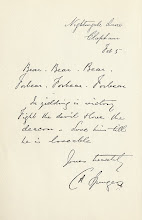
A portion of a letter by Charles Haddon Spurgeon to William Cooper about his need for Christ. Spurgeon, only a young man himself, had been a student-teacher at a school in Newmarket, where he met William. Spurgeon later moved to another school in Cambridge and wrote this letter to his former pupil, encouraging him to come to Christ for cleansing. Spurgeon was only 17 or 18 years of age at this time, yet he was greatly concerned about the salvation of lost sinners. The letter was written sometime in the year 1851.
Perhaps you intend to think about religion after you have enjoyed sin a little longer; or (but surely you are not so foolish) possibly you think that you are too young to die. But who knows whether that future time will be afforded, and who said that you can turn to Christ just when you please? Your heart is deceitful above all things, and your natural depravity so great that you will not turn to God. Trust not, then, to resolutions made in your own strength, they are but wind; nor to yourself, who are but a broken reed; nor to your own heart, or you are a fool. There is no way of salvation but Christ; you cannot save yourself, having no power even to think one good thought; neither can your parents’ love and prayers save you; none but Jesus can, He is the Saviour of the helpless, and I tell you that He died for all such as feel their vileness, and come to Him for cleansing.
The Letters of Charles Haddon Spurgeon: Collected and Collated by his son, Charles Spurgeon, Marshal Brothers Limited, 1923, p. 174. Also available by Logos Research Systems, 2009.
Perhaps you intend to think about religion after you have enjoyed sin a little longer; or (but surely you are not so foolish) possibly you think that you are too young to die. But who knows whether that future time will be afforded, and who said that you can turn to Christ just when you please? Your heart is deceitful above all things, and your natural depravity so great that you will not turn to God. Trust not, then, to resolutions made in your own strength, they are but wind; nor to yourself, who are but a broken reed; nor to your own heart, or you are a fool. There is no way of salvation but Christ; you cannot save yourself, having no power even to think one good thought; neither can your parents’ love and prayers save you; none but Jesus can, He is the Saviour of the helpless, and I tell you that He died for all such as feel their vileness, and come to Him for cleansing.
The Letters of Charles Haddon Spurgeon: Collected and Collated by his son, Charles Spurgeon, Marshal Brothers Limited, 1923, p. 174. Also available by Logos Research Systems, 2009.
Labels:
C. H. Spurgeon,
Christ alone,
death,
deceitful heart,
depravity,
faith,
salvation,
William Cooper
Thursday, March 4, 2010
Walking by Faith

A selection from a letter by Mary Winslow (1774-1854) to a friend. She spoke of a minister who had many needs in providing for his family but who was trusting in the Lord. She then wrote about the importance of living by faith. Not date is given for the letter.
How good it is to walk by faith. I am certain it is the right road to glory; no other would do us equal good. Faith in Jesus brings us countless blessings to the soul, and glory to God the Father. No wonder, then, the Lord tries the little we have, that it may be increased, and that every other grace might grow in proportion. We never should value a throne of grace as we ought to do if our faith was not tried. Jesus is very precious, and I am most graciously permitted in His name to have free access to the heart of God, my Father and your Father.
Heaven Opened: A Selection from the Correspondence of Mrs. Mary Winslow, edited by her son, Octavius Winslow, 1864, reprinted by Reformation Heritage Books, 2001, pp. 290-91.
How good it is to walk by faith. I am certain it is the right road to glory; no other would do us equal good. Faith in Jesus brings us countless blessings to the soul, and glory to God the Father. No wonder, then, the Lord tries the little we have, that it may be increased, and that every other grace might grow in proportion. We never should value a throne of grace as we ought to do if our faith was not tried. Jesus is very precious, and I am most graciously permitted in His name to have free access to the heart of God, my Father and your Father.
Heaven Opened: A Selection from the Correspondence of Mrs. Mary Winslow, edited by her son, Octavius Winslow, 1864, reprinted by Reformation Heritage Books, 2001, pp. 290-91.
Wednesday, August 12, 2009
Our Acceptance With God

A letter from George Whitefield to an inquirer about the way of salvation.
London, June 8, 1741
Dear Sir,
I like your last letter best. There is one thing you still lack, “to be convinced of unbelief.” By faith, and not by works, are you to be justified in the sight of God. Make use of the means. You must take care that you do not rest in them. You must not think anything you can do, will in the least recommend you to the favour of God; and yet you must strive, as if you were to be saved by your striving. The only cause of our acceptance with God lies at the feet of sovereign mercy, through Christ. Entreat the Lord to give you faith, and who knows but he may have mercy upon you. Remember you are a poor sinner, and deserve nothing. That God may reveal his dear Son in you, is the hearty prayer of
Your affectionate friend and servant,
G.W.
Letters of George Whitefield: For the Period 1734-1742, The Banner of Truth Trust, 1976, reprinted from The Works of George Whitefield, 1771, pp. 270-71.
London, June 8, 1741
Dear Sir,
I like your last letter best. There is one thing you still lack, “to be convinced of unbelief.” By faith, and not by works, are you to be justified in the sight of God. Make use of the means. You must take care that you do not rest in them. You must not think anything you can do, will in the least recommend you to the favour of God; and yet you must strive, as if you were to be saved by your striving. The only cause of our acceptance with God lies at the feet of sovereign mercy, through Christ. Entreat the Lord to give you faith, and who knows but he may have mercy upon you. Remember you are a poor sinner, and deserve nothing. That God may reveal his dear Son in you, is the hearty prayer of
Your affectionate friend and servant,
G.W.
Letters of George Whitefield: For the Period 1734-1742, The Banner of Truth Trust, 1976, reprinted from The Works of George Whitefield, 1771, pp. 270-71.
Friday, November 7, 2008
The Valuable Experiences of Brainerd and Elliot
A selection from a letter by Thomas Chalmers to “a young Clergyman,” giving him advice for the work of the ministry. Chalmers advised the young minister to model his ministry after the lives of two great missionaries to the American Indians – David Brainerd and John Elliot. The letter was written November 12, 1838.
It is a most valuable experience of Brainerd—that the regular distribution of time is essential to one’s religious prosperity; and of Elliot—that through faith in Christ Jesus, it is in the power of prayer and of pains to do everything.
Letters of Thomas Chalmers, edited by William Hanna, first published 1853, reprinted by The Banner of Truth, 2007, pp. 311-12.
It is a most valuable experience of Brainerd—that the regular distribution of time is essential to one’s religious prosperity; and of Elliot—that through faith in Christ Jesus, it is in the power of prayer and of pains to do everything.
Letters of Thomas Chalmers, edited by William Hanna, first published 1853, reprinted by The Banner of Truth, 2007, pp. 311-12.
Subscribe to:
Posts (Atom)