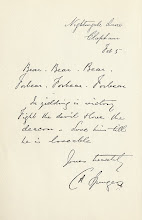
A selection from a letter by Augusta Toplady to someone who had written him with words of admiration. He responded with a personal assessment of himself. The letter was written November 2, 1777.
Madam,
Your letter quite distresses me, because it places excellencies to my account which I feel myself to be totally unpossessed of. Among all the weak and unworthy servants of Christ, I am the unworthiest and the weakest. If you know me as well as I know myself, you would be entirely of my mind.
For the Lord’s sake let us look to Jesus only, and learn to cease from man. Christ is all in all. Every other person and thing are vile, and wretched, and hateful, but so far as he deigns to smile and bless. “Less than nothing and vanity” is the only motto that belongs to me. If he vouchsafe to wash me in his blood, and to save me by his infinitely free and glorious redemption; a more worthless and helpless sinner will never sing his praises in the land of glory.
Instead of commending me, pray for me; that I may be kept from evil, and devote my few days (in humble and earnest attempt at least) to the honour of his name…
The Works of Augustus Toplady, Bookshelf Publications, reprint from the 1794 edition, p. 878.
Friday, January 30, 2009


Wednesday, January 28, 2009
Obedience to Christ and Compassion for the Perishing
A selection from a letter by Sarah Boardman to her parents about the death of her husband, George Boardman. The Boardman’s went to Burma to serve with Adoniram Judson in the mission work that he had begun. George Boardman died at age 30. Mrs. Boardman told her parents that he refused to leave the primitive area where they were trying to reach the Karens with the gospel for a place that would be better for his health. In a letter written on March 7, 1831, she recounted the words of her husband, who said:
And even should my poor, unprofitable life be somewhat shortened by staying, ought I, on that account merely, to leave this interesting field? Should I not rather stay and assist in gathering in these dear scattered lambs of the fold? You know, Sarah, that coming on a foreign mission involves the probability of a shorter life, than staying in one’s native country. And yet obedience to our Lord, and compassion for the perishing heathen, induced us to make this sacrifice. And have we ever repented that we came? No; I trust we can both say that we bless God for bringing us to Burmah, for directing our footsteps to Tavoy, and even for leading us hither.
The Lives of the Three Mrs. Judsons, by Arabella Stuart, first published in 1851, reprinted by Particular Baptist Press, 1999, pp. 175-76.
And even should my poor, unprofitable life be somewhat shortened by staying, ought I, on that account merely, to leave this interesting field? Should I not rather stay and assist in gathering in these dear scattered lambs of the fold? You know, Sarah, that coming on a foreign mission involves the probability of a shorter life, than staying in one’s native country. And yet obedience to our Lord, and compassion for the perishing heathen, induced us to make this sacrifice. And have we ever repented that we came? No; I trust we can both say that we bless God for bringing us to Burmah, for directing our footsteps to Tavoy, and even for leading us hither.
The Lives of the Three Mrs. Judsons, by Arabella Stuart, first published in 1851, reprinted by Particular Baptist Press, 1999, pp. 175-76.
Monday, January 26, 2009
Master Your Temper
A portion of a letter by the Welsh pastor, John Elias, to his son John who was away at school. Edward Morgan said of Elias, “How few professors and ministers pay so much attention to the spiritual interest of their children as Elias did!” Elias’s son was sixteen years of age when this letter was written in 1819.
Take great care of thy temper; learn to be master of it now in thy youthful days; yea, if some laugh at thee, or despise thee, or offend thee, receive it mildly, and take care that thou dost not suffer thy self to be under the dominion of an angry, surly, and revengeful temper. It is not manly, much less Christian-like – nay, it is Satan-like. Therefore, my dear son, beware of this temper; it is a disgrace to the human nature; it is a great defect in the moral character of man, to say that he is of a rash, angry, and revengeful temper.
John Elias: Life, Letters and Essays, by Edward Morgan, first published in 1844, reprinted by the Banner of Truth, 1973, p. 204.
Take great care of thy temper; learn to be master of it now in thy youthful days; yea, if some laugh at thee, or despise thee, or offend thee, receive it mildly, and take care that thou dost not suffer thy self to be under the dominion of an angry, surly, and revengeful temper. It is not manly, much less Christian-like – nay, it is Satan-like. Therefore, my dear son, beware of this temper; it is a disgrace to the human nature; it is a great defect in the moral character of man, to say that he is of a rash, angry, and revengeful temper.
John Elias: Life, Letters and Essays, by Edward Morgan, first published in 1844, reprinted by the Banner of Truth, 1973, p. 204.
Friday, January 23, 2009
The Loss of My Beloved Pearce!
A selection from a letter by Sarah Pearce, wife of Samuel Pearce, pastor of the Cannon Street Baptist Church in Birmingham, England. She was writing to her friend, Francis Franklin, about the recent death of her 18 month-old son, Samuel. She also mentioned how terribly she missed her husband who had died a year earlier at the age of 33. The letter was written July 11, 1800.
Oh could I feel but half the resignation respecting the loss of my beloved Pearce! But I cannot. Still bleeds the deep, deep wound; and a return to Birmingham is a return to the most poignant feelings. I wish however to resign him to the hand that gave and that had an unquestionable right to take away. Be still then every tumultuous passion, and know that he who hath inflicted these repeated strokes is God; that God whom I desire to reverence under every painful dispensation, being persuaded that what I know not now, I shall know hereafter.
The Christian Lover: The Sweetness of Love and Marriage in the Letters of Believers, by Michael Haykin, with Victoria J. Haykin, Reformation Trust Publishing, 2009, p. 68.
Oh could I feel but half the resignation respecting the loss of my beloved Pearce! But I cannot. Still bleeds the deep, deep wound; and a return to Birmingham is a return to the most poignant feelings. I wish however to resign him to the hand that gave and that had an unquestionable right to take away. Be still then every tumultuous passion, and know that he who hath inflicted these repeated strokes is God; that God whom I desire to reverence under every painful dispensation, being persuaded that what I know not now, I shall know hereafter.
The Christian Lover: The Sweetness of Love and Marriage in the Letters of Believers, by Michael Haykin, with Victoria J. Haykin, Reformation Trust Publishing, 2009, p. 68.
Wednesday, January 21, 2009
He Love Black Man All Same White Man
A selection from a letter by Maggie Paton, wife of missionary John Paton, to a friend back home in Stirling, Scotland, about some of their first impressions of the New Hebrides. The letter was written on October 17, 1865.
I remember seeing a number of Natives assembled on the deck-house one Sabbath for Service, which Mr. Paton conducted in what is here termed Sandalwood English—a sort of peculiar broken English, which traders use with the Natives all over the Islands. I was amazed to see how he had gained the attention of all, when not above two or three of them knew the same language. They were looking earnestly into his face, and evidently drinking in every word. I crept nearer, and, listening attentively, heard such sentences as the following: Jehovah very good. He love Black Man all same White Man. He send Son belonga Him. He die for all Man.
Letters and Sketches from the New Hebrides, by Maggie Whitecross Paton, printed by Reformation Heritage Books and Sprinkle Publications, 2003, pp. 6-7.
I remember seeing a number of Natives assembled on the deck-house one Sabbath for Service, which Mr. Paton conducted in what is here termed Sandalwood English—a sort of peculiar broken English, which traders use with the Natives all over the Islands. I was amazed to see how he had gained the attention of all, when not above two or three of them knew the same language. They were looking earnestly into his face, and evidently drinking in every word. I crept nearer, and, listening attentively, heard such sentences as the following: Jehovah very good. He love Black Man all same White Man. He send Son belonga Him. He die for all Man.
Letters and Sketches from the New Hebrides, by Maggie Whitecross Paton, printed by Reformation Heritage Books and Sprinkle Publications, 2003, pp. 6-7.
Monday, January 19, 2009
Make Haste to Seek that Pearl
A selection from a letter by Samuel Rutherford, imprisoned at Aberdeen for nonconformist views, and no longer permitted to preach from his pulpit in Anwoth. The letter was written to Thomas Corbet, a member of the parish church in Anwoth. It was written in 1637.
If you depart from what I taught you in a hair-breadth, for fear or favour of men, or desire of ease in this world, I take heaven and earth to witness that ill shall come upon you in the end. Build not your nest here. This world is a hard, ill-made bed; no rest is in it for your soul. Awake, awake, and make haste to seek that Pearl, Christ, that this world seeth not. Your night and your Master Christ will be upon you within a clap; your hand-breadth of time will not bide you. Take Christ, howbeit a storm follow him. Howbeit this day be not yours and Christ’s, the morrow will be yours and his. I would not exchange the joy of my bonds and imprisonment for Christ with all the joy of this dirty and foul-skinned world, I am filled with Christ’s love.
Letters of Samuel Rutherford: A Selection, The Banner of Truth Trust, the first edition of letters was published in 1664, this selection was published in 1973, p. 147.
If you depart from what I taught you in a hair-breadth, for fear or favour of men, or desire of ease in this world, I take heaven and earth to witness that ill shall come upon you in the end. Build not your nest here. This world is a hard, ill-made bed; no rest is in it for your soul. Awake, awake, and make haste to seek that Pearl, Christ, that this world seeth not. Your night and your Master Christ will be upon you within a clap; your hand-breadth of time will not bide you. Take Christ, howbeit a storm follow him. Howbeit this day be not yours and Christ’s, the morrow will be yours and his. I would not exchange the joy of my bonds and imprisonment for Christ with all the joy of this dirty and foul-skinned world, I am filled with Christ’s love.
Letters of Samuel Rutherford: A Selection, The Banner of Truth Trust, the first edition of letters was published in 1664, this selection was published in 1973, p. 147.
Friday, January 16, 2009
See That You Please the Lord
A selection from a letter by the Puritan preacher, Joseph Alleine, to his congregation from prison. He was ejected for nonconformity in 1662 and was arrested and imprisoned because he continued to preach. While in prison he wrote his congregation numerous letters. John Wesley referred to him as “the English Rutherford.” This letter was written November 22, 1663.
The Lord taketh infinite care for you; see that it be your care, the care of your very hearts, to please the Lord. Set your hearts to it as the business of your lives, and the very end of your beings, to walk worthy of the Lord unto all well-pleasing… He must be pleased, though all the world be displeased. Let it be enough to you to have his good-will. Let this be the one thing that you bend yourselves to seek; and if you set to seek it, you may be sure to find it.
Life and Letters of Joseph Alleine, by Rev. Richard Baxter, Theodosia Alleine, and others, with a new introduction by Joel R. Beeke and Herb Samworth, Reformation Heritage Books, reprinted in 2003, p. 187-88.
The Lord taketh infinite care for you; see that it be your care, the care of your very hearts, to please the Lord. Set your hearts to it as the business of your lives, and the very end of your beings, to walk worthy of the Lord unto all well-pleasing… He must be pleased, though all the world be displeased. Let it be enough to you to have his good-will. Let this be the one thing that you bend yourselves to seek; and if you set to seek it, you may be sure to find it.
Life and Letters of Joseph Alleine, by Rev. Richard Baxter, Theodosia Alleine, and others, with a new introduction by Joel R. Beeke and Herb Samworth, Reformation Heritage Books, reprinted in 2003, p. 187-88.
Subscribe to:
Posts (Atom)