Showing posts with label sickness. Show all posts

Tuesday, June 7, 2011

Bodily Afflictions

A selection from a letter by Rev. J. C. Philpot, to a dear friend, Thomas Clowes, who was very sick and would be dead and in glory in two months time. Mr. Philpot encouraged his friend to overcome any doubts brought about by unbelief and rest in the Lord for strength. Philpot himself was feeling very poorly and shared his own experience. The letter was written December 17, 1866.

I know from experience with what a heavy weight bodily afflictions press, not only upon our mortal tabernacle, but upon our soul, and how depressing they are to the mind and spirits. I can, therefore, feelingly sympathise with you in the painful trial, and indeed all the more, as just now passing through it myself. But all we can say is, "It is from the Lord, and He must and will deal with us as seemeth good in His sight." You have had for many years a good measure of health and strength, and though rarely free from your stomach affection, yet you have been spared to a good age [78]. You cannot expect to have now that health and strength which you had in younger days, and it will be your wisdom and mercy to bow down before the will of God, and submit with patient resignation to the strokes of His afflicting rod. He had often in times past blessed, relieved, and comforted your soul, and though through the power of unbelief you may at times call in question all He has done for you and in you, yet all your doubts and fears do not affect the reality of His work nor the exceeding riches of His superabounding grace.

Letters and Memoir of Joseph Charles Philpot, first published in 1871, reprinted by Baker Book House, 1981, p.451.

Tuesday, April 26, 2011

Hope the Best

A selection from a letter by John Newton to John Ryland, Jr. Newton made reference to Ryland's son, John Tyler Ryland, who was about one year old at the time, who was gravely ill. Mr. Newton expressed his hope that all might be well with the lad and exhorted his father to do the same. The letter was written October 26, 1787.

I hope your little boy will live to be a comfort to you; perhaps he may preach the gospel, when you can no longer speak. However this may be, devote and entrust him to the Lord, and he will take care of him. Sufficient to the present day is the evil thereof [Matthew 6:34]. Why should you burden yourself by looking a great while forward to peradventures and possibilities? Hope the best; and when you meet with a dark cloud, wait and expect to see, in due time, a rainbow painted upon it, or a light and glory springing out of it.

Wise Counsel: John Newton’s Letter to John Ryland, Jr., edited by Grant Gordon, The Banner of Truth Trust, 2009, letter #40, pp. 194-95.

Thursday, September 9, 2010

Compassion for Others


A portion of a letter written by Bob Jennings, a pastor in Sedalia, Missouri. Pastor Jennings has recently been diagnosed with pancreatic cancer. He is writing a blog about his experience in this journey toward death. He posted a reply to a letter from an 8 or 9 year old boy about his illness and what he had learned through this great trial. The letter was posted September 8, 2010.

That was very nice of you to write. That is merciful of you; that is compassion. Jesus was very compassionate, as it is written, "He saw a large crowd, and felt compassion for them…" (Matthew 14:14).


This sickness that I have has helped me see how lacking in compassion I have been. Others have been sick and I did not enter into their difficulty like I should have. I had good health and that was their problem. But we are in a very needy world. How many people are not in good health. Really everybody is sick and will die. So, we want to sincerely reach out to others, especially with God’s message, for, if their soul is ok, then their body will be ok too. My little grandson, Raymond, 7, said, “Grandpa, I know you will feel better in heaven.”


What is the key to serving others? We must be free of selfishness and filled with the living God. God sent His Son for others. That is how the Lord Jesus was. He gave Himself for others.


The Lord bless you, and may He give you a great heart of compassion for others, as it is written, "Do not merely look out for your own personal interests, but also for the interests of others" (Philippians 2:4).

Bob Jennings Journal, http://bobjenningsjournal.com/, September 8, 2010.

Friday, May 21, 2010

The Value of a Mother


A selection from a letter by Robert L. Dabney to his mother, who had been sick. The letter expresses his appreciation for her and sets forth her noble character. The letter was written December 2, 1857.

Your sickness was needed to teach us all your value, and the love which we ought to feel and manifest for you. If there ever were children who owed a heavy debt of gratitude to a mother, we are among them; and if there ever was a mother in whom the description of Proverbs ought to be verified, "Her children rise up and call her blessed" [Prov. 31:28], surely our mother is one. I find my best solace in uncertainly to be in praying that the God and Saviour, whose compassions fail not, and who is in Louisa [the county in Virginia she lived in] as truly as in Prince Edward [the county in Virginia he lived in], will soothe all your sufferings, heal your sickness, and make affliction bring forth a far more exceeding weight of glory.

The Life and Letters of Robert Lewis Dabney, by Thomas Cary Johnson, first published in 1903, reprinted by the Banner of Truth Trust, 1977, p. 179.

Thursday, March 18, 2010

Earnestly Pray for Brainerd

A selection from a letter by Jonathan Edwards to Rev. Joseph Bellamy. David Brainerd, missionary to the Indians, was convalescing in his home (another preacher, Eleazar Wheelock, was also sick and recuperating at the Edward's house). Edwards hoped and prayed that Brainerd's health would improve but it was not to be. The letter was written May 6, 1747, and Brainerd passed away on October 9. Bellamy was a close friend to both Wheelock and Brainerd.

Mr. Brainerd has lately been at my house with Mr. Wheelock. Mr. Wheelock is very poorly and not able to preach, and so has been for some time; tis' uncertain whether he [will] ever preach more. Mr. Brainerd is far from being so broken in his understanding, as I have heard. He is capable of conversing very agreeably, and praying in the family most admirably. He is now gone to Boston with my daughter Jerusha. She intends to stay in Boston about a fortnight while Mr. Brainerd goes to the eastward, and then he is to return with her hither again.

Mr. Brainerd is a very desirable man indeed; I am glad I have had such an opportunity of acquaintance with him. Physicians speak of the state of his bodily constitution as very dangerous and difficult, and Dr. Mather of this town gives him over, but Dr. Pynchon is not so positive that he will not recover. For my part I cannot but have some hopes of his recovery. I think it is what all that know him should earnestly pray for.

Jonathan Edwards: Letters and Personal Writings, edited by George S. Claghorn, vol. 16 in The Works of Jonathan Edwards, Yale University Press, 1998, p. 223.

Monday, November 30, 2009

What We Need


A selection from a letter by Martyn Lloyd-Jones to the Rev. Ron Clarke, minister of Buckingham Chapel, Clifton, England. Both men were in poor health. Lloyd-Jones was only a few months away from death but wrote in response to a letter received from Mr. Clarke. The letter reveals his contentment in the midst of sickness. It was written December 4, 1980.

We have both been passing through new experiences and I am sure that you feel as I do that finally nothing matters but the fact that we are in God’s hands. We and our works are nothing. It is His choosing us before the foundation of the world that matters and He will never leave us nor forsake us. More and more do I see that what we need is a simple child-like faith, just to believe His word and surrender ourselves to Him utterly.

D. Martyn Lloyd-Jones Letters 1919-1981, Selected with Notes, by Ian H. Murray, Banner of Truth, 1994, p. 231.

Saturday, November 28, 2009

So Live As to Be Missed


A selection from a letter by John Newton to John Ryland, Jr. The elder Newton, an Anglican, had a lengthy correspondence with the younger Ryland, a Baptist. Ryland’s letters to Newton have not survived but Newton’s letters to Ryland have. In this letter, Newton comments on Andrew Fuller, who had experienced a light stroke. It was an opportunity for Newton to speak of ministering faithfully so as to be missed when removed from the sphere of service to the Lord. The letter was written February 18, 1793.

I sympathize with Mr. Fuller, and shall be glad to hear that he is better. Should he be removed or laid aside it will doubtless be a loss to your denomination, and I suppose beyond that boundary. I hope that he and you and I shall all so live, as to be missed a little when we are gone. But the Lord standeth not in need of sinful man. And he sometimes takes away his most faithful and honoured ministers in the midst of their usefulness, perhaps [for this reason] among other reasons, that he may show us he can do without them. The residue of the Spirit is with him. And believers may confidently adopt Mr. Pope’s maxim, ‘Whatever is, is right.’ Blessed is the servant whom his Lord when he cometh shall find so doing, with his loins girded up, and his lamp burning. Give my love to Mr. Fuller and pray for me that I likewise may be faithful to the end.

Wise Counsel: John Newton’s Letter to John Ryland, Jr., edited by Grant Gordon, The Banner of Truth Trust, 2009, letter #59, pp. 279-80.

Friday, August 7, 2009

The Lord Was Very Gracious


A selection from a letter by Thomas Boston, to his friend James Hog. Both of them were “Marrow men,” holding the freeness of the gospel to all men in the midst of religious culture of hyper-Calvinism. Boston’s family was going through “the furnace of affliction” due to serious sickness. After he related their particular troubles, Boston appealed to his friend for prayer and spoke of his trust in the Lord. The letter was written in June, 1724.

I have given you this particular account, as making no doubt of your sympathy, and that you will join with us in the deliverance wrought for us, and in seeking pity and help in the continued affliction, and grace rightly to improve both the one and the other. The Lord was very gracious according to His word, and I felt Him to be the lifter up of mine head, while carried through the deep waters; and my soul blesseth His holy name for this dispensation in the this trial, in which He made me inwardly to rejoice when nothing of that kind appeared about me. O that I could praise and trust Him! He is a skilful pilot, and one might be very easy in doubtful events, trusting and relying on Him, believing that what is good He will give.

Memoirs of Thomas Boston, first published in 1899, reprinted by the Banner of Truth, 1988, p. 500.

Friday, May 29, 2009

Working Bees or Dead Flies


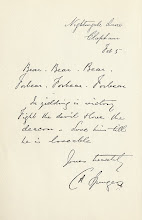
A selection from a letter by C. H. Spurgeon to the members of his church, The Metropolitan Tabernacle, London, England. Spurgeon had gone to France to recover from ill health. The letter was written October 28, 1891, just a few months before his death. The letter expresses his desire for the members of the church to assist those preaching at the Tabernacle in hopes of revival.

My one great restorative will be news of revival at the Tabernacle. When sinners are saved and saints are sanctified, my sun will have risen with healing in his wings. If the Lord will work by Dr. Pierson, and Mr. Stott, and the brethren at home, and make them useful at a tenfold rate compared with me in my best days, I will unfeignedly rejoice. “Would God that all the Lord’s people were prophets!” Oh, that he would use every man and woman of you! Those whom the Lord does not use are very apt to be seized by another, and turned to his evil purposes. Those who are not working bees usually turn into dead flies, and spoil the sweetest ointments by the pot-full at a time. May no one in our church sink into such a wretched condition; far rather may we be so blest as to become blessings to all around!

The Suffering Letters of C. H. Spurgeon, annotations by Hannah Wyncoll, The Wakeman Trust, 2007, pp. 107-08.

Saturday, February 21, 2009

What I Pray For

A selection from a letter by Robert L. Dabney to his sister, Betty. She was suffering from a severe case of bronchitis. The letter was written December 22, 1861. She did not recover from the illness though much prayed for and in the hands of the best medical care. Dabney told his sister how he framed his petitions on her behalf.

You cannot tell how much I have been affected and moved by your sickness. A large part of every prayer I try to offer is for you. Shall I tell you what I pray for? First, that you may possess a sustaining faith, and the ‘the joy of the Lord may be your strength;’ and that patience may have its perfect work in you. Second, that for the sake of mamma, and of all of us, rather than for your own sake, your disease may be speedily rebuked and your health firmly restored.

The Life and Letters of Robert Lewis Dabney, by Thomas Cary Johnson, first published in 1903, reprinted by the Banner of Truth Trust, 1977, p. 248.