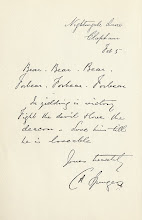
A selection from a letter to a friend by the well-known hymn writer and preacher of the gospel, Augustus Toplady. Toplady wrote simply of what one must be in order to be happy and the means by which one finds it. The letter was written November 9, 1772.
To be happy we must be virtuous; and in order to our becoming truly virtuous, we must experience the grace of God, which bringeth salvation.
The Works of Augustus Toplady, Bookshelf Publications, reprint from the 1794 edition, p. 834.
Showing posts with label happiness. Show all posts
Friday, February 25, 2011
Wednesday, November 24, 2010
Pray to God to Give You a New Heart
A selection from a letter by Rev. Daniel Baker to some Sunday School children in Frankfort, Kentucky, where Baker used to pastor, who had sent him money to aid in his mission work in Texas. He told them how God had been saving people through his ministry in Texas, and as he was want to do, exhorted them to be sure that they were Christians and ready to go to heaven when they died. The letter was written from Galveston, July 20, 1849.
And remember, dear children, if you wish to try to get some of the people in Texas to go to heaven, you must be sure to try to get to heaven yourselves. O, it is a sweet place, a blessed place; and if you get there you will be as angels, with your crowns so bright, and your robes so white. I do believe that there are a great many children there already, and many others are on their way to that happy world now. A little girl, only thirteen years of age, joined my church last Sabbath; she was permitted by the Session to sit down at the table of the Lord, and take the sacrament. She seemed very happy, and I do believe she is a real Christian.
Would you not like to be real Christians too, and go to heaven when you die? Then you must pray to God to give you a new heart, and make you good children. I used to live in Frankfort; I used to preach in your church, and talk to your school; but I don't know that I shall ever be in Frankfort again. Many of you, I suppose, never saw me. No matter; if we get to heaven, we will see and love each other there; and there we will see our blessed Saviour, and the holy angels, and all our pious friends, and be so happy for ever and ever!
Making Many Glad: The Life and Labours of Daniel Baker, by William M. Baker, first published in 1858, reprinted by the Banner of Truth, 2000, p. 387.
And remember, dear children, if you wish to try to get some of the people in Texas to go to heaven, you must be sure to try to get to heaven yourselves. O, it is a sweet place, a blessed place; and if you get there you will be as angels, with your crowns so bright, and your robes so white. I do believe that there are a great many children there already, and many others are on their way to that happy world now. A little girl, only thirteen years of age, joined my church last Sabbath; she was permitted by the Session to sit down at the table of the Lord, and take the sacrament. She seemed very happy, and I do believe she is a real Christian.
Would you not like to be real Christians too, and go to heaven when you die? Then you must pray to God to give you a new heart, and make you good children. I used to live in Frankfort; I used to preach in your church, and talk to your school; but I don't know that I shall ever be in Frankfort again. Many of you, I suppose, never saw me. No matter; if we get to heaven, we will see and love each other there; and there we will see our blessed Saviour, and the holy angels, and all our pious friends, and be so happy for ever and ever!
Making Many Glad: The Life and Labours of Daniel Baker, by William M. Baker, first published in 1858, reprinted by the Banner of Truth, 2000, p. 387.
Labels:
children,
Christ,
Daniel Baker,
happiness,
heaven,
missions,
offering,
salvation,
Sunday School
Tuesday, October 12, 2010
Happy in Living and Blessed in Dying
A portion of a letter from Robert Murray McCheyne to a female acquaintance about the state of her soul. Six letters that McCheyne wrote her were published. They are model evangelistic letters of a believer concerned for an unbeliever. This paragraph comes from the fourth letter and was written December 1841.Now, will you come, for all things are ready? Are you now saying in your heart, I cannot but believe I am the chief of sinners, and Jesus offers to be my refuge, my Mediator, my all in all; I feel He is precious? Oh! dear friend, I trust you do. This only will make you happy in living, and blessed in dying. This is a poor, dying world. Man that is born of a woman is of few days and full of trouble. There is no part here that death cannot take from us. But if you have Christ, you have the only imperishable portion! Oh, may the Holy Spirit give you a firm hold of Jesus! Then we shall meet in that sweet place, where there shall be no more death, neither sorrow nor crying, neither shall there be any more pain. The Lord deal kindly and gently with you, both soul and body. Farewell, dear friend.
Memoir and Remains of R.M. McCheyne, A. A. Bonar, electronic edition, Logos, p. 118. The book is also published by Banner of Truth Trust.
Labels:
evangelism,
gospel,
happiness,
living and dying,
Robert Murray M'Cheyne
Tuesday, July 13, 2010
He Reigns Over All
A selection from a letter by Samuel Pearce, pastor of the Cannon Street Baptist Church in Birmingham, England, to Mr. Matthias, a friend he met while preaching in Ireland. The General Evangelical Society in Dublin invited him to come to Ireland to preach the gospel. He made several friends on his mission there from the University of Dublin, Mr. Matthias being one of them. Pearce wrote of how much he valued his new friends. He also shared with him the joy in the Lord that he was experiencing at that time. The letter was written in September or October, 1776.
I thank God, I never, I think, rejoiced habitually so much in him as I have done of late. "God is love." That makes me happy. I rejoice that God reigns; that he reigns over all; that he reigns over me; over my crosses, my comforts, my family, my friends, my senses, my mental powers, my designs, my words, my preaching, my conduct; that he is God over all, blessed for ever. I am willing to live, yet I long to die, to be freed from all error and all sin. I have nothing else to trouble me; no other cross to carry. The sun shines without all day long; but I am sensible of internal darkness. Well, through grace it shall be all light by and by. Yes, you and I shall be angels of light; all Mercuries then; all near the Sun; always in motion; always glowing with zeal, and flaming with love. Oh for the new heavens and the new earth wherein dwelleth righteousness!
A Heart for Missions: The Classic Memoir of Samuel Pearce, by Andrew Fuller, with an introduction by Michael Haykin, reprinted by Solid Ground Christian Books, 2006, p. 88.
Tuesday, June 22, 2010
He Has Brought Us Here
A letter written by Ann Judson, wife of Adoniram Judson, missionary to Burma, to her sisters. The hardships of missionary life were great, and she longed to see them again and visit with them, but there was much work to do for Christ. She shares some of their goals in this letter, written in December of 1815.
On how I long to visit Bradford; to spend a few evenings by your firesides, in telling you what I have seen and heard. Alas! We have no fireside, no social circle. We are still alone in this miserable country, surrounded by thousands ignorant of the true God… But we still feel happy in our employment, and have reason to thank God that he has brought us here. We do hope to live to see the Scriptures translated into the Burman language, and a church formed from among these idolaters.
The Three Mrs. Judsons, by Arabella W. Stuart, first published in 1851, reprinted by Particular Baptist Press, 1999, pp. 37-38.
On how I long to visit Bradford; to spend a few evenings by your firesides, in telling you what I have seen and heard. Alas! We have no fireside, no social circle. We are still alone in this miserable country, surrounded by thousands ignorant of the true God… But we still feel happy in our employment, and have reason to thank God that he has brought us here. We do hope to live to see the Scriptures translated into the Burman language, and a church formed from among these idolaters.
The Three Mrs. Judsons, by Arabella W. Stuart, first published in 1851, reprinted by Particular Baptist Press, 1999, pp. 37-38.
Wednesday, April 21, 2010
Your Only Happiness
A selection from a letter by Samuel Rutherford to Lady Kenmure with spiritual advice in time of troubles. The Letter was written from Anwoth, January 14, 1632, prior to his being imprisoned for nonconformity.
You shall find it your only happiness, under whatsoever thing disturbeth and crosseth the peace of your mind in this life, to love nothing for itself, but only God for Himself. Our love to Him should not begin on earth as it shall be in heaven; for the bride taketh not, by a thousand degrees, so much delight in her wedding garments as she does in her bridegroom; so we, in the life to come, nevertheless clothed with glory as with a robe, shall not be so much affected with the glory that goeth about us, as with the Bridegroom’s joyful face and presence.
Letters of Samuel Rutherford, With a Sketch of his Life and Biographical Notices of His Correspondents, by Andrew A. Bonar, first published in 1664, reprinted by the Banner of Truth, 1984, p. 20.
Labels:
bride,
bridegroom,
happiness,
hope and glory,
Lady Kenmure,
peace,
presence,
Samuel Rutherford
Wednesday, February 17, 2010
Be Devoted to God
A selection from a letter by Daniel and Hannah Sutcliff, to their son John, who was studying at the Bristol Baptist Academy. Smallpox had killed a number of their friends and relatives. They were grateful that God had spared their son and wrote to exhort him to live his life to the glory of God. John Sutcliff later became the pastor of the Baptist church in Olney, a town made famous by the ministry of John Newton and William Cowper. John received this letter on March 7, 1773.
Dear Son, thy life has been spared through that and other disorders which calls for thankfulness and gratitude. O that it may be devoted to God, spent to His glory and the good of them where His providence may call thee to which end I would suggest a few things…
First, be humble, seek not great things for thyself… If thou have [John] Gillies’ history near thee read the life of [Richard] Blackerby and the extract from the life of David Brainerd.
2nd. Indulge yourself in the happiness of frequent contemplations upon and addresses to the Lord Jesus for light and assistance in all thy studies: consider that this Divine Redeemer’s presence is the life and light of thy soul.
The British Particular Baptists: 1638-1910, volume 3, edited by Michael A. G. Haykin, Particular Baptist Press, 2003, “John Sutcliff: 1752-1814,” by Michael A. G. Haykin, p. 22.
Dear Son, thy life has been spared through that and other disorders which calls for thankfulness and gratitude. O that it may be devoted to God, spent to His glory and the good of them where His providence may call thee to which end I would suggest a few things…
First, be humble, seek not great things for thyself… If thou have [John] Gillies’ history near thee read the life of [Richard] Blackerby and the extract from the life of David Brainerd.
2nd. Indulge yourself in the happiness of frequent contemplations upon and addresses to the Lord Jesus for light and assistance in all thy studies: consider that this Divine Redeemer’s presence is the life and light of thy soul.
The British Particular Baptists: 1638-1910, volume 3, edited by Michael A. G. Haykin, Particular Baptist Press, 2003, “John Sutcliff: 1752-1814,” by Michael A. G. Haykin, p. 22.
Labels:
devotion,
gratitude,
happiness,
humility,
John Sutcliff,
parents,
providence
Thursday, December 31, 2009
Live Near to God

A selection from a letter by Andrew Fuller to a young man in prospect of his ordination to the gospel ministry. Fuller lamented the fact that he would not be able to attend the ordination but wrote some very valuable brotherly counsel to his young friend. The letter was written August 30, 1810.
If you would preserve spirituality, purity, peace, and good order in the church, you must live near to God yourself, and be diligent to feed the flock of God with evangelical truth. Without these nothing good will be done…
A young man, in your circumstances, will have an advantage in beginning a church on a small scale. It will be like cultivating a garden before you undertake a field. You may also form them in many respects to your own mind; but if your mind be not the mind of Christ, it will, after all, be of no use. Labour to form them after Christ’s mind, and you will find your own peace and happiness in it.
The Works of Andrew Fuller, edited by Andrew Gunton Fuller, first published in 1841, republished by The Banner of Truth Trust, 2007, p. 851.
If you would preserve spirituality, purity, peace, and good order in the church, you must live near to God yourself, and be diligent to feed the flock of God with evangelical truth. Without these nothing good will be done…
A young man, in your circumstances, will have an advantage in beginning a church on a small scale. It will be like cultivating a garden before you undertake a field. You may also form them in many respects to your own mind; but if your mind be not the mind of Christ, it will, after all, be of no use. Labour to form them after Christ’s mind, and you will find your own peace and happiness in it.
The Works of Andrew Fuller, edited by Andrew Gunton Fuller, first published in 1841, republished by The Banner of Truth Trust, 2007, p. 851.
Labels:
Andrew Fuller,
evangelical truth,
happiness,
mind of Christ,
ordination,
peace,
spirituality
Subscribe to:
Posts (Atom)