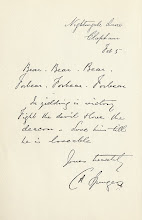
A selection from a letter by Francis Ridley Havergal, the beloved hymn writer, to a clerical friend and his wife, written on Christmas day, 1873.
Several times lately I have felt literally overwhelmed and overpowered with the realization of God’s unspeakable goodness to me. I say it deliberately, and with thankfulness and joy for which I have no words; I have not a fear, or a doubt, or a care, or a shadow of a shadow upon the sunshine of my heart. Every day brings some quite new cause for praise; only today He has given me such a victory as I never had before, in a very strong temptation, lifted me above it in a way I never experienced yet. And I believe He will ‘keep’ me henceforth as I never before believed possible.
Letters by the Late Frances Ridley Havergal, edited by her sister, Maria V. G. Havergal, first published in 1885, reprinted by Kessinger Publishing, p. 139.
Friday, December 26, 2008


Monday, December 22, 2008
Real Religion
A portion of a letter by William Jay to his fiancée, Miss Anne Davies. They were married on January 6, 1791, Mr. Roland Hills performing the service. The date is not given for this letter but it was written not long before the wedding. Mr. Jay expressed the kind of marriage he hoped for.
Yes, my love, let us determine to live as strangers and pilgrims here, and plainly declare by our profession and conduct that we seek a better country, that is a heavenly. Not when we shall be incapable of pursuing this world, and when our gust for earthly pleasure shall be abated by old age; but now while our affections are so warm, and when so many are carried away by the vanity of the world and the pride of life, let us unreservedly dedicate ourselves to God, and present ourselves as a living sacrifice, holy and acceptable to God, which is our reasonable service. Nothing but real religion can make us holy and happy in any situation or relation. In proportion as it prevails we shall find heaven begun below.
The Autobiography of William Jay, first published in 1854 and reprinted by The Banner of Truth Trust, 1974, p. 483.
Yes, my love, let us determine to live as strangers and pilgrims here, and plainly declare by our profession and conduct that we seek a better country, that is a heavenly. Not when we shall be incapable of pursuing this world, and when our gust for earthly pleasure shall be abated by old age; but now while our affections are so warm, and when so many are carried away by the vanity of the world and the pride of life, let us unreservedly dedicate ourselves to God, and present ourselves as a living sacrifice, holy and acceptable to God, which is our reasonable service. Nothing but real religion can make us holy and happy in any situation or relation. In proportion as it prevails we shall find heaven begun below.
The Autobiography of William Jay, first published in 1854 and reprinted by The Banner of Truth Trust, 1974, p. 483.
Friday, December 19, 2008
I Desire to Follow His Guidance
A selection from a letter by Augustus Toplady to the Countess of Huntingdon, about his role as a “regular” preacher, a sentinel who keeps to his post, rather than a cavalry officer that is ready for duty wherever he is sent. The letter was written December 9, 1774.
I remember that, in one of my last conversations with dear Mr. Whitefield, antecedently to his last voyage to America, that great and precious man of God said as follows: ‘My good sir, why do not you come out? Why do not you come out? You might be abundantly more useful, were you to widen your sphere, and preach at large, instead of restraining your ministry to a few parish churches.’ My answer was to this effect: that ‘The same Providence which bids others roll at large seems to have confined me to a particular orbit.’
And, I honestly own, I am still of the same mind. If there be, for me, a yet more excellent way, God, I trust, will reveal even this to me. I hope I can truly say, that I desire to follow his guidance with a single eye.
The Works of Augustus Toplady, Bookshelf Publications, reprint from the 1794 edition, p. 862.
I remember that, in one of my last conversations with dear Mr. Whitefield, antecedently to his last voyage to America, that great and precious man of God said as follows: ‘My good sir, why do not you come out? Why do not you come out? You might be abundantly more useful, were you to widen your sphere, and preach at large, instead of restraining your ministry to a few parish churches.’ My answer was to this effect: that ‘The same Providence which bids others roll at large seems to have confined me to a particular orbit.’
And, I honestly own, I am still of the same mind. If there be, for me, a yet more excellent way, God, I trust, will reveal even this to me. I hope I can truly say, that I desire to follow his guidance with a single eye.
The Works of Augustus Toplady, Bookshelf Publications, reprint from the 1794 edition, p. 862.
Wednesday, December 17, 2008
The Fatality of Sin in Private
A selection from a letter by the one-eyed Baptist preacher of Wales, Christmas Evans, to a young preacher with advice on how to have a successful ministry. The letter was probably written towards the end of his life, which occurred in 1838.
Remember this, that you cannot commit some loved sin in private, and perform the work of the ministry in public, with facility and acceptance. For a preacher to fall into sin, be it a secret one, and to live in it, is as fatal, ultimately, as the cutting of Samson’s hair. Be strong in the grace that is in Christ Jesus against all corruption.
Christmas Evans: The Life and Times of the One-Eyed Preacher of Wales, by Tim Shenton, Evangelical Press, 2001, p. 445.
Remember this, that you cannot commit some loved sin in private, and perform the work of the ministry in public, with facility and acceptance. For a preacher to fall into sin, be it a secret one, and to live in it, is as fatal, ultimately, as the cutting of Samson’s hair. Be strong in the grace that is in Christ Jesus against all corruption.
Christmas Evans: The Life and Times of the One-Eyed Preacher of Wales, by Tim Shenton, Evangelical Press, 2001, p. 445.
Monday, December 15, 2008
The Need for Real Unction
A selection from a letter by Thomas Chalmers to his friend, Charles Bridges, author and pastor in Suffolk, England. Chalmers was professor of divinity at the University of Edinburgh. He wanted for himself and for his students more than orthodoxy; he desired that they be energized by the Spirit for their Gospel labors. The letter was written January 2, 1834.
I deeply feel my need of effort and prayer, that my whole course may be more and more spiritualized, assured as I am of the possibility of delivering all the lessons of theology in the strictest form of sound words, and with the fullest adherence to the letter of the truth as it is in Jesus, while the real unction and vitality of the Gospel spirit may be altogether wanting.
Letters of Thomas Chalmers, edited by William Hanna, first published 1853, reprinted by The Banner of Truth, 2007, p. 324.
I deeply feel my need of effort and prayer, that my whole course may be more and more spiritualized, assured as I am of the possibility of delivering all the lessons of theology in the strictest form of sound words, and with the fullest adherence to the letter of the truth as it is in Jesus, while the real unction and vitality of the Gospel spirit may be altogether wanting.
Letters of Thomas Chalmers, edited by William Hanna, first published 1853, reprinted by The Banner of Truth, 2007, p. 324.
Friday, December 12, 2008
Where Are You Going, My Dear Child?
A letter by Rev. Daniel Baker to his daughter. He was away from home preaching meetings in North Carolina. When away from home he usually wrote his children, and when he did, he often exhorted them to think of eternity and the need for professing faith in Christ. This letter was written in 1834.
My daughter, remember your father and mother are going to heaven; where are you going, my dear child? Are you willing to be separated from your parents in that eternity which is hastening on? Take care of your soul for if you lose that, what have you got beside?
Making Many Glad: The Life and Labours of Daniel Baker, by William M. Baker, first published in 1858, reprinted by the Banner of Truth, 2000, p. 194.
My daughter, remember your father and mother are going to heaven; where are you going, my dear child? Are you willing to be separated from your parents in that eternity which is hastening on? Take care of your soul for if you lose that, what have you got beside?
Making Many Glad: The Life and Labours of Daniel Baker, by William M. Baker, first published in 1858, reprinted by the Banner of Truth, 2000, p. 194.
Wednesday, December 10, 2008
She Is Gone To Heaven
A selection from a letter by John A. Broadus to his wife, Maria, after the death of his beloved sister, Carry Whitescarver. He was grieved over her passing but thankful that she had lived an exemplary life and had gone to be with the Lord. The letter was written September 1, 1852.
May her holy life, and this her hopeful, happy death be the life and death of her so unworthy, yet so richly-blessed, ‘baby’ brother! Oh, that sister was dear to me, dearer than any knew, dearer than I knew myself, yet she is gone! But then, she is gone to heaven; and I can hope, humbly and trustingly, that by the grace of God I shall see my sister Carry again, and part from her no more. My dear Maria, be a Christian, with all your heart, now.
Life and Letters of John Albert Broadus, by Archibald Thomas Robertson, 1901, reprint by Gano Books, p. 100.
May her holy life, and this her hopeful, happy death be the life and death of her so unworthy, yet so richly-blessed, ‘baby’ brother! Oh, that sister was dear to me, dearer than any knew, dearer than I knew myself, yet she is gone! But then, she is gone to heaven; and I can hope, humbly and trustingly, that by the grace of God I shall see my sister Carry again, and part from her no more. My dear Maria, be a Christian, with all your heart, now.
Life and Letters of John Albert Broadus, by Archibald Thomas Robertson, 1901, reprint by Gano Books, p. 100.
Subscribe to:
Posts (Atom)