Monday, January 4, 2010

I Have A Great Concern For Your Soul's Salvation


A portion of a letter by Ruth Bryan to an unconverted friend. Three letters to this man, known as Mr. J. A., appear in the book. She told him, “I long for your salvation, and still mention you to the King to whom power belongeth.” She not only witnessed to him and urged him to believe on Christ, she prayed for his salvation. This particular letter was written in December, 1855. After telling him of all the things that Christ does for needy sinners, she wrote:

Perhaps you will say, ‘And what is all this to me?’ Why, it is this to you, beloved – without these things you must perish forever. Should you ask, ‘What have you to do with it?’ I answer, ‘I have a great concern for your soul’s salvation.’ But you may object, ‘The things you have spoken of are for God’s chosen people, and I do not know that I am one.’ You do not know that you are not one, and should rather say, ‘Why not, my soul? Why not for Thee?’ And though they are a free gift not to be obtained by any creature power, yet ask God to give them to you. Ask Him to give you the Holy Spirit to make you feel your need of them. Oh may that Holy Spirit

Convince you of your sin,
Then lead to Jesus’ blood;
And to your wondering soul reveal
The secret love of God
.

That you may have an experimental knowledge and enjoyment of these things, is the earnest and affectionate desire of yours very sincerely,

R. Bryan.

Jeremiah 6:16, but I hope not the last clause.

The Marvelous Riches of Savoring Christ: Letters of Ruth Bryan, with a Preface by the Rev. A. Moody Stuart, Reformation Heritage Books, 2005, pp. 134-35.

Thursday, December 31, 2009

Live Near to God


A selection from a letter by Andrew Fuller to a young man in prospect of his ordination to the gospel ministry. Fuller lamented the fact that he would not be able to attend the ordination but wrote some very valuable brotherly counsel to his young friend. The letter was written August 30, 1810.

If you would preserve spirituality, purity, peace, and good order in the church, you must live near to God yourself, and be diligent to feed the flock of God with evangelical truth. Without these nothing good will be done…

A young man, in your circumstances, will have an advantage in beginning a church on a small scale. It will be like cultivating a garden before you undertake a field. You may also form them in many respects to your own mind; but if your mind be not the mind of Christ, it will, after all, be of no use. Labour to form them after Christ’s mind, and you will find your own peace and happiness in it.

The Works of Andrew Fuller, edited by Andrew Gunton Fuller, first published in 1841, republished by The Banner of Truth Trust, 2007, p. 851.

Monday, December 28, 2009

Preaching Grace


A portion of a letter by Martin Luther to Philip Melanchthon. The bulk of the letter contains Luther’s views on celibacy and communion but he concludes with a word about sin and forgiveness. Luther appears to encourage licentiousness but his intentions lay elsewhere. The great reformer meant to highlight the greatness of Christ’s atonement. However, it is easy to see why others misunderstood his meaning. The letter was written August 1, 1521.

If you are a preacher of grace, then preach a true and not a fictitious grace; if grace is true, you must bear a true and not a fictitious sin. God does not save people who are only fictitious sinners. Be a sinner and sin boldly, but believe and rejoice in Christ even more boldly, for he is victorious over sin, death, and the world. As long as we are here [in this world] we have to sin. This life is not the dwelling place of righteousness, but, as Peter says, we look for new heavens and a new earth in which righteousness dwells. It is enough that by the riches of God’s glory we have come to know the Lamb that takes away the sin of the world. No sin will separate us from the Lamb, even though we commit fornication and murder a thousand times a day. Do you think that the purchase price that was paid for the redemption of our sins by so great a Lamb is too small? Pray boldly—you too are a mighty sinner.

Luther's Works, Vol. 48, Letters I, edited by J. J. Pelikan, H. C. Oswald and H. T. Lehmann, Fortress Press, letter # 91, p. 283.

Thursday, December 24, 2009

The Saviour of the Helpless


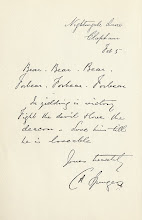
A portion of a letter from C. H. Spurgeon to William Cooper, one of his former pupils at Newmarket. Spurgeon himself was very young but wrote this young boy about the need of coming to Christ. The letter was written from Cambridge in 1851.

Perhaps you intend to think about religion after you have enjoyed sin a little longer; or (but surely you are not so foolish) possibly you think that you are too young to die. But who knows whether that future time will be afforded, and who said that you can turn to Christ just when you please? Your heart is deceitful above all things, and your natural depravity so great that you will not turn to God. Trust not, then, to resolutions made in your own strength, they are but wind; nor to yourself, who are but a broken reed; nor to your own heart, or you are a fool. There is no way of salvation but Christ; you cannot save yourself, having no power even to think one good thought; neither can your parents’ love and prayers save you; none but Jesus can, He is the Saviour of the helpless, and I tell you that He died for all such as feel their vileness, and come to Him for cleansing.

The Letters of Charles Haddon Spurgeon, first published in 1923, published in electronic format by Logos Research Systems, Inc., 2009, p. 173.

Monday, December 21, 2009

Cherishing the Elderly


A selection from a letter by Rev. Charles Colcock Jones, to his son, Charles. The father conveyed to the son the loss of a friend in death. The friend was an elderly black servant in another family. Rev. Jones had visited her several times in her illness and conducted her funeral. He reminded his son of the honor that should be given to the elderly. The letter was written July 30, 1858.

The death of old and valued members of our families and households creates losses that never can be repaired. We ought to cherish the spark of life in the aged to the last hour, and pay them every attention, and add all we can to their comfort and happiness. God’s command is: ‘Thou shalt rise up before the old and gray-headed.’ How comprehensive! How beautiful!

The Children of Pride: A True Story of Georgia and the Civil War, edited by Robert Manson Myers, Yale University Press, 1972, p. 433. Iain Murray makes reference to this book of letters in a chapter on Charles and Mary Colcock Jones in his excellent book, Heroes (published by The Banner of Truth Trust).

Thursday, December 17, 2009

Sad Errors


A letter from George Whitefield to the Welsh evangelist, Howell Harris. Whitefield was in Boston but expecting to return to England soon. He wrote of concerns with the theology of John Wesley and his influence on friends at Fetters Lane Society. The letter was written September 24, 1740.

And is dear Brother H[owell] H[arris] yet alive in body and soul? Blessed be God, who causes those that wait on him to renew their strength. I rejoice in your success; may you mount with wings like eagles, walk and not be weary, run and not be faint! You shall not be taken or hurt, till the appointed hour is come.

I hope your conversation was blessed to dear Mr. W[esley]. O that the LORD may batter down his freewill, and compel him to own his sovereignty and everlasting love! Some of F[etters] Lane society, I fear, are running into sad errors; but this happens for our trial, especially mine. Those that before, I suppose, would have plucked out their eyes for me, now I suspect, I shall see very shy, and avoiding me. This is my comfort, the LORD is a never-failing friend; his truth will make its way in spite of all carnal reasoning. O pray for me that I may have the spirit of judgment and a sound mind…

Letters of George Whitefield: For the Period 1734-1742, The Banner of Truth Trust, 1976, reprinted from The Works of George Whitefield, 1771, p. 210.

Monday, December 14, 2009

My Sense of Duty


A selection from a letter by Robert L. Dabney to the esteemed professor of theology at Princeton Seminary, Charles Hodge. Hodge had been trying to persuade Dabney to leave his teaching post at Union Seminary in order to teach Historical Theology at Princeton. The professorship was vacant due to the unexpected death of J. A. Alexander. Dabney refused the invitation despite the pleas of Hodge and the appeal of being a professor at such a famous school. Having given several reasons why he could not accept the offer, he gave as his last reason for remaining at Union, the call of duty. The letter was written April 10, 1860.

Last, I give no little weight to this thought, that I am most probably deciding as a Christian should, because I am deciding contrary to the promptings of ambition, and, indeed, of nearly all the natural affections of carnality.

In the eyes of the Presbyterians of Virginia, Princeton is ever esteemed venerable and attractive. Do not suppose, my dear sir, that I am insensible to her superiority. The man who goes there and does his duty, will have his name blown much further by the trumpet of fame than mine will ever be. He will be in the focus of national observation, at least, for Presbyterians; I shall remain in comparative obscurity. He will teach the many, I the few; for I do not dream that your Seminary will cease to maintain the preeminence so honorably earned; and especially, the faithful and useful man at Princeton will probably receive that most gratifying of all earthly rewards, a united, enlightened, and steady support on the part of the proper constituency of the Seminary, which Presbyterians in Virginia have not always been accustomed to bestow, even on those who attempted to serve them faithfully.

I have my eyes open to all these things, and because my sense of duty outweighs them, I feel a good confidence that it is conscience, and not carnality, which decides me.


The Life and Letters of Robert Lewis Dabney, by Thomas Cary Johnson, first published in 1903, reprinted by the Banner of Truth Trust, 1977, p. 205.