Thursday, October 13, 2011

A True Calvinist

A selection from a letter by Rev. Henry Venn to a pastor friend, Rev. James Stillingfleet. Mr. Venn spoke of John Berridge preaching at his church. Berridge was the vicar of Everton and was a much beloved preacher of the gospel. Spurgeon wrote a chapter about him in a book entitled, Eccentric Preachers. Venn commented on Berridge's Calvinism. Would that there were more Calvinist like him! The letter was written November 22, 1771.

Last Wednesday, Mr. Berridge was here, and gave us a most excellent sermon. He is a blessed man—a true Calvinist; not hot in doctrine, nor wise above what is written, but practical and experimental.

Letters of Henry Venn, by John Venn, first published in 1835, republished by the Banner of Truth, 1993, p. 189 (photo of John Berridge).

Tuesday, September 27, 2011

No Inclination to Turn Back

A portion of a letter by the missionary to the Indians in Oklahoma, Isaac McCoy (1784-1846), to a critic, a Mr. Samuel Dedman of Pike County, Indiana, who opposed his plans to live among the Indians and give his life, if necessary, in reaching them with the gospel. The letter was written on January 12, 1820.

I assure you, my brother, that every opposing difficulty, the opposition of the association not expected, has only tended to increase my missionary ardour. May my merciful God forgive me if I be wrong, and set me right. I would rather be a missionary to the Indians, than fill the President's chair, or sit on the throne of Alexander, emperor of Russia. I would rather preach Jesus to the poor Indians in a bark camp, than address the thousands who assemble in Sansom Street meeting house, Philadelphia [the General Missionary Convention had been held there, May 7, 1817]. Something has turned my attention towards the Indians, and every feeling of my soul is enlisted in their cause, yet still I may be wrong. But I feel not the least inclination to turn back, but would drive on with the vehemence of Peter, the meekness of Moses, and the wisdom of Solomon.

Kansas Historical Quarterly, "Isaac McCoy and the Treaty of 1821," by Lela Barnes, vol. 5, no. 2, p. 128. Thanks to Gary Long of Particular Baptist Press for sending me a digitized copy of this letter.

Wednesday, September 21, 2011

Good From Scripture for One's Own Soul

A portion of a letter from Andrew Fuller (1754-1815) to a young minister about preaching. Fuller wrote several letters to this person under the title, "Thoughts on Preaching." The emphasis in this paragraph is the need for searching the Scriptures for one's own benefit, not just to find sermons.

To understand the Scriptures in such a manner as profitably to expound them, it is necessary to be conversant with them in private; and to mix, not only faith, but the prayer of faith, with what we read. There is a great difference between reading the Scriptures as a student, in order to find something to say to the people, and reading them as a Christian, with a view to get good from them to one’s own soul. That which is gained in the latter of these ways is, beyond all comparison, of the greatest use, both to ourselves and others. That which we communicate will freeze upon our lips, unless we have first applied it to ourselves; or, to use the language of Scripture, "tasted, felt, and handled the word of life."

The Works of Andrew Fuller, "Thoughts on Preaching," volume 1, letter 1, p. 713.

Thursday, September 15, 2011

I Cannot Hate Them In Return

A selection from a letter by Augustus Toplady to John Ryland, Jr. Toplady addressed the conflict he had with those of "Wesley's party," that is, the Arminians. He was greatly despised for his defense of Calvinism but sought to love those who differed with him, though he himself could be very sharp in disputation. The letter was written April 30, 1773.

The envy, malice, and fury of Wesley's party, are inconceivable. But, as violently as they hate me, I dare not, I cannot hate them in return. I have not so learned Christ.—They have my prayers and my best wishes, for their present and eternal salvation, But their errors have my opposition also: and this is the irremissible sin, which those red-hot bigots know not how to forgive.

The Works of Augustus Toplady, volume 6, London, reprint, p. 173.

Wednesday, September 7, 2011

Soldiers Converted in a Foreign Land

A portion of a letter from missionary William Carey, to his sisters back home in England. He writes about the conversion, this time, not of the Indian people he was attempting to reach with the gospel, but European soldiers stationed there, most of whom were surely British. The letter was written from Calcutta, May 4, 1810.

There has, of late, been a great awakening among the European Soldiers in several Regiments now in India. Bro. Chamberlain has baptized near fifty, mostly belonging to one Regiment. There are thirteen now in Fort William, who are under hopeful impression, who constantly attend worship at our Chapel in Calcutta. One of them, who has been long under very strong convictions is a native of Flower near Daventry, and another from the neighborhood of Bedford. Thus the Lord takes these people from a Land of Gospel light, to a land of gross Idolatry, and there reveals his grace to them.

The Journal and Selected Letters of William Carey, collected and edited by Terry G. Carter, Smyth & Helwys, 2000, p. 186.

Wednesday, August 31, 2011

I Really Don't Like This Guy

A portion of a letter written by a forty-three-year old black man from Tennessee, to John MacArthur. This gentleman had been influenced by the Black Power movement and had turned away from Christianity. In listening to MacArthur preaching on the Grace to You radio broadcast, he was converted and began to live for Christ.

I bought into the teaching against a "white" Jesus, and the pro-Black teachings became my religion… When I first heard you on radio about nine years ago, I thought to myself, "I really don't like this guy and what he is saying." I was pretty sure you were white. Then one day I heard you preach on forgiveness of sins and love, and the veil was lifted from my eyes. Up until then, I had never truly heard the gospel preached, never truly understood the holiness of God. The Word of God began to have an incredible impact on me as I listened to your preaching daily. By God's grace, I've been living for Him, studying His Word, and listening to your broadcast for the last nine years.

John MacArthur: Servant of the Word and Flock, Iain H. Murray, The Banner of Truth Trust, 2011, p. 180.

Wednesday, August 24, 2011

Total Despair Unless

A portion of a letter by Francis Schaffer to a friend who had spent time with his family at L’Abri in Switzerland, a retreat center for Christian study and growth. Schaffer’s friend was struggling with depression. He himself experienced depression at times and knew by experience, not just in theory, the pain of ups and downs in mind and heart. His suggestion to her is to keep in mind the objective work of Christ on the cross. The letter was written January 4, 1971.

We all have our times of being strong and our times of being weak. The swings of the pendulum cover different ground for different ones of us, and the swings of the pendulum are of greater intensity for one of God’s children than another. But the swings are there for all of us—for weakness and unhappiness and also for sin. It is for this reason that any honest person must be totally in despair unless they understand the reality of the finished work of Christ upon the cross for us. If it was not for this, none of us could have any peace of mind either for this world or from the world to come.

Letter of Francis A. Schaeffer, edited with introductions by Lane T. Dennis, Crossway Books, 1985, pp. 118-19.

Wednesday, July 27, 2011

We May Hear the Lion Roar But He Cannot Reach Us

A selection from a letter by Mary Winslow (1774-1854). Joel Beeke says that her letters are "a rich treasury of experiential and practical divinity." Widowed at 40 and left to raise nine children, three of whom became faithful ministers of the gospel, Mrs. Winslow knew God's Word and gave sweet counsel to her many correspondents. She once encouraged her son, Octavius, to fill his sermons with Christ, from first to last. She followed that same practice in writing letters. No date is given for this letter nor is the recipient known, but she warned of Satan's devices and set forth Christ as the only refuge.

Satan will keep us poring over our difficulties until they grow into mountains in our imagination. We have but a very imperfect idea of Satan's power and malice towards us. Our only help is to flee at once to our Stronghold, our Refuge, our Hiding-place, where alone we are safe. Oh, how safe! We may hear the lion roar, but he cannot reach us. Sheltered beneath the wing of Jesus we can defy his malice and his power. What does the Lord try us for but to carry on our spiritual education, and thus mature us for our glorious inheritance above?

Heaven Opened: A Selection from the Correspondence of Mrs. Mary Winslow, edited by her son, Octavius Winslow, 1864, reprinted by Reformation Heritage Books, 2001, pp. 253-54.

Tuesday, July 19, 2011

He Exhorts His Fellow Sinners

A portion of a letter by James Haldane to his ten year-old daughter, Elizabeth. He and his friend, John Campbell, were away preaching in the northern part of Scotland. He told her about a man that had been converted on a previous trip they had made to the north, who had lost both his hands "by the going off of a gun." This convert was most thankful for the goodness of God in sparing his life that he might come to know Christ. The letter was written June 22, 1805.

He was brought to a knowledge of the truth, by a sermon of Mr. Campbell's, the last time we were north. We did not find him at home, but just as we were setting off, after dinner, he came running to see us, and appears to be very happy in waiting for the coming of Jesus. He occasionally exhorts his fellow-sinners, and sometimes holds out his arms, and calls their attention to the goodness of God, in not allowing him to die when he was ignorant of Christ.

The Lives of Robert and James Haldane, by Alexander Haldane, first published in 1852, reprinted by The Banner of Truth, 1990, p. 349.

Thursday, July 14, 2011

A Firmer Grip Than Ever

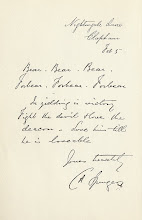
A portion of a letter from Charles Haddon Spurgeon, written to his congregation, four weeks prior to his death. His church was the Metropolitan Tabernacle, London, England. He was writing from Menton, France, where he had gone to recover from illness. But recovery was not meant to be. He had gone through the valley of the shadow of death just a short while before, but his health was now worse. He wanted his flock to know that the gospel he had preached for over 40 years was still his hope and joy, and should be theirs too. The letter was written January 6, 1892.

I feel my mind grasping with firmer grip than ever that everlasting gospel which for so many years I have preached to you. We have not been deceived. Jesus does give rest to those who come to him, he does save those who trust him, he does photograph his image on those who learn of him. I hate the Christianised infidelity of the modern school more than ever, as I see how it rends away from sinful man his last and only hope. Cling to the gospel of forgiveness through the substitutionary sacrifice, and spread it with all your might, each one of you, for it is the only cure for bleeding hearts.

The Suffering Letters of C. H. Spurgeon, annotations by Hannah Wyncoll, Wakeman Trust, 2007, pp. 118-19.

Monday, July 11, 2011

The Wisdom and Love of God in the Crucifixion

A selection from a letter by John Newton to John Ryland, Jr. The elder Newton, an Anglican, corresponded with the younger Ryland, a Baptist, for a period of 40 years. Newton addresses the subject of God's sovereign control over all events in this letter, in particular, the crucifixion of Jesus. Though it was "the worst action that the worst men ever committed," it must be considered as God's appointment and "the brightest display of His glory ever afforded to his creatures." The letter was written March 15, 1794.

But I compose my mind by considering all hearts and all things as instruments of him who worketh all things according to the counsel of his own will [Eph. 1:11], and makes all subservient to the fulfilling it. I think the crucifixion of our Lord, was, taken in one view, the worst action that the worst men ever committed. But instead of scolding Caiaphas, Judas, and Pilate (whose part I should have acted had I been in their places and left to myself), I rather choose to admire the wisdom and love of God in this transaction, which considered as his appointment, was the brightest display of His glory ever afforded to his creatures.

Wise Counsel: John Newton’s Letter to John Ryland, Jr., edited by Grant Gordon, The Banner of Truth Trust, 2009, letter #64, pp. 303-04.

Thursday, July 7, 2011

Hold Fast That No Man Take Your Crown

A portion of a letter by the Puritan preacher, Joseph Alleine, to his church. Alleine was in prison, being held because he preached without the approval of the crown. Disappointing news had come to him that he would not be freed when hoped. The news, however, was more disappointing for his flock than for him, so he exhorted them not to lose their zeal for the Lord and to remain faithful. His letter was more like a sermon, for he said, "I forget that I am writing a letter." No date is given for the letter but it was written sometime in 1663 or1664.

Now is the time that the love of many doth wax cold. But I bless God it is not so with you; I am sure your love to me is, as true friends should be, like the chimmeys, warmest in the winter of adversity; and I hope your love to God is much more, and I would that you should abound yet more and more.

Where else should you bestow your loves? Love ye the Lord, ye his saints, and cling about him the faster, now ye see the world is striving to separate you from him. How many are they that go to knock off your fingers! O, methinks, I see what tugging there is. The world is plucking, and the devil is plucking. Oh! hold fast, I beseech you; hold fast, that no man take your crown. Let the water that is sprinkled, yea, rather poured upon your love, make it to flame up the more.

Are you not betrothed unto Christ? Oh remember, remember your marriage covenant! Did you not take him "for richer for poorer, for better for worse?" Now prove your love to Christ to have been a true conjugal love, in that you can love him when most slighted, despised, undervalued, blasphemed among men. Now acquit yourselves, not to have followed Christ for the loaves. Now confute the accuser of the brethren, you may be ready to suggest of the best of you, as he did of Job, "Doth he serve the Lord for nought?"  And let it be seen that you loved Christ and holiness, purely for their own sakes; that you can love a naked Christ when there is no hopes of worldly advantage, or promoting of self-interest in following him.

Life and Letters of Joseph Alleine, by Rev. Richard Baxter, Theodosia Alleine, and others, with a new introduction by Joel R. Beeke and Herb Samworth, Reformation Heritage Books, reprinted in 2003, pp. 206-07.

Tuesday, July 5, 2011

Field-Preaching

A selection from a letter by George Whitefield to a friend who had taken a settled pastorate in London. Whitefield knew that God had called him to an itinerant ministry, at least for the present. He shares some of his reasons why and rejoices in the blessing of God on his labors. The letter was written July 13, 1741.

I have no freedom, but in going about to all denominations. I cannot join with any one, so as to be fixed in any particular place. Every one hath his proper gift. Field-preaching is my plan; in this I am carried as on eagles wings. God makes way for me every where. The work of the Lord increases. I am comforted night and day. O free grace to such an hell-deserving sinner!

Letters of George Whitefield for the Period 1734-1742, published by the Banner of Truth Trust, 1976, Letter [CCC], p. 277.

Friday, July 1, 2011

The Summit of Ambition

A selection from a letter by Andrew Fuller, to Mr. and Mrs. James Chater and Mr. and Mrs. William Robinson, who were following in the train of William Carey, off to do mission work in India. Fuller exhorted each couple regarding their relations to the unconverted, as man and wife, and in regards to one another. He also challenged them to "be very conversant with your Bibles" and to "often think of the dying love of Christ." But above all, he entreated them to focus on Christ. The letter was written April 5, 1806.

My dear Brethren, know nothing but 'Jesus Christ and him crucified' [1 Cor. 2:2]. Be this the summit of your ambition. For you to live must be Christ [Phil. 1:21]. You may never be of that literary consequence which some are; but if you possess a savour of Christ, you will be blessings in your generation; and when you die, your names will be precious, not only in India and Britain, but in the sight of the Lord.

The Armies of the Lamb: The Spirituality of Andrew Fuller, edited and introduced by Michael A. G. Haykin, Joshua Press, p. 209.

Wednesday, June 29, 2011

Mingling Thanksgiving and Mourning

A portion of a letter by Rev. Benjamin Morgan Palmer, esteemed professor at Columbia Seminary, South Carolina, and later pastor of the First Presbyterian Church of New Orleans, to a friend suffering grief because of the death of his father. This encouraging letter of sympathy was written October 9, 1856.

It would be superfluous to exhort any of you to patience and submission, for I doubt not you have already united in saying, 'The Lord gave and the Lord hath taken away; blessed be the name of the Lord.' While nature will have her pangs and wring her tribute of tears and grief, you have still so many materials of praise and song that you must mingle thanksgiving and mourning. His pure life, his unstained character, his long devotion to his Master's cause and Church, his pious counsels, and his fervent prayers, his faith and patience and hope—all meeting together in his dying moments; all these will be objects of memory to stay your sorrow and sustain you from despondency and gloom. If, too, the Church below has lost, the Church above has gained. It is only a transfer from one to the other, and the Church is not a loser, though we may miss him much.

The Life and Letters of Benjamin Morgan Palmer, by Thomas Cary Johnson, first published in 1906, printed by the Banner of Truth Trust, 1987, p. 167.

Monday, June 27, 2011

A Sermon Instead of a Letter

A selection from a letter by Rev. Robert L. Dabney to his older brother, Charles William Dabney. The letter is evangelistic. He longed to see his brother, a distinguished lawyer, come to an open profession of Christ. After writing at length about depravity and the necessity of the new birth, Dabney concluded with an earnest appeal. The letter was written December 23, 1855.

You will say I send you a sermon instead of a letter. Well, I will add one more feature of resemblance; and as the preachers follow their sermons with a prayer for the divine blessing, after I have folded up this lame and halting composition, and directed it to you, I will kneel down, and pray to "the God who seeth in secret," to guide you into his truth, to show you the way of salvation, and place you in it, to bless your little ones and make them his children, and to give the sweetest and best influences of his grace to my dear sister; and may the Lord forgive me that I, so poor and beggarly a sinner, should try to unfold the riches of his grace to one less guilty than myself.

The Life and Letters of Robert Lewis Dabney, by Thomas Cary Johnson, first published in 1903, reprinted by the Banner of Truth Trust, 1977, pp. 184-85.

Friday, June 24, 2011

In My Old Age

A selection from a letter by Rev. Henry Venn, a minister in the Church of England, to an acquaintance, Mrs. Braiser, who had lost an infant in death. He gave reasons why "our dear children, taken away almost as soon as we see them, are safe in the hands of their merciful Creator and Redeemer." He also spoke of his trials in old age but of the nearness to God in meditation and prayer. The letter was written March 27, 1781.

My health is very much restored; yet I am forced, I think, to pay dearly for it. I am obliged to be on horseback every day, and cannot study and apply as my heart delights to do. I began to make trial of preaching four times one week; but I smarted for it for more than a fortnight; so that I must be content with doing very little indeed in my old age. Oh that I may enjoy more meditation and prayer, and communion with God, till I am with Him, whose Name is most glorious in my eyes, and His service the highest honor… Oh for an overcoming faith, to possess the inheritance of the saints in light, by hope, before we are translated to it!

Letters of Henry Venn, by John Venn, first published in 1835, republished by the Banner of Truth, 1993, pp. 323-34.

Thursday, June 23, 2011

A Free Ransom Given for Sold Souls

A morsel of a letter by Samuel Rutherford. It was written to a friend, Alexander Gordon, who promoted and supported the Presbyterian cause in Scotland. No letters ever written by mortal man are so full of Christ as Rutherford's. Spurgeon thought them to be the nearest thing to inspiration than any writings of mere men. This letter is as always, full of Christ. It was written in 1637.

Sinners can do nothing but make wounds, that Christ may heal them; and make debts, that He may pay them, and make falls, that He may raise them; and make deaths, that He may quicken them; and spin out and dig hells for themselves, that he may ransom them. Now, I will bless the Lord that ever there was such a thing as the free grace of God, and a free ransom given for sold souls; only, alas! guiltiness maketh me ashamed to apply to Christ, and to think it pride in me to put out my unclean and withered hand to such a Saviour. But it is neither shame nor pride for a drowning man to swim to a rock, nor for a shipbroken soul to run himself ashore upon Christ.

Letters of Samuel Rutherford: With a Sketch of his Life and Biographical Notices of His Correspondents, by the Rev. Andrew A. Bonar, first published in 1664, reprinted by the Banner of Truth Trust, 1984, Letter # CCXVII, pp. 425-26.

Wednesday, June 22, 2011

Peace With God

A portion of a letter from Thomas Charles to a friend, Mr. John Walker. Napoleon Bonaparte was the new Emperor of France and Britain feared a French invasion. Charles wrote to his friend, "I pray that the time may speedily arrive, when they shall learn war no more." He then spoke wonderfully of the peace that Christians have with God through the Lord Jesus Christ. The letter was written January 11, 1805.

Peace with God through our Lord Jesus Christ is to us sinners a blessing, which in value, and in its happy efforts, passeth all understanding. Jesus is our peace – our peace-purchaser, our peace-maker, our peace-ratifier, and our peace-preserver forever. He himself is everything to us.

Thomas Charles’ Spiritual Counsels: Selected from his Letters and Papers, by Edward Morgan, first published in 1836, reprinted by the Banner of Truth, 1993, p. 326.

Thursday, June 16, 2011

Pedocommunion - The Bible Knows No Such Custom

A selection from a letter by Joseph Kinghorn, pastor of St. Mary's Baptist Church, Norwich, England, to his parents, with whom he had extensive correspondence. He asked his parents a series of penetrating questions about a pedobaptist's proposal to bring infants to the Lord's Table, that are relevant for the 21st Century. Some today, who baptize infants, also receive them for communion. Thankfully, the PCA recently took a strong stand against pedocommunion. Kinghorn speaks to this matter as it relates to the baptism of children. The letter was written April 2, 1792.

One of our Independents, Mr. Newton [not John Newton], has publicly proposed to his people to bring all their children to the Lord's Supper, as baptized persons, thinking they have as much right to one ordinance as to another. Now this is consistent.

But does it not make the absurdity of infant baptism appear greater? Can those have any right to church privileges, who cannot be supposed to make a credible profession of religion? Is not the tendency of this practice contrary to that inquiry and sober decision which ought to distinguish a man's actions, when he takes a part as a professor of Christianity? Is he who has always been in the church, he knows not why or when, likely to make, or has he the opportunity of making, his religious conduct so much his own, as if he had first believed, and then acted upon that belief? Is not this the strongest chain ever yet forged to connect the church and the world together, and to make the connection so intimate as to destroy the very essence of a Christian church? Is it not contrary to the tenor of the New Testament, where an attention to the Lord's Supper is described as not only the effect of professed faith, but also consequent on that examination which must necessarily be personal? And is not the best thing we can say of it, this—the Bible knows no such custom?

The Life and Works of Joseph Kinghorn, by Martin Hood Wilkin, reprinted by Particular Baptist Press, 1995, p. 208.